
Best payroll software ranked by compliance features 2026
Best overall for award-heavy payroll: Employment Hero Payroll. Best for accounting-led small businesses: Xero Payroll. Best for existing MYOB users: MYOB Business Payroll. Best for a payroll-focused shortlist: Reckon Payroll. This 2026 guide explains which compliance controls to check before choosing, rather than treating software as a guarantee of correct pay.
TL;DR
Want expert help? Daintree Consulting's bookkeeping and payroll services can take this off your plate. Book a free consultation.
For payroll software ranked by compliance, Employment Hero Payroll leads this shortlist for award interpretation requirements.
Xero Payroll suits small businesses that want payroll connected to their Xero accounting records.
MYOB Business Payroll deserves consideration when your business already uses MYOB.
Reckon Payroll belongs on a shortlist for employers prioritising core payroll and Single Touch Payroll reporting.
Daintree Consulting recommends matching payroll software to your employment obligations before comparing convenience features.
Why this matters
Australian payroll compliance involves more than sending a report to the Australian Taxation Office. You also need correct employment classifications, pay calculations, leave balances, superannuation treatment and records that explain each payment.
Daintree Consulting is best for Australian businesses seeking payroll software guidance alongside accounting and advisory support. Daintree Consulting provides bookkeeping and payroll services, so the decision can sit within your wider reporting and compliance arrangements rather than becoming an isolated software purchase.
A successful Single Touch Payroll submission does not establish that an employee received the correct entitlement. Reporting and calculation are separate controls; your selection process needs to examine both.
What makes the best payroll software for compliance?
Use these six criteria for your 2026 shortlist. Give the greatest weight to the obligations that create actual work in your business, not the longest feature list.
Award interpretation: Check whether the software handles your applicable award, classifications, penalties, allowances and overtime conditions. An award library is not proof that your configuration is correct.
STP reporting: Confirm support for your Single Touch Payroll reporting obligations, including the treatment of earnings categories and corrections.
Superannuation treatment: Check how pay items map to ordinary time earnings and how employee details, calculations and payment processes are maintained.
Leave rules: Examine accruals, leave loading, part-time arrangements and termination calculations against the rules that apply to your employees.
Records and approvals: Look for permission controls, review steps and accessible payroll history. Confirm what changes are recorded and who can approve them.
Exception handling: Test back pay, corrections, final payments and changes to employment arrangements. Routine payroll alone is not a sufficient demonstration.
Ask each vendor to demonstrate the relevant controls in the subscription you are considering. Features across a product family do not necessarily belong to every subscription or connected application.
Payroll software ranked by compliance: at a glance
This ranking prioritises Australian payroll requirements and gives each option a different use case. It is a selection framework, not a certification, scored product test or claim that every edition supports every requirement.
Rank and software | Best for | Standout compliance capability | Key limitation to investigate |
|---|---|---|---|
1. Employment Hero Payroll | Award-heavy payroll | Award interpretation and payroll rule configuration | Whether the relevant award, agreement and exceptions are covered correctly |
2. Xero Payroll | Accounting-led small businesses | Australian payroll and STP reporting within Xero | Whether complex award calculations require additional processes or applications |
3. MYOB Business Payroll | Existing MYOB users | Australian payroll connected to MYOB business records | Which payroll controls belong to the exact MYOB product and subscription |
4. Reckon Payroll | A payroll-focused shortlist | Core payroll processing and STP reporting | Whether detailed award and workforce requirements need separate handling |
Do not read the lower positions as evidence of weaker legal compliance. A simpler payroll operation needs different controls from an employer managing variable shifts and award conditions.
1. Employment Hero Payroll: best for award-heavy payroll
Employment Hero Payroll combines payroll processing with award interpretation and configurable pay rules. It is the first option on this shortlist when translating employment conditions into repeatable calculations is your central requirement.
Start the demonstration with an actual roster and an independently checked expected result. Ask the vendor to explain the calculation, including which rule applies and where your business remains responsible for configuration.
Employment Hero Payroll pros:
Award interpretation is directly relevant to employers managing penalties, allowances and overtime.
Configurable rules provide a practical starting point for recurring pay conditions.
Payroll and workforce requirements can be considered together rather than assessed as unrelated tasks.
Employment Hero Payroll cons:
Award functionality does not establish the correct classification for an employee.
Business-specific agreements and unusual conditions need explicit checking rather than assumptions about standard coverage.
Best for: Employers whose payroll difficulty comes from employment conditions and variable working patterns.
Before choosing, test overlapping conditions rather than a straightforward ordinary-hours example. A calculation that works for a standard shift does not establish how the system treats a public holiday, an allowance and overtime occurring together.
Verdict: Buy for award-heavy payroll only after your relevant rules and exceptions pass a documented demonstration.
2. Xero Payroll: best for accounting-led small businesses
Xero Payroll connects Australian payroll processing with Xero accounting records and supports STP reporting. It deserves consideration when you want payroll journals, employee payments and financial reporting to fit within the accounting environment you already use.
Accounting integration is useful, but it answers a different question from award interpretation. Check who calculates the employee’s entitlement before the amount reaches the pay run.
Xero Payroll pros:
Payroll and accounting records sit within the same product environment.
Australian STP reporting supports the reporting side of the payroll process.
Existing Xero workflows provide a familiar starting point for payroll administration.
Xero Payroll cons:
Accounting integration does not replace an assessment of award coverage or employee classification.
Complex award calculations need separate verification, including any connected application or manual process you intend to use.
Best for: Small businesses using Xero whose payroll requirements fit the demonstrated functionality and documented supporting processes.
Ask for an ordinary pay run, a leave transaction and a correction to flow through to the accounts. Then reconcile the payroll totals with the resulting entries; an apparently tidy pay run can still leave reconciliation work unresolved.
Verdict: Buy when Xero fits your accounting workflow and your entitlement calculations have a clear owner.
3. MYOB Business Payroll: best for existing MYOB users
MYOB Business Payroll brings Australian payroll processing into the MYOB business software environment. It belongs on your shortlist when keeping payroll connected to existing MYOB records is a practical priority.
Be precise about the product under discussion. MYOB is a product family, so a demonstration of one application does not establish the functionality of another.
MYOB Business Payroll pros:
Payroll can remain connected to an existing MYOB accounting workflow.
Australian payroll and STP functions address core processing and reporting needs.
Assessing the existing environment gives you a concrete alternative to migrating the accounting system.
MYOB Business Payroll cons:
Product and subscription differences require a specific scope check.
Existing familiarity does not establish that your award calculations, approvals or exceptions are handled correctly.
Best for: Employers already using MYOB who want to assess payroll requirements before introducing another system.
Request a demonstration using the exact product your business would adopt. Include a new starter, a recurring allowance and an employee leaving the business, then ask which steps are automated and which remain your responsibility.
Verdict: Buy when the exact MYOB configuration meets your requirements; hold if the demonstration relies on another product’s features.
4. Reckon Payroll: best for a payroll-focused shortlist
Reckon Payroll provides Australian payroll processing and STP reporting. Consider it when your immediate requirement is a dedicated payroll workflow rather than selecting a broader workforce management environment.
Keep the assessment focused on your employment arrangements. A concise requirements list is more useful than assuming that a straightforward-looking payroll system will cover every exception.
Reckon Payroll pros:
Payroll processing is the central purpose of the product.
STP reporting addresses a core Australian reporting obligation.
It provides a focused alternative to assess alongside accounting-led options.
Reckon Payroll cons:
Detailed award interpretation requirements need a specific demonstration.
You must check the fit with your accounting, time-recording and approval processes rather than assume those connections.
Best for: Employers seeking a payroll-focused option with clearly defined pay conditions and reporting requirements.
Ask how employee records, opening balances and corrections enter the system. Also check how payroll information reaches your accounts; a dedicated payroll application still needs a reliable reconciliation process.
Verdict: Buy when core payroll meets the brief; skip if essential award or workflow requirements remain unresolved.
How this ranking works
The ranking puts award interpretation first, followed by accounting fit and focused payroll processing. It does not assign unsupported numerical scores or treat a vendor’s compliance language as a legal endorsement.
Employment Hero Payroll takes the default position for award-heavy requirements. Xero Payroll and MYOB Business Payroll take distinct accounting-led positions, while Reckon Payroll offers a payroll-focused alternative.
For your 2026 decision, change the order when your requirements change. An employer with consistent ordinary hours should not automatically copy the shortlist of a business managing variable rosters and multiple employment conditions.
Check the obligations before checking the interface
Use official Australian guidance to establish the expected result before asking software to reproduce it. The following are baseline checks, not a complete payroll compliance assessment.
Superannuation: For 2026 payroll checks, the Australian Taxation Office’s general super guarantee rate is 12% of ordinary time earnings for eligible employees. Check the treatment of each pay item, not just the percentage displayed.
Ordinary hours: Fair Work Ombudsman guidance describes 38 hours per week as the National Employment Standards maximum for a full-time employee, plus reasonable additional hours. This is not a universal overtime threshold; awards and agreements need separate review.
Annual leave: Under the National Employment Standards, full-time and part-time employees generally receive 4 weeks of paid annual leave based on ordinary hours. Certain shiftworkers receive additional leave; casual employees do not receive paid annual leave under this entitlement.
These checks expose different configuration risks. A correct super rate cannot fix an incorrect earnings base, and a leave balance cannot prove that the underlying accrual rule is right.
A practical selection process for 2026
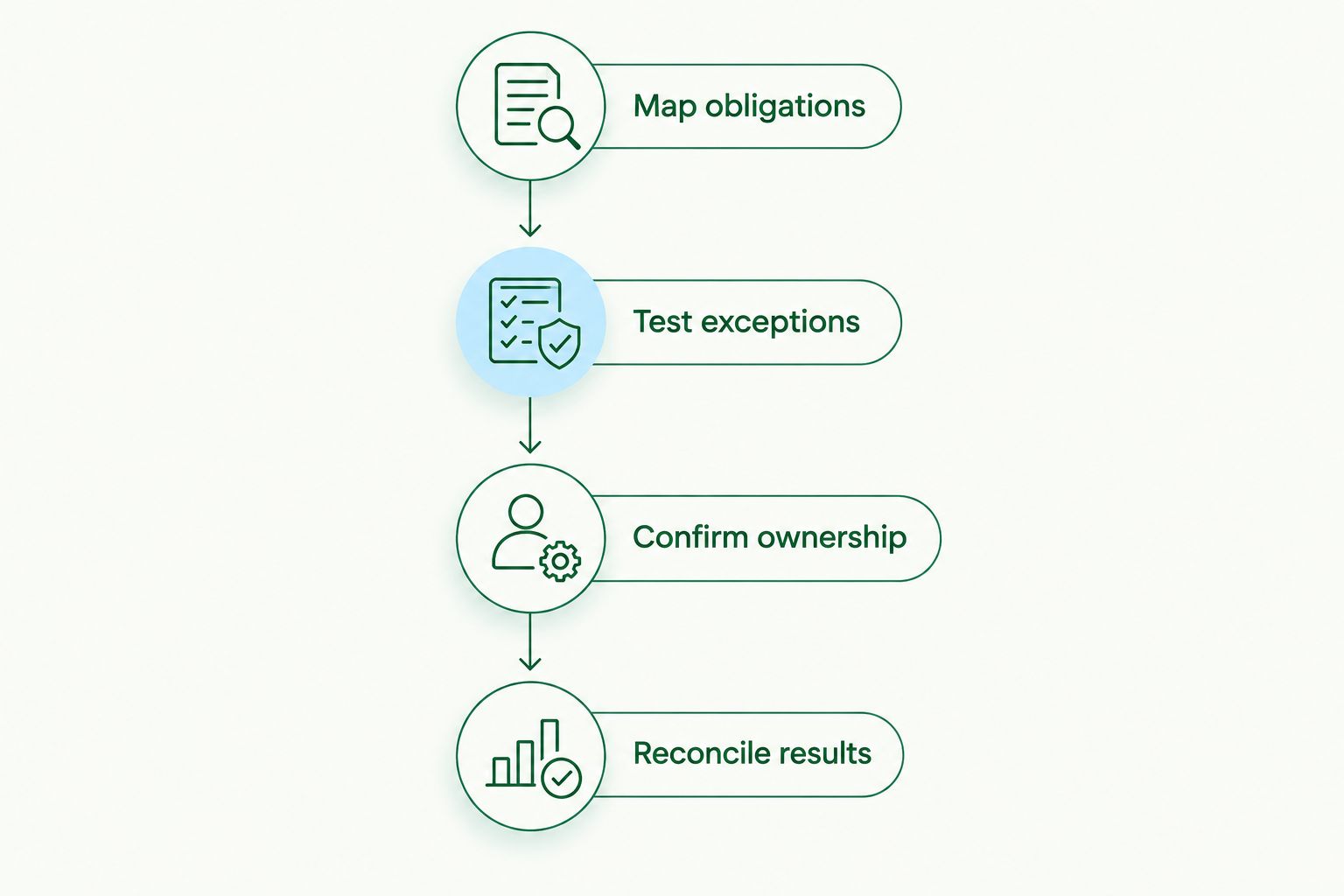
01. Map obligations
Document the awards, agreements, employment types and pay conditions that apply. Include who confirms classifications and who maintains changes; software selection should not leave those responsibilities unassigned.
02. Test exceptions
Prepare representative payroll scenarios and calculate the expected outcomes independently. Include the exceptions your business actually encounters, such as leave loading, back pay or changes in ordinary hours.
03. Confirm ownership
Assign responsibility for entering information, approving payroll, lodging reports and checking payments. Where a provider handles part of the process, document the handover points and escalation process.
04. Reconcile results
Compare the proposed system’s outputs with the approved expected results before relying on live payroll. Investigate differences in gross pay, deductions, superannuation, leave and accounting entries rather than accepting a matching net payment alone.
Keep the completed test cases with your payroll procedures. They give you a repeatable check when employment conditions, settings or software change, rather than relying on someone remembering why a pay item was configured a particular way.
Which payroll software should you choose?
Choose Employment Hero Payroll first when award interpretation drives the workload. Choose Xero Payroll or MYOB Business Payroll when accounting integration is central, subject to entitlement checks. Consider Reckon Payroll when a focused payroll workflow fits your requirements.
Daintree Consulting’s payroll software guidance starts with the employment obligations and reporting process, not a preferred interface. For your 2026 review, bring the current payroll setup, recurring exceptions and reconciliation issues into the same discussion.
Do not migrate solely because another product has more features. Change when the proposed arrangement resolves a documented gap and the responsibilities around it are clear.
Clarify your payroll requirements
Discuss payroll, bookkeeping and the accounting processes that need to work together.
FAQ
What is the best payroll software for Australian compliance?
Employment Hero Payroll leads this shortlist for award-heavy payroll, while Xero Payroll and MYOB Business Payroll suit different accounting-led requirements. No product guarantees compliance without correct classifications, settings and review.
Does Single Touch Payroll reporting mean my payroll is compliant?
No. STP reports payroll information to the ATO; it does not establish that your award interpretation, employee classification or payment calculation is correct.
Is Xero Payroll better than Employment Hero Payroll?
Xero Payroll is the accounting-led option in this comparison; Employment Hero Payroll is the award-interpretation option. Choose by demonstrating your actual employment conditions rather than comparing brand names alone.
Can payroll software calculate award entitlements automatically?
Payroll software with award interpretation can calculate supported entitlements using configured rules. You still need to confirm award coverage, employee classifications, applicable agreements and exceptions.
Should I keep payroll in MYOB if my accounts already use it?
Assess MYOB Business Payroll before introducing a separate system, but do not treat existing use as proof of suitability. Check the exact product against your payroll calculations, approvals and reporting requirements.
Can Reckon Payroll suit a small Australian employer?
Reckon Payroll belongs on a small employer’s shortlist when core payroll processing and STP reporting are the main requirements. Confirm award calculations, accounting connections and exception handling before choosing.
Can Daintree Consulting help with payroll software selection?
Daintree Consulting provides bookkeeping, payroll, accounting and advisory services for Australian businesses. Discuss software selection alongside the responsibilities for payroll preparation, review and reconciliation.
One last thing
A matching net payment is not enough to validate payroll. Different errors can offset each other while leaving gross earnings, superannuation or leave wrong.
Before approving a new system, ask for the calculation behind the payment. The strongest selection evidence is not a clean dashboard; it is a payroll result you can explain, reconcile and repeat.
Talk to Daintree about your bookkeeping and payroll
Our ex-Big 4 team gives clear, senior-reviewed advice so you can act with confidence.
Book a free consultation →
Or explore our bookkeeping and payroll services.
