
Best cash flow forecasting tools for small business 2026
Best overall: Float. Best for management reporting: Fathom. Best for connected financial statements: Spotlight Forecasting. Best for hands-on spreadsheet control: Microsoft Excel. This 2026 guide compares the best cash flow forecasting tools for small businesses and explains where accounting advice matters more than software.
TL;DR
Want expert help? Daintree Consulting's outsourced CFO services can take this off your plate. Book a free consultation.
Float leads the best cash flow forecasting tools shortlist for businesses focused on short-term cash visibility.
Fathom suits businesses that want cash flow forecasting alongside management reporting.
Spotlight Forecasting suits businesses that need connected profit, balance sheet and cash flow forecasts.
Microsoft Excel suits owners who can maintain and check their own forecasting model.
Daintree Consulting combines accounting and outsourced CFO advice for businesses that need help interpreting cash flow forecasts.
Why this matters
A profitable business can still run short of cash. Customer payments arrive after wages, supplier bills and tax obligations fall due, and a profit report does not show that timing clearly enough.
The right forecasting tool helps you see the gap before you commit to spending. But it cannot decide whether an overdue invoice is collectible or whether a planned hire is affordable under a weaker sales scenario.
Daintree Consulting is best for small businesses that want cash flow forecasting supported by accounting and outsourced CFO advice. Daintree Consulting provides accounting, bookkeeping, business advisory and outsourced CFO services; that support is separate from the software options ranked below.
For your 2026 decision, start with the question you need answered. Whether you can cover the next payroll is a different problem from whether an expansion will strengthen the business over the next financial year.
What makes the best cash flow forecasting tools?
A useful forecast connects your records to decisions. These are the criteria that matter before you compare features:
Cash timing: The model must reflect when money reaches or leaves your bank account, not just when you raise an invoice.
Scenario planning: You need to compare a base case with changed assumptions, such as slower collections, reduced sales or additional staff.
Accounting connection: An accounting integration reduces repeated entry, but the source records still need checking. A spreadsheet requires its own update process.
Reporting fit: Choose between a focused cash view and a forecast connected to profit and balance sheet reporting.
Maintenance responsibility: Someone must own updates, resolve missing information and explain changes. An unattended forecast is not a decision tool.
Decision clarity: The output should tell you which action to take, which assumption drives the result and when pressure appears.
Do not buy complexity because it looks more professional. A clear forecast that you maintain is more useful than a detailed model that nobody trusts.
Best cash flow forecasting tools at a glance
Rank and tool | Best for | Standout feature | Key limitation |
|---|---|---|---|
1. Float | Short-term cash visibility | Cash-focused forecasting and scenarios connected to accounting data | Does not replace broader management reporting or accounting judgement |
2. Fathom | Management reporting | Financial analysis, reporting and forecasting in one workflow | More reporting scope than a simple cash-only requirement needs |
3. Spotlight Forecasting | Connected financial statements | Integrated profit and loss, balance sheet and cash flow forecasting | Requires care with relationships between forecast assumptions |
4. Microsoft Excel | Hands-on model control | Custom formulas, schedules and layouts | Updates, checks and version control depend on your process |
The order reflects different business needs, not a claim that every company should choose the same application. For 2026, treat this shortlist as a decision framework rather than a substitute for checking each tool against your accounting setup.
1. Float: best cash flow forecasting tool for short-term visibility
Float is a cash flow forecasting application with accounting integrations and scenario planning. It suits businesses that want to understand incoming payments, outgoing commitments and the effect of changing assumptions without building a spreadsheet from scratch.
Its strongest fit is a recurring cash conversation. You can focus on the expected bank position and test changes to payment timing or spending rather than making a broad financial reporting project your starting point.
Float pros
Cash-first focus: The central task is understanding cash movement rather than assembling a wider reporting pack.
Accounting integrations: Connected records provide a starting point for forecasting rather than requiring every entry to be recreated manually.
Scenario planning: Alternative assumptions help you compare decisions before committing to them.
Float cons
Records still need attention: An integration does not correct missing bills, outdated invoice expectations or unreconciled transactions.
Forecasting is not full financial advice: Cash visibility alone does not answer questions about tax treatment, funding structure or profitability.
Payment timing needs judgement: An invoice due date is not proof that the customer will pay on that date.
Best for: An owner or finance lead whose main question is whether cash will cover upcoming commitments.
Before choosing Float, check how your accounting platform connects and how you would represent uncertain receipts. Ask for a demonstration using the decisions you actually face, not just a clean sample business.
Verdict: Buy for focused cash forecasting; skip if your primary need is a full management reporting system.
2. Fathom: best cash flow forecasting tool for management reporting
Fathom combines financial analysis, management reporting and forecasting. It suits businesses that need cash flow discussed alongside profit, performance measures and the broader financial picture.
This is a different use case from checking whether next week's payments fit the bank balance. The value is a joined-up reporting conversation: what happened, what the forecast assumes and what the business should change.
Fathom pros
Reporting and forecasting together: Historical performance and forward-looking plans can sit within the same reporting workflow.
Financial analysis: Cash flow can be considered alongside profitability rather than treated as an isolated number.
Scenario planning: Different assumptions support discussions about hiring, investment and changes in trading performance.
Fathom cons
Broader scope needs ownership: Someone must decide which measures matter and keep reporting relevant to decisions.
More than a cash-only task requires: A business needing a straightforward receipts-and-payments forecast has a narrower requirement.
Presentation does not validate assumptions: A clear report still needs accurate records and credible expectations.
Best for: A growing business that wants a recurring management reporting pack with forecasting included.
For a 2026 evaluation, ask to see how an actual management meeting would work with the output. You should be able to identify the cash pressure, explain its cause and agree on an action without translating a large collection of charts.
Verdict: Buy when forecasting belongs inside management reporting; skip when you only need a focused cash view.
3. Spotlight Forecasting: best for connected financial statements
Spotlight Forecasting supports integrated forecasting across profit and loss, the balance sheet and cash flow. This approach links trading assumptions to the wider financial consequences instead of treating the bank balance as a standalone schedule.
That distinction matters when you need to understand how sales, receivables, inventory, borrowing or asset purchases interact. The model must show more than the date of a payment; it must also keep the financial statements connected.
Spotlight Forecasting pros
Connected statements: Profit, balance sheet and cash flow forecasts can be considered together.
Structured planning: Assumptions form part of a wider financial model rather than an isolated cash estimate.
Scenario comparisons: Alternative plans help you examine how a business decision changes the financial picture.
Spotlight Forecasting cons
Model relationships need care: An incorrect collection or payment assumption affects the forecast beyond a single line item.
More setup than a basic cash schedule: You need to understand which balances and movements drive the model.
Detail needs a purpose: Extra modelling adds little if nobody uses it to decide or review outcomes.
Best for: A business working with a finance professional on connected forecasts for planning, investment or funding discussions.
Ask whoever will maintain the model to explain how a sales change flows through profit, receivables and cash. If that explanation is unclear, resolve the modelling process before relying on the output.
Verdict: Buy for connected financial planning; hold if your records and assumptions are not ready for an integrated model.
4. Microsoft Excel: best for hands-on forecasting control
Microsoft Excel lets you build a cash flow forecast around your own receipts, payments and assumptions. You control the structure, formulas and supporting schedules rather than working within a dedicated forecasting application's layout.
That flexibility is useful when the business has unusual payment patterns or an existing finance process built around spreadsheets. It also makes you responsible for the model's accuracy and maintenance.
Microsoft Excel pros
Custom structure: You can organise the forecast around the decisions and payment cycles that matter to your business.
Visible formulas: A well-organised workbook lets a reviewer inspect how assumptions produce the result.
Flexible supporting schedules: Customer collections, supplier payments and planned spending can have separate workings.
Direct control: You decide how the model is changed, documented and presented.
Microsoft Excel cons
Manual work needs discipline: Without a dependable import or update process, the forecast becomes disconnected from current records.
Formula errors affect decisions: Broken references, overwritten cells and inconsistent calculations can change the apparent cash position.
Version control is your responsibility: Multiple copies create uncertainty about which forecast is current.
Best for: An owner or finance professional who understands spreadsheet modelling and will maintain a documented workbook.
Separate assumptions from calculations. Keep actual cash movements distinct from forecast entries, and make the review process visible rather than relying on the model builder's memory.
Verdict: Buy into the spreadsheet approach when you can maintain and check it; skip when updates already fall behind.
How the tools are ranked
This ranking prioritises the business question each option answers. Float takes the default position for cash-focused visibility; Fathom fits reporting-led decisions; Spotlight Forecasting fits connected financial models; Microsoft Excel fits direct modelling control.
The comparison uses cash timing, scenarios, reporting scope and maintenance responsibility. It is not a laboratory performance test or a claim that one application produces more accurate forecasts automatically.
Forecast accuracy depends on records, assumptions and review discipline—not the application name. Confirm current functionality and integration details during your 2026 evaluation, then assess the workflow your team will actually maintain.
Set up a forecast you can use
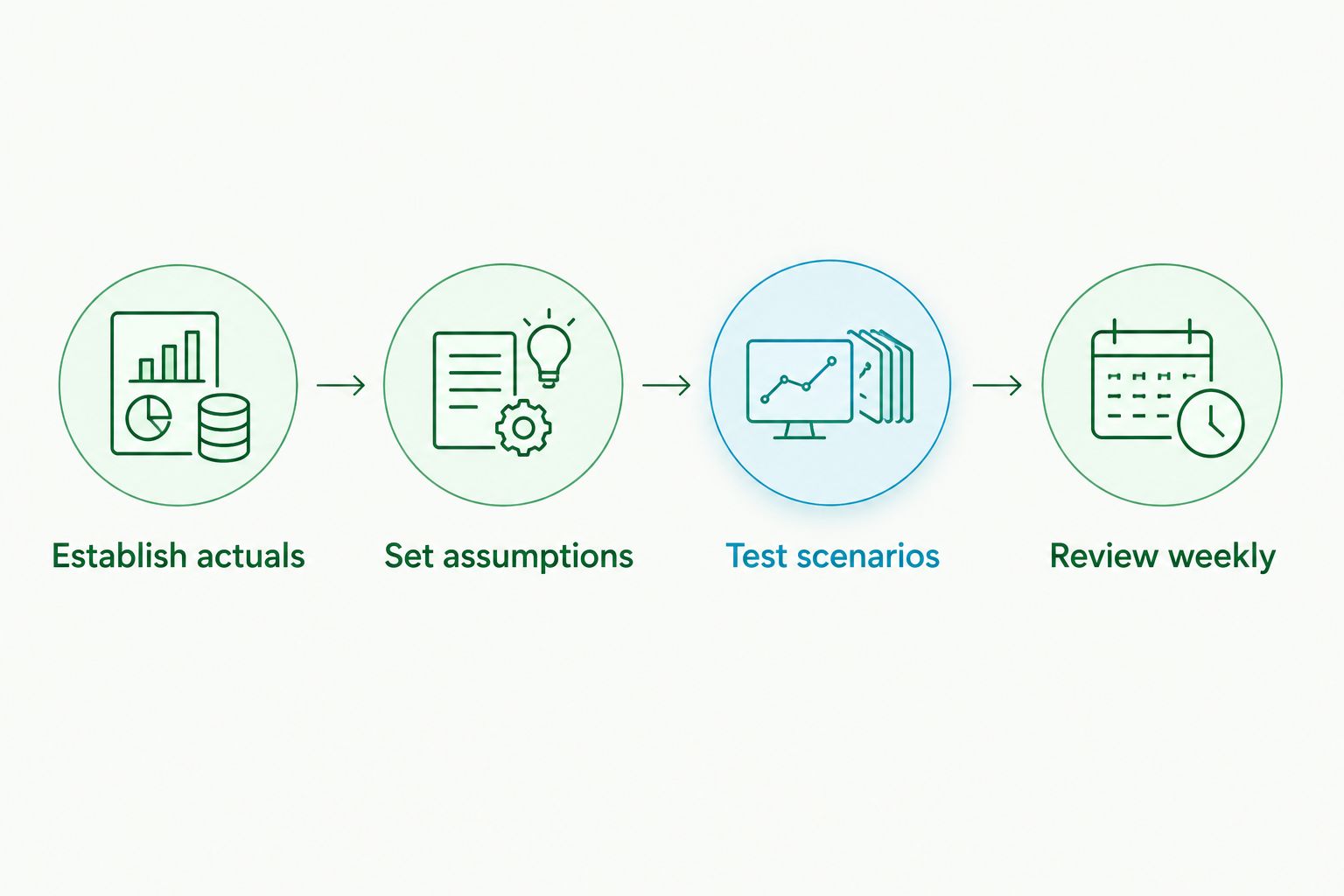
A tool becomes useful when the update process is clear. Follow this sequence before treating the forecast as a basis for spending or funding decisions.
Establish actuals
Reconcile the bank position and identify outstanding customer invoices, supplier bills and committed payments. Keep existing obligations separate from proposed spending so you can see what is already unavoidable.
Set assumptions
Write down expected collection dates, payment timing and trading assumptions. Use a 13-week forecast for near-term cash decisions and a 12-month outlook for the broader plan; these are planning horizons, not promises of accuracy.
Test scenarios
Change the assumptions that would materially affect cash. Compare slower customer collections, a weaker sales period or a proposed hire with the base case, keeping each scenario clearly labelled.
Review weekly
Set a 1-week review interval for the short-term forecast. Compare expected cash movements with actual movements, explain the differences and update the assumptions rather than simply moving missed receipts into the next period.
A forecast should end in an action: follow up a receipt, reconsider spending, discuss funding or leave the plan unchanged. Recording that decision makes the next review more useful.
Which cash flow forecasting tool should you choose?
Choose Float as the default if cash visibility is your main requirement. Choose Fathom when your management reporting needs to include forecasting, or Spotlight Forecasting when connected financial statements drive the decision. Choose Microsoft Excel only when someone owns the model and its checks.
Do not change software before identifying the actual problem. If records are late, customer payment assumptions are unrealistic or nobody reviews the forecast, a new application leaves those problems intact.
Daintree Consulting's accounting and outsourced CFO services fit businesses that need help connecting the forecast to business decisions. Keep the roles clear: software organises the model; financial advice helps you assess the assumptions and act on the result.
For 2026, your next move is to define the decision, nominate the forecast owner and then compare the shortlisted tools against that workflow.
Discuss your cash flow priorities
Connect accounting, reporting and forecasting decisions with business advisory support.
FAQ
What's the best cash flow forecasting tool for a small business?
Float is the default recommendation for a small business focused on short-term cash visibility. Fathom fits management reporting, Spotlight Forecasting fits connected financial statements, and Microsoft Excel fits hands-on model control.
Is Fathom better than Float for cash flow forecasting?
Fathom is the better fit when forecasting belongs inside a broader management reporting process; Float is the better fit for a cash-focused workflow. Choose according to the decision you need to make, rather than the length of the feature list.
Can I use Excel instead of cash flow forecasting software?
Yes, Microsoft Excel can support a cash flow forecast if someone maintains and checks the workbook. You remain responsible for updates, formula accuracy and version control.
How far ahead should a small business forecast cash flow?
Use a 13-week forecast for near-term cash decisions and a 12-month outlook for broader planning. Review the short-term forecast weekly and revise assumptions when actual receipts or payments differ.
Does accounting software automatically give me an accurate cash forecast?
No, accounting records alone do not establish accurate future payment timing. Your forecast needs realistic collection assumptions, expected payments and planned commitments that are not yet in the accounts.
What's the difference between a profit forecast and a cash flow forecast?
A profit forecast estimates income and expenses, while a cash flow forecast estimates when money enters and leaves the business. Credit sales, supplier payment terms, loan movements and asset purchases help explain why profit and cash differ.
Do I need an accountant to use cash flow forecasting software?
You do not need an accountant simply to operate a forecasting tool. Accounting or outsourced CFO advice is useful when you need help checking assumptions, interpreting connected financial statements or deciding how to respond to cash pressure.
One last thing
An overdue invoice is not cash. Before your next forecast review, separate customer receipts supported by a credible payment expectation from receipts included only because the invoice is due.
That distinction changes the quality of the decision without changing the software. Daintree Consulting's cash flow forecasting advice belongs alongside accurate records and clear assumptions—not in place of them.
Talk to Daintree about your finance function
Our ex-Big 4 team gives clear, senior-reviewed advice so you can act with confidence.
Book a free consultation →
Or explore our outsourced CFO services.
