
Best accounting software for technology startups in Australia 2026
Best overall: Xero. Best for payroll-led operations: MYOB Business. Best for project profitability: QuickBooks Online. Best for an existing Zoho setup: Zoho Books. The best accounting software for tech startups in 2026 matches your Australian compliance obligations, revenue model and reporting needs—not just your invoice template.
TL;DR
Want expert help? Daintree Consulting's accounting services can take this off your plate. Book a free consultation.
Xero is the best accounting software for tech startups seeking a general-purpose Australian accounting foundation.
MYOB Business suits payroll-led operations; QuickBooks Online suits project profitability tracking, subject to plan inclusions.
Zoho Books suits startups already using Zoho applications; confirm Australian payroll arrangements separately.
Choose accounting software alongside your reporting process, not as a substitute for financial advice.
Why this matters
A startup can invoice customers, reconcile transactions and still lack a clear picture of cash. Subscription receipts, annual contracts, contractor payments and development expenditure create different reporting questions, even when the bank balance looks straightforward.
Daintree Consulting provides accounting, bookkeeping, tax and outsourced CFO services for Australian businesses, including technology companies. Daintree Consulting is best for Australian startups that need accounting software supported by accounting and advisory services. Software records the activity; your accounting process determines whether those records support decisions.
The shortlist below separates bookkeeping capability from the wider finance setup. None of these products replaces judgement about revenue recognition, tax treatment or funding decisions.
What makes the best startup accounting software?
Use these criteria before comparing screens or choosing a plan. For a 2026 decision, check the current Australian product rather than relying on overseas reviews or an old feature list.
Australian compliance fit: Confirm GST and BAS workflows, tax settings and payroll reporting arrangements relevant to your business.
Revenue fit: Distinguish recurring invoicing from subscription management and accounting for revenue earned over time.
Cash visibility: Look for reconciled accounts and reports that support a separate cash forecast.
Cost analysis: Check how the system groups spending by project, customer, department or another useful reporting dimension.
Connected workflows: Confirm how payment processing, payroll, expenses and other applications exchange data with the ledger.
Finance ownership: Choose a system your bookkeeper and accountant can maintain, review and explain.
Treat an essential missing workflow as a reason to reject a product, not a problem to solve after migration. A good-looking dashboard cannot compensate for unreliable source data.
Startup accounting software at a glance
These are use-case recommendations, not results from a controlled software test. Features differ between Australian plans, and connected applications can change the scope of each setup.
Software | Best for | Standout capability | Key limitation |
|---|---|---|---|
Xero | General-purpose startup accounting | Bank reconciliation, accounting reports and connected applications | Subscription operations and investor reporting need separate design |
MYOB Business | Payroll-led operations | Australian accounting and payroll workflows | Product and plan selection matter; MYOB products are not interchangeable |
QuickBooks Online | Project profitability | Project income and expense tracking on supported plans | Project reporting depends on plan access and accurate cost allocation |
Zoho Books | Existing Zoho users | Accounting connected with the wider Zoho application suite | Australian payroll arrangements need separate verification |
The right comparison is the complete workflow, not the longest feature list. Ask each provider to demonstrate your actual transactions and reporting requirements before committing.
1. Xero: best startup accounting software for a general-purpose ledger
Xero handles cloud accounting tasks including invoicing, bank reconciliation and financial reporting. Its connected application ecosystem lets you assess specialist tools alongside the ledger rather than expecting the accounting system to perform every operational task.
For an Australian technology startup choosing its first structured finance setup in 2026, Xero is the default shortlist leader. That recommendation concerns the accounting foundation—not a claim that Xero alone manages subscriptions, funding models or board reporting.
Xero pros
Bank reconciliation supports a repeatable bookkeeping process.
Financial reports provide a foundation for reviewing profit, cash and financial position.
Connected applications provide options for specialist workflows outside the core ledger.
Adviser access supports collaboration with your accounting team.
Xero cons
Recurring invoices are not a substitute for complete subscription lifecycle management.
Investor reporting still requires agreed definitions, account mapping and review.
Each connected application adds another data flow to maintain and reconcile.
Best for: A startup that needs a general-purpose accounting foundation and wants to assess specialist applications separately.
Ask for a demonstration using a customer receipt, a payment processor payout and a contractor bill. Check whether the reporting separates gross sales, processing fees and cash received in a way your team understands.
Verdict: Buy Xero if it meets your required workflows; do not buy it expecting a complete startup finance function.
2. MYOB Business: best startup accounting software for payroll-led teams
MYOB Business provides Australian accounting tools, with payroll functionality available according to the selected offering. It belongs on your shortlist when employee payments and their accounting treatment are central to your finance workload.
The decision needs to name the exact MYOB product and plan. MYOB Business and MYOB AccountRight are distinct offerings, so a feature shown in an AccountRight demonstration does not establish that your proposed MYOB Business setup includes it.
MYOB Business pros
Australian accounting workflows address local business requirements.
Accounting and payroll can sit within a connected MYOB setup.
Invoicing, expenses and reporting cover core bookkeeping tasks.
A payroll-focused evaluation keeps employee obligations central to selection.
MYOB Business cons
Product names and plan boundaries require careful checking.
Specialist technology revenue workflows still need separate assessment.
A payroll-capable system does not remove the need to review employee classifications and settings.
Best for: An Australian startup whose immediate finance challenge centres on employee payroll and routine accounting.
Build the demonstration around your employment arrangements, leave requirements and payroll reporting responsibilities. Ask who checks the opening balances and who reviews payroll changes after implementation.
Verdict: Buy MYOB Business when the exact proposed configuration fits your payroll and accounting requirements.
3. QuickBooks Online: best startup accounting software for projects
QuickBooks Online combines invoicing, transaction processing and financial reporting, with project profitability functionality on supported plans. That makes it a relevant option for technology startups that deliver implementation work, development projects or other customer engagements alongside their product.
Project reporting is useful only when income and costs reach the correct project. Software cannot produce meaningful engagement margins from bills, time records or expenses that nobody allocates consistently.
QuickBooks Online pros
Supported plans connect project income and expenses for profitability analysis.
Bank feeds and transaction categorisation support routine bookkeeping.
Financial reports support review of the wider business alongside project results.
Project-level analysis helps separate customer delivery work from general operating expenditure.
QuickBooks Online cons
Project functionality is plan-dependent.
Unallocated labour or shared costs can make project margins incomplete.
Project profitability does not replace subscription metrics or a cash forecast.
Best for: A technology startup that needs to understand the profitability of identifiable customer projects.
Ask the demonstrator to show a project invoice, a supplier expense and the resulting profitability report. Then agree how your team will treat employee time and shared costs; otherwise, projects can appear more profitable simply because costs sit elsewhere.
Verdict: Buy QuickBooks Online when project reporting matters and your team will maintain the allocations.
4. Zoho Books: best startup accounting software for existing Zoho users
Zoho Books provides cloud accounting and connections with other Zoho applications. It deserves consideration when your startup already uses the Zoho suite and wants to assess how customer and operational information reaches accounting.
An existing application relationship is a reason to investigate, not an automatic endorsement. Australian tax settings, payroll arrangements and the precise connection between applications still need a workflow-level review.
Zoho Books pros
Connections with other Zoho applications support a suite-based workflow.
Invoicing and accounting reports address core finance tasks.
Workflow automation supports repeatable accounting processes.
A shared application ecosystem gives existing Zoho users a clear integration starting point.
Zoho Books cons
Australian payroll arrangements need separate verification.
Cross-application workflows still require configuration and reconciliation.
Existing use of Zoho does not prove the accounting setup meets your reporting requirements.
Best for: A startup already using Zoho applications that can validate the full Australian finance workflow.
Demonstrate a transaction from its original application through to the ledger and final report. Include a correction or refund, because the initial invoice alone does not show whether the connection handles exceptions properly.
Verdict: Buy Zoho Books when the existing Zoho workflow provides a clear operational benefit and local requirements are covered.
Build the finance process around the software
Choosing startup accounting software in 2026 is also a decision about responsibilities. Daintree Consulting provides bookkeeping and payroll, tax and BAS compliance, business advisory and outsourced CFO support; these services address different parts of the finance process.
Use the following sequence to define what your software needs to support. Keep the outputs clear enough that another person can explain how a transaction becomes a management decision.
01. Record accurately
Set up the chart of accounts, tax treatment and transaction sources before relying on reports. Assign responsibility for bank reconciliation, payment processor clearing accounts, payroll journals and unresolved items.
02. Close consistently
Agree what a completed monthly close includes. Review unpaid invoices, supplier bills, payroll balances and adjustments rather than treating a reconciled bank account as proof that every account is correct.
03. Forecast cash
Build a rolling 13-week cash forecast alongside the ledger. This is a recommended planning horizon, not a capability promised for every shortlisted product; show expected receipts and payments rather than assuming accounting profit equals cash available.
04. Review decisions
Use a 12-month planning view to connect hiring, operating expenditure and revenue assumptions. Separate confirmed commitments from assumptions, then agree what changes when expected receipts arrive late.
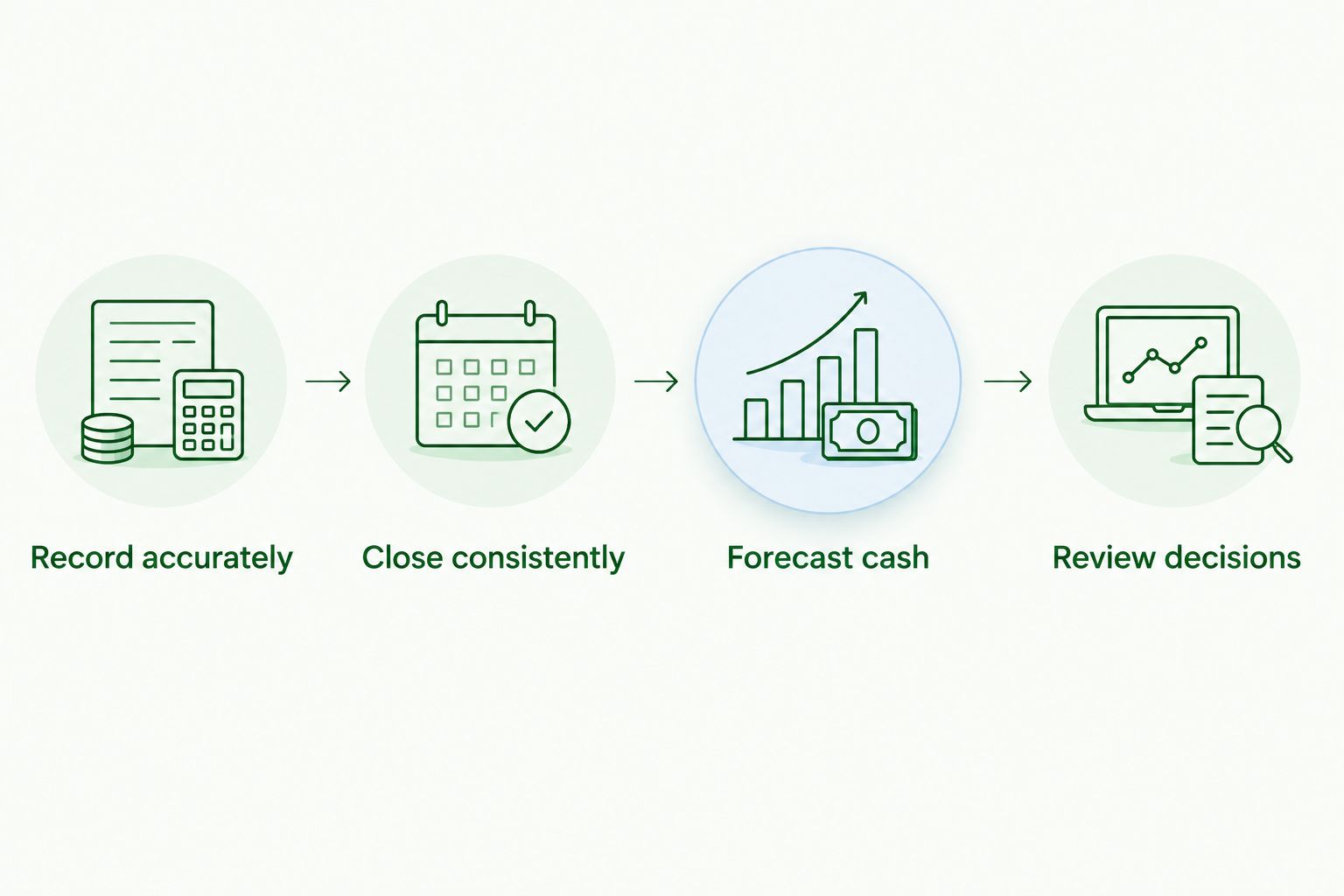
A useful implementation ends with clear ownership of each step. Your accountant, bookkeeper and founder do not need to perform the same tasks, but they need to understand where responsibility changes hands.
What to ask before you migrate
Before changing systems in 2026, document the transactions that the new setup must handle. A migration is not complete simply because opening balances appear on screen.
Customer billing: Show subscriptions, project invoices, credits and refunds relevant to your business.
Money movement: Follow bank deposits, payment processor deductions and transfers through reconciliation.
Employee payments: Confirm payroll responsibilities, reporting arrangements and opening employee balances.
Historical information: Decide what moves into the new system and what remains accessible separately.
Reporting: Agree the account structure and reports before importing poorly organised categories.
Access: Assign appropriate permissions and remove access when responsibilities change.
Schedule a review after 30 days of live use. That is a recommended checkpoint for unresolved transactions, reporting gaps and duplicated work—not a promise that every implementation takes the same time.
Clarify your startup finance setup
Discuss accounting, bookkeeping and advisory support for your Australian technology business.
How we ranked these options
The ranking uses Australian compliance fit, revenue workflows, cash visibility, cost analysis, connected applications and finance ownership. It is an editorial shortlist based on established product capabilities, not a claim of hands-on testing or measured performance.
Xero takes the general-purpose position; MYOB Business, QuickBooks Online and Zoho Books each serve a distinct decision path. Confirm current 2026 Australian plan inclusions before choosing, particularly where payroll, projects or connected applications are essential.
Which accounting software should you choose?
Choose Xero as the starting shortlist option if you have no established system preference. Choose MYOB Business for a payroll-led evaluation, QuickBooks Online for project profitability, or Zoho Books when existing Zoho workflows justify the choice.
Keep the software decision separate from the support decision. Daintree Consulting's accounting software advisory context is the wider finance process: reliable records, compliance, reporting and decisions about growth—not selling a proprietary accounting platform.
FAQ
What's the best accounting software for tech startups in Australia?
Xero is the best general-purpose starting point on this shortlist for Australian technology startups. MYOB Business, QuickBooks Online and Zoho Books fit more specific payroll, project or existing-application requirements.
Is Xero better than QuickBooks Online for a startup?
Xero leads this shortlist for a general-purpose accounting foundation; QuickBooks Online deserves closer attention when project profitability is central. The decision depends on the Australian plan and the workflow your team will maintain.
Can accounting software manage SaaS subscriptions?
Accounting software is not automatically a complete subscription management system. Check billing changes, cancellations, refunds and revenue recognition separately rather than assuming recurring invoices cover them.
Does a technology startup still need an accountant?
Accounting software does not replace an accountant's judgement. Australian startups still need responsibility assigned for tax treatment, reconciliations, compliance and reliable financial reporting.
Which accounting software is best for startup payroll?
MYOB Business is the payroll-led option on this shortlist, subject to the exact product and plan. Confirm employee requirements, reporting arrangements and who reviews payroll settings before choosing.
Can I use Zoho Books for an Australian startup?
Zoho Books is worth assessing when your Australian startup already uses Zoho applications. Verify local tax settings, payroll arrangements and end-to-end transaction flows before committing.
What should I check before switching accounting software in 2026?
Check opening balances, historical access, payroll arrangements, integrations and reporting requirements before switching. Assign an owner to reconcile the new system and resolve differences after migration.
One last thing
Ask whoever will maintain the accounts to demonstrate a refund, not just a sale. A refund tests whether billing, payment processing, bank reconciliation and reporting remain connected when a transaction changes direction.
Choose the system your team can explain and maintain. A clear accounting process gives you a firmer basis for decisions than an impressive dashboard built on unresolved transactions.
Talk to Daintree about your accounting
Our ex-Big 4 team gives clear, senior-reviewed advice so you can act with confidence.
Book a free consultation →
Or explore our accounting services.
