
Best accounting software for healthcare clinics in Australia 2026
Best overall: Xero. Best for payroll-focused clinics: MYOB Business. Best for accountant-led reporting: QuickBooks Online. Best for a tightly scoped bookkeeping setup: Reckon One. This 2026 guide compares the best accounting software for healthcare clinics in Australia by the financial work each clinic needs to manage, not by the length of a feature list.
TL;DR
Want expert help? Daintree Consulting's accounting services can take this off your plate. Book a free consultation.
Xero is the default choice for the best accounting software for healthcare clinics shortlist in Australia.
MYOB Business suits clinics that put payroll and Australian accounting requirements at the centre of their selection.
QuickBooks Online suits clinics whose accountant already works with its reporting and bookkeeping processes.
Reckon One suits a defined bookkeeping scope; confirm the required functions before choosing your subscription.
Daintree Consulting suits healthcare clinics needing accounting and advisory support alongside their software.
Why this matters
A clinic needs more than a record of money received. You need to distinguish patient receipts, practitioner payments, wages, tax liabilities and operating expenses without treating every bank deposit as the same kind of income.
Accounting software records the financial position; practice-management software supports the clinical and patient administration workflow. Choosing one does not remove the need to define how information passes between them.
Daintree Consulting provides accounting, bookkeeping, payroll and advisory services to Australian businesses, including healthcare businesses. The useful starting point is your reporting and compliance requirements, then the software that supports them.
For your 2026 decision, write down the work the clinic must complete reliably. A familiar application with a clear reconciliation process is a better starting point than an unfamiliar application selected for functions nobody owns.
What makes the best accounting software for healthcare clinics?
Use these criteria before comparing brands:
Receipt reconciliation: You need to explain the difference between services billed, receipts recorded and deposits reaching the bank.
Australian compliance: Check GST reporting, BAS preparation and the payroll functions required for your actual arrangements.
Practitioner accounting: Decide how employee wages, contractor payments and any service-fee arrangements will be recorded.
Management reporting: Identify the reports you need to understand cash flow, operating costs and clinic performance.
Accountant access: Choose a system your accounting team can maintain, review and explain without parallel spreadsheets becoming the main record.
Information boundaries: Keep clinical information out of the accounting ledger unless there is a necessary, lawful reason to include it.
Ask each provider to demonstrate your workflow rather than a generic sales presentation. Use a de-identified example showing a receipt, a refund, a payment to a practitioner and the final bank reconciliation.
The deciding question is simple: can your team explain where the money went and why the reports show that result?
Accounting software for healthcare clinics at a glance
These recommendations concern accounting applications, not clinical systems. Confirm current Australian subscription inclusions and compatibility with your existing systems before making a commitment.
Software | Best for | Standout function | Key limitation to assess |
|---|---|---|---|
Xero | A general-purpose cloud accounting starting point | Bank reconciliation and shared accounting records | Clinic-specific receipt and practitioner workflows still need a defined process |
MYOB Business | Clinics prioritising payroll administration | Australian accounting and payroll options | Required payroll functions depend on the selected subscription |
QuickBooks Online | Clinics working closely with an accountant familiar with the platform | Bookkeeping and financial reporting | Accountant familiarity does not establish compatibility with your clinical systems |
Reckon One | Clinics with a clearly bounded bookkeeping requirement | A selectable accounting-function approach | You must confirm the complete scope rather than assume all functions are included |
The table is a decision tree, not a claim that one application wins every comparison. Your existing accountant, payroll arrangements and receipt workflow should change the order of your shortlist.
1. Xero: best accounting software for a general-purpose clinic setup
Xero is cloud accounting software for recording transactions, reconciling bank accounts and producing financial reports. For a clinic without an established preference, it is the default starting point for the accounting shortlist—not a substitute for checking the clinic's requirements.
The practical question is how clinic receipts will reach the ledger. Decide whether the accounting record needs individual transactions or reconciled summaries, then identify who will investigate differences.
Xero pros:
Bank reconciliation supports matching accounting records to bank activity.
Shared access lets the clinic and its accountant work with the same financial records.
Financial reports provide a starting point for reviewing income, expenses and the balance sheet.
Xero cons:
Choosing Xero does not establish a working connection with your practice-management system.
Standard financial reports still depend on account coding that reflects the clinic's operations.
Before choosing Xero in 2026, ask for a demonstration of a receipt that reaches the bank after a deduction or adjustment. A clean example is less useful than one showing how an exception is identified and resolved.
Best for: Clinics seeking a general-purpose cloud accounting foundation, with a bookkeeper or accountant responsible for the setup.
Verdict: Buy Xero when the clinic's receipt, reporting and payroll requirements have been confirmed against the proposed setup.
2. MYOB Business: best accounting software for payroll-focused clinics
MYOB Business offers Australian accounting and payroll options. It belongs on the shortlist when employee payroll is a central part of the clinic's finance workload.
Start with the employment arrangements, not the application. Your payroll setup needs to reflect the people you employ, the applicable entitlements and the reporting obligations attached to those arrangements.
MYOB Business pros:
Australian accounting functionality supports local financial administration.
Payroll options make it relevant to clinics that want accounting and payroll considered together.
Keeping payroll and accounting within a defined setup gives your team a clear reconciliation responsibility.
MYOB Business cons:
The selected subscription must match the clinic's required payroll scope.
Software settings do not determine whether a worker is correctly treated as an employee or contractor.
Ask for a demonstration covering your actual payroll process, including corrections and the accounting entries created after a pay run. Check Single Touch Payroll requirements against the current Australian Taxation Office guidance and the proposed subscription.
A clinic paying both employees and independent practitioners needs separate thinking about those arrangements. Do not assume every payment to someone working in the clinic belongs in payroll.
Best for: Clinics that put employee payroll administration at the centre of their accounting decision.
Verdict: Buy MYOB Business when its confirmed payroll scope matches the clinic's employment arrangements and accounting process.
3. QuickBooks Online: best accounting software for accountant-led reporting
QuickBooks Online is cloud accounting software for bookkeeping and financial reporting. It is a sensible candidate when your accountant already works with the application and can show how the clinic's records will be maintained.
That existing working relationship matters. You need someone who can explain account coding, reconcile balances and turn reports into decisions, rather than simply provide access to a dashboard.
QuickBooks Online pros:
Transaction recording and bank reconciliation support routine bookkeeping.
Financial reports help your accountant review the clinic's income and expenses.
Shared access supports a defined division of work between the clinic and its accounting team.
QuickBooks Online cons:
Familiarity with QuickBooks Online does not prove that your clinical-system workflow will work.
Payroll requirements need separate confirmation for the proposed Australian setup.
Ask your accountant to show the reports they would use at a clinic review. Then ask which reconciliations must be completed before those reports are dependable.
Do not move to QuickBooks Online solely because someone prefers its interface. The stronger reason is a clear operating process that your team can maintain and your accountant can review.
Best for: Clinics whose accounting team already has a defined QuickBooks Online bookkeeping and reporting process.
Verdict: Buy QuickBooks Online when accountant familiarity translates into clear responsibilities, reconciliations and useful reporting.
4. Reckon One: best accounting software for a defined bookkeeping scope
Reckon One is an online accounting option with selectable functions. It deserves consideration when the clinic can describe its bookkeeping requirements clearly and wants to assess those requirements individually.
Start with the necessary work: transaction recording, invoicing where required, bank reconciliation and financial reports. Add payroll or other functions only after checking what the proposed subscription includes.
Reckon One pros:
A selectable-function approach encourages a specific discussion about requirements.
Core bookkeeping functions provide an accounting record for routine financial activity.
A bounded scope helps the clinic assign responsibility for each accounting task.
Reckon One cons:
A basic setup is not evidence that every required clinic workflow is covered.
Adding requirements later means reassessing the subscription and the surrounding process.
Ask the provider and accountant to map every required task to an included function or a documented external process. An omitted requirement is still work someone must complete.
Best for: Clinics with a straightforward, explicitly documented bookkeeping scope.
Verdict: Hold Reckon One until the full accounting, payroll and receipt-reconciliation scope is confirmed.
How to check the shortlist against your clinic
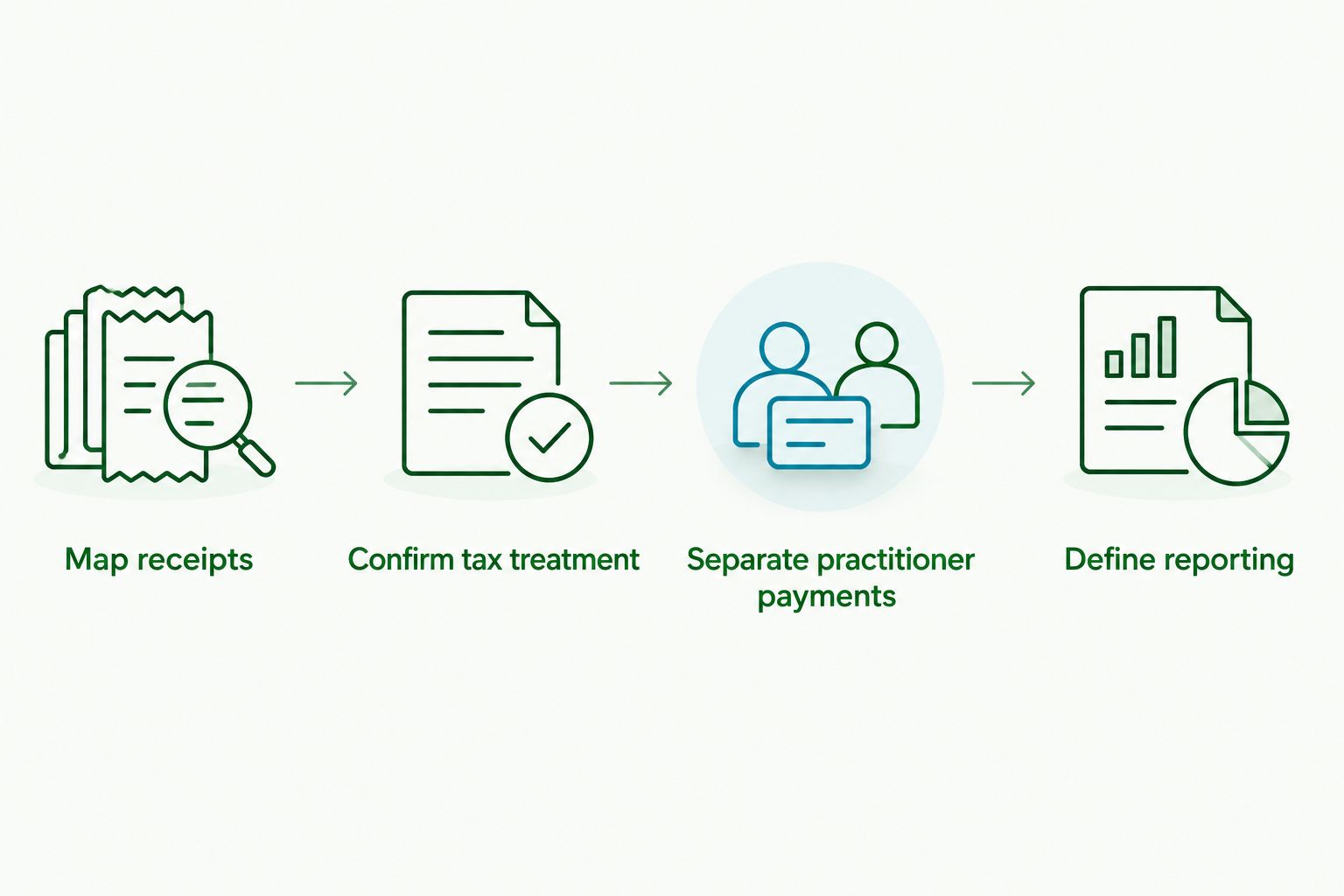
Use this sequence before selecting software in 2026. It keeps the discussion focused on financial responsibilities rather than demonstrations of unrelated functions.
01. Map receipts
Document how services billed become receipts and bank deposits. Identify refunds, adjustments and settlement deductions that need separate treatment.
Your process must explain the gap between the clinical record and the bank. A bank feed alone does not establish that every receipt was recorded correctly.
02. Confirm tax treatment
Identify the clinic's taxable and GST-free supplies with your tax adviser. Do not apply one GST code to every transaction simply because the business operates in healthcare.
Under Australian Taxation Office guidance current in 2026, the general compulsory GST registration threshold for a business is $75,000 in GST turnover. GST turnover generally includes GST-free sales; it is not the same as profit or taxable sales alone.
Australia's standard GST rate is 10% on taxable supplies. Eligible healthcare supplies can be GST-free when the relevant conditions are met, so treatment depends on the supply and arrangement rather than the clinic's label.
03. Separate practitioner payments
Distinguish employee payroll from contractor payments and service-fee arrangements. Have your adviser confirm the accounting and tax treatment before configuring the application.
A payment description cannot settle worker classification. The ledger must follow the actual arrangement, not create one by default.
04. Define reporting
Specify the reports needed to review cash, liabilities, expenses and operating results. Assign responsibility for preparing them and resolving unexplained balances.
For a 2026 implementation, use the clinic's 12-month reporting period to check how opening balances, comparative reports and year-end work will be handled.
Keep patient names and clinical details out of demonstration files. A de-identified example can still show whether the proposed financial process handles adjustments correctly.
How we ranked these accounting options
The recommendations prioritise receipt reconciliation, Australian accounting requirements, practitioner payments, reporting and accountant access. They are a requirements-based shortlist, not the result of a clinic-specific software trial.
Xero receives the default slot as a general-purpose accounting starting point. MYOB Business receives the payroll-focused slot, QuickBooks Online the accountant-led reporting slot, and Reckon One the defined-scope slot.
Daintree Consulting's healthcare accounting role is separate from the software ranking. Accounting and advisory support should help you determine the required process; it should not be mistaken for another software product.
Which accounting software should your clinic choose?
Start with Xero if you need a default shortlist candidate. Move MYOB Business to the front when payroll is the main requirement, or QuickBooks Online when your accountant can demonstrate an established process that fits your clinic.
Assess Reckon One when your requirements are tightly defined. Do not select it on an assumption about total cost; confirm the complete scope first.
For an existing clinic, keep the current system in contention. A change is justified by a financial problem the new setup resolves—not by a new dashboard.
Daintree Consulting can support healthcare clinics with accounting, bookkeeping, payroll and advisory needs. Bring the receipt process, practitioner arrangements and required reports into that conversation so the software decision follows the business requirements.
Clarify your clinic's accounting needs
Discuss bookkeeping, payroll and reporting requirements before choosing your accounting setup.
FAQ
What's the best accounting software for healthcare clinics in Australia in 2026?
Xero is the default starting point in this shortlist for a general-purpose clinic accounting setup. Choose only after checking receipt reconciliation, payroll, tax treatment and the reports your accountant needs.
Is Xero better than MYOB Business for a medical clinic?
Xero is the general-purpose recommendation here; MYOB Business is the payroll-focused recommendation. The better fit depends on the clinic's actual requirements and the functions included in the proposed subscription.
Can accounting software replace my practice-management system?
Accounting software should not be treated as a replacement for your practice-management system. Define which system records clinical and patient administration information, and how the necessary financial information reaches the accounting ledger.
Do healthcare clinics need to register for GST?
A healthcare business generally needs to register when its GST turnover reaches the Australian Taxation Office's $75,000 threshold. GST-free sales generally count towards GST turnover, so providing GST-free services does not automatically remove the registration requirement.
Are all healthcare services GST-free in Australia?
No, healthcare services are not automatically GST-free. The treatment depends on the relevant supply and statutory conditions; confirm each type of service or arrangement before assigning GST codes.
Can clinic accounting software handle contractor payments as payroll?
Employee wages and contractor payments require treatment that reflects the actual working arrangement. Confirm worker classification and any related obligations before deciding how payments will be recorded.
How much does accounting software for a clinic cost?
Check current Australian provider information for the subscription and functions your clinic requires. Compare setup, ongoing bookkeeping, payroll administration and accountant support as separate parts of the decision.
Can Daintree Consulting help with healthcare clinic accounting?
Daintree Consulting provides accounting, bookkeeping, payroll and advisory services to Australian businesses, including healthcare businesses. Those services support the financial work around the application rather than replace the software itself.
One last thing
A balanced bank reconciliation does not prove that the clinic collected every amount it was owed. It shows that the recorded bank activity reconciles; completeness of receipts requires a separate check against the source records.
Before approving your 2026 software setup, ask who owns that check and how unresolved differences are recorded. That responsibility is more useful than another dashboard.
Talk to Daintree about your accounting
Our ex-Big 4 team gives clear, senior-reviewed advice so you can act with confidence.
Book a free consultation →
Or explore our accounting services.
