
Best accounting software for franchises in Australia 2026
Best overall starting point: Xero. Best for an MYOB-based network: MYOB Business. Best for straightforward franchisee bookkeeping: QuickBooks Online. Best for group consolidation: Sage Intacct. This 2026 guide compares accounting software for franchises by ownership structure, reporting needs and the work required to keep your numbers reliable.
TL;DR
Want expert help? Daintree Consulting's accounting services can take this off your plate. Book a free consultation.
Xero is the default shortlist choice for accounting software for franchises using separate business ledgers.
MYOB Business suits franchisees whose network already uses MYOB reporting processes.
QuickBooks Online suits straightforward franchisee bookkeeping; Sage Intacct suits group consolidation requirements.
Daintree Consulting suits owners seeking accounting and advisory support rather than a software vendor.
Why this matters
A franchise outlet, a multi-site operator and a franchisor need different financial views. Choosing software before identifying which business you operate creates avoidable reporting work.
For accounting software for franchises, the starting point at Daintree Consulting is the business behind the ledger: its bookkeeping, tax, payroll and advisory needs. Choose the reporting structure first, then the software. A familiar dashboard does not resolve unclear ownership or inconsistent account coding.
This 2026 shortlist separates everyday bookkeeping from group financial management. It is a decision guide, not a claim that one platform fits every franchise agreement.
What makes the best accounting software for franchises?
Assess each platform against these criteria before comparing features:
Entity structure: Distinguish separate legal entities from outlets belonging to the same entity. They create different accounting requirements.
Australian compliance: Check the proposed setup for GST, BAS and payroll reporting obligations relevant to your business.
Consistent reporting: Use comparable account codes and reporting periods across outlets before comparing performance.
Operational connections: Confirm how point-of-sale, payroll, inventory and other systems pass information into the ledger.
Access and control: Decide what franchisees, managers, head office and external advisers can see and change.
Consolidation: Establish whether you need outlet comparisons, combined management reporting or formal group consolidation with intercompany eliminations.
Ask suppliers to demonstrate your required workflow. A feature name on a comparison page does not establish that the proposed configuration handles your franchise structure.
Accounting software for franchises at a glance
Software | Best for | Standout capability | Key limitation |
|---|---|---|---|
Xero | Separate franchisee ledgers with shared reporting conventions | Cloud accounting with an established integration ecosystem | Separate ledgers do not automatically produce consolidated group accounts |
MYOB Business | Franchisees working within an MYOB-based network | Australian business accounting and payroll options | Confirm that the specific MYOB product supports the required workflow |
QuickBooks Online | Straightforward franchisee bookkeeping | Cloud bookkeeping and financial reporting | Complex group reporting needs a separate assessment |
Sage Intacct | Groups needing multi-entity financial management | Multi-entity accounting and consolidation | Implementation is a broader finance project than setting up a basic ledger |
These are distinct use cases, not interchangeable recommendations. For a 2026 selection, ask each supplier to demonstrate the current product edition, relevant integrations and proposed reporting process.
1. Xero: best accounting software for separate franchisee ledgers
Xero provides cloud accounting for business bookkeeping and financial reporting. Its integration ecosystem makes it a practical starting point when a franchise uses separate operational systems alongside its accounting ledger.
The strongest fit is a network where individual businesses keep their own books but follow common reporting conventions. Start by standardising the chart of accounts and month-end process; software alone will not make inconsistent records comparable.
Xero pros
Cloud access supports collaboration between business owners and their advisers.
Bank reconciliation and financial reporting support routine bookkeeping.
Integrations provide ways to connect accounting with other business systems, subject to the specific connection.
Xero cons
Separate organisations do not automatically become a consolidated group reporting system.
Different account codes and bookkeeping practices still require standardisation.
Each operational integration needs checking for data coverage and reconciliation responsibilities.
Best for: Franchisees and networks that want separate ledgers with a consistent accounting approach.
Ask for a demonstration using sales, refunds, payment-processing deductions and bank settlements from your operating model. Confirm who resolves a difference when the point-of-sale total does not match the bank deposit.
Verdict: Buy Xero when separate ledgers fit your structure and the reporting workflow is demonstrated.
2. MYOB Business: best accounting software for MYOB-based networks
MYOB Business provides accounting tools for Australian businesses, with payroll options depending on the product and configuration. It belongs on the shortlist when your franchise network already works with MYOB records and reporting processes.
Continuity matters, but it is not a reason to accept a poor fit. Identify the exact MYOB product in use before assuming that another MYOB product provides the same functions.
MYOB Business pros
Australian accounting workflows provide a relevant starting point for local businesses.
Existing MYOB familiarity can reduce the process changes involved in a transition.
Keeping common reporting conventions supports clearer communication within an MYOB-based network.
MYOB Business cons
MYOB products are not interchangeable; capabilities need checking against the specific product.
Existing familiarity does not establish suitability for consolidation or complex reporting.
Moving inconsistent records into another file does not correct the underlying bookkeeping.
Best for: Franchisees whose network already uses MYOB and has a workable reporting process.
Before changing systems in 2026, separate software problems from process problems. Late reconciliations, inconsistent payroll coding and unclear responsibilities require attention even when you retain the existing platform.
Verdict: Buy MYOB Business when network compatibility matters and the exact product meets your requirements.
3. QuickBooks Online: best accounting software for simple franchisees
QuickBooks Online provides cloud bookkeeping and financial reporting. It is a reasonable shortlist option for a franchisee whose main requirement is maintaining clear business records rather than managing a complex group finance function.
A simple requirement still needs a proper setup. Confirm how the ledger will handle your sales data, payroll information and franchisor reporting obligations before committing.
QuickBooks Online pros
Cloud access supports shared work between the owner and accountant.
Bank feeds and reconciliation tools support transaction processing.
Financial reports provide a starting point for reviewing business performance.
QuickBooks Online cons
A straightforward bookkeeping setup is not a substitute for group consolidation.
Integration suitability depends on the operational systems you actually use.
Franchisor reporting formats still need to be mapped and checked.
Best for: An independently operated franchise business with straightforward accounting requirements.
Ask the demonstrator to produce the actual report your franchisor requires. A generic profit and loss statement is not enough if the franchise agreement defines sales, fees or reporting categories differently.
Verdict: Buy QuickBooks Online when the business needs straightforward bookkeeping and its reporting requirements are met.
4. Sage Intacct: best accounting software for group consolidation
Sage Intacct is a financial management platform with multi-entity accounting and consolidation capabilities. It belongs on the shortlist when the finance team needs to manage a group, not simply maintain several independent bookkeeping files.
Treat selection as a finance-system project. Entity relationships, reporting dimensions, approval responsibilities and intercompany transactions need clear definitions before implementation.
Sage Intacct pros
Multi-entity functionality addresses group finance requirements directly.
Consolidation capabilities support a different requirement from outlet-by-outlet bookkeeping.
Dimensional reporting supports analysis beyond a basic chart of accounts.
Sage Intacct cons
Implementation requires more design work than a straightforward bookkeeping setup.
Australian tax, payroll and operational connections need assessment within the proposed solution.
A franchisee with simple records does not need group-level complexity merely because it belongs to a franchise.
Best for: Franchise groups with genuine multi-entity financial management and consolidation requirements.
Request a demonstration of intercompany transactions and their elimination from group reports. Then ask the same team to show how an outlet manager sees only the information relevant to that role.
Verdict: Buy Sage Intacct when group complexity justifies a dedicated financial management implementation.
How we ranked these options
The order follows the decision most franchise owners face: establish reliable business accounting, respect existing network requirements, avoid unnecessary complexity and address consolidation when the structure demands it.
The criteria are entity structure, compliance workflow, reporting consistency, integrations, access and consolidation. This is a use-case ranking, not a benchmark of transaction speed or implementation results.
Separate legal entities from operating locations
An outlet is not necessarily a separate company. Equally, businesses trading under the same franchise brand are not necessarily one accounting group.
Start by listing legal entities, owners and operating locations. Then identify which reports each owner, manager and franchisor needs. That distinction determines whether location-level reporting, separate ledgers or group consolidation belongs in the design.
Do not confuse combined totals with consolidated accounts. Consolidation can require adjustments, including eliminating transactions between group entities; adding reports together does not complete that work.
Access needs the same attention. A shared brand does not give every participant a right to every franchisee's financial records. Document reporting permissions alongside the accounting structure.
Put the accounting process in place before migration
Use this sequence for a 2026 implementation. Each step should produce a clear decision before the next begins.
Entity map
Record which legal entity owns each outlet and which accounts belong to it. Identify intercompany relationships and the people responsible for approving the structure.
Account mapping
Agree on sales, direct costs, wages, occupancy expenses and franchise fees. Keep categories consistent enough to compare outlets without erasing differences that matter.
Data reconciliation
Reconcile the old records before moving balances. Check bank accounts, receivables, payables, payroll liabilities and tax balances rather than assuming the opening position is correct.
Parallel reporting
Compare reports from the existing process with the proposed process before relying on the new system. Investigate differences and document any deliberate changes in accounting treatment.
Ownership
Assign responsibility for exceptions, reconciliations, reporting and approvals. Every recurring task needs an owner, including failed integrations and unmatched settlements.
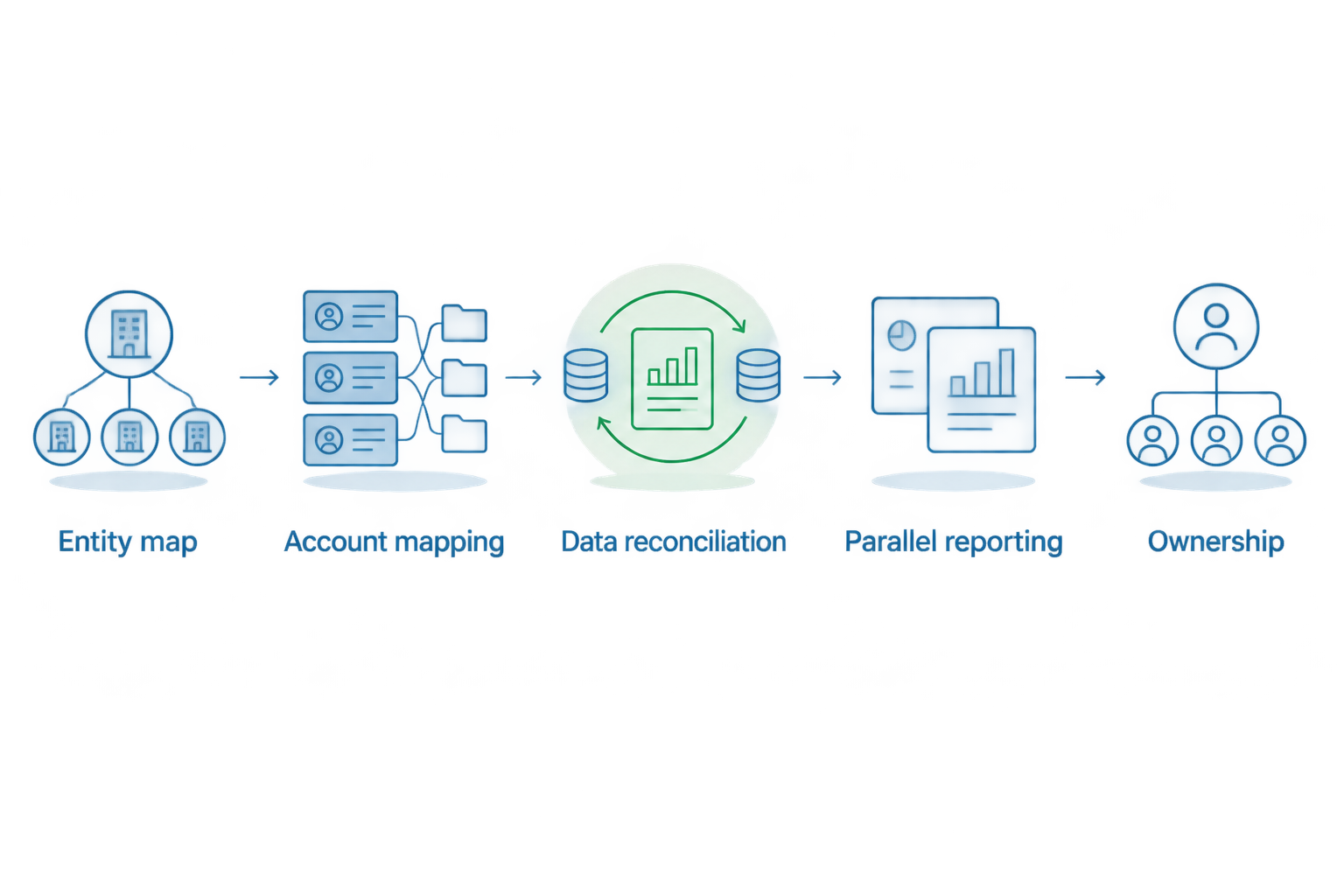
A migration is complete when the records reconcile and the responsible people can produce the required reports. Logging into a new system is only the beginning.
Decide what the reports must help you do
For your 2026 reporting brief, start with decisions rather than dashboard preferences. Which outlet needs attention? What cash commitments are approaching? Are franchise fees calculated from the agreed sales definition?
Consider these planning checks:
Use a 13-week cash flow forecast when you need a near-term view of receipts and payments.
Build a 12-month budget to connect operating plans with expected financial results.
Review 30-day overdue invoices as a defined collection category, where your business sells on account.
These are suggested planning horizons and review categories, not promised software outcomes. Your accountant should help determine which ones fit the business.
Daintree Consulting provides accounting, bookkeeping, payroll and outsourced CFO services. When assessing accounting software for franchises, match that support to the work you need done: accurate records, compliance, reporting or forward planning.
Clarify your accounting requirements
Discuss bookkeeping, reporting and advisory needs before choosing your next accounting setup.
Which accounting software should you choose?
Start with Xero if you need a practical shortlist default for separate franchisee ledgers. Choose MYOB Business when an established MYOB workflow meets your requirements, QuickBooks Online for straightforward franchisee bookkeeping, and Sage Intacct when consolidation drives the decision.
Do not switch because another franchisee prefers a different interface. Switch when the proposed setup resolves a defined accounting or reporting requirement and the implementation responsibilities are clear.
FAQ
What's the best accounting software for franchises in Australia?
Xero is the default shortlist choice in this guide for separate franchisee ledgers. MYOB Business suits an MYOB-based network, QuickBooks Online suits straightforward bookkeeping, and Sage Intacct suits group consolidation requirements.
Does every franchise outlet need separate accounting software?
No, an outlet does not automatically need a separate accounting system. Start with the legal entities and reporting obligations, then decide how locations should be represented in the records.
Is Xero better than MYOB for a franchise?
Xero is not automatically better than MYOB for a franchise. Compare the specific products against your existing network processes, operational connections and reporting requirements.
Can a franchisor see every franchisee's accounts?
A franchisor's access depends on the franchise agreement and the permissions granted. Define the information to be shared and configure access accordingly rather than assuming full ledger access is required.
Does accounting software calculate franchise royalties automatically?
Do not assume accounting software calculates franchise royalties automatically. Confirm the agreement's calculation basis, required source data and proposed workflow, then test the result against a manual calculation.
When does a franchise group need consolidation software?
Consolidation software belongs on the shortlist when a group needs consolidated reporting across entities, including relevant intercompany adjustments. Multiple trading locations alone do not establish that requirement.
Can Daintree Consulting help beyond bookkeeping?
Daintree Consulting provides accounting, tax and BAS compliance, payroll, business advisory and outsourced CFO services. Match the support to whether your business needs reliable records, compliance management or financial planning.
One last thing
Before comparing outlet margins, check where the accounts place franchise fees and owner remuneration. Different classifications can create an apparent performance gap even when the underlying economics are similar.
Ask for the same account mapping before asking for a better dashboard. Clear comparisons begin with consistent records.
Related guides
Talk to Daintree about your accounting
Our ex-Big 4 team gives clear, senior-reviewed advice so you can act with confidence.
Book a free consultation →
Or explore our accounting services.
