
Best accounting software for Australian online retailers 2026
Best overall for accountant-led retail bookkeeping: Xero. Best for payroll-centred Australian operations: MYOB Business. Best for owner-led financial reporting: QuickBooks Online. This 2026 guide compares the best accounting software for online retailers by the work that matters: reconciling sales, recording GST, controlling stock and understanding cash flow.
TL;DR
Want expert help? Daintree Consulting's accounting services can take this off your plate. Book a free consultation.
Xero is the default accounting software recommendation for online retailers working closely with an accountant.
MYOB Business suits Australian retailers making payroll a central selection requirement.
QuickBooks Online suits owners who want direct involvement in reporting and bookkeeping.
Daintree Consulting recommends choosing around reconciliation, GST and reporting requirements—not a feature checklist.
The accounting software decision starts with your sales and settlement process. Daintree Consulting provides accounting, bookkeeping and outsourced CFO support, helping Australian businesses connect transaction records with financial decisions.
Why this matters
An online store records orders. A payment provider collects money, deducts fees and sends settlements to your bank. Your accounting system needs to explain the relationship between those records, not simply show that money arrived.
A bank deposit is not the same thing as sales revenue. Treating a net settlement as sales can hide merchant fees, refunds and GST errors. Software selection should start with how you will reconcile those differences.
For Australian retailers choosing in 2026, the practical question is not which application has the longest feature list. It is which setup gives you reliable books without creating unnecessary manual work.
What makes the best accounting software for online retailers?
Use these criteria before comparing subscription packages. A suitable accounting system must support your actual operation, including the work performed outside the accounting application.
Settlement reconciliation: You need to connect gross sales, refunds, fees and net deposits without counting revenue twice.
Australian GST reporting: Your records must distinguish taxable sales, GST-free sales and relevant adjustments correctly.
Stock accounting: Decide where inventory quantities, stock values and cost of goods sold will be maintained.
Payroll requirements: Check employee processing, Single Touch Payroll and your responsibilities before selecting a package.
Useful reporting: Look for a clear profit and loss statement, balance sheet and access to the underlying transactions.
Accountant access: Agree who reviews the books, fixes exceptions and prepares compliance work.
Do not treat an integration listing as proof that the whole process works. Ask what the connection imports, how it handles refunds and where reconciliation happens. Those answers matter more than the presence of a familiar store logo.
Accounting software at a glance
These recommendations distinguish operating priorities rather than claiming a universal winner. Check the current Australian edition and package details before committing in 2026.
Rank and software | Best for | Standout capability | Key limitation |
|---|---|---|---|
1. Xero | Accountant-led retail bookkeeping | Bank reconciliation and shared financial records | Ecommerce settlement handling still needs a defined process |
2. MYOB Business | Payroll-centred Australian operations | Australian accounting and payroll options | Required payroll and inventory capabilities depend on the package |
3. QuickBooks Online | Owner-led financial reporting | Transaction categorisation and financial reports | Reporting quality still depends on accurate imports and account mapping |
No accounting application removes the need to decide where orders, stock movements and payment settlements become accounting entries. Document that boundary before switching anything on.
1. Xero: best accounting software for accountant-led retail bookkeeping
Xero supports invoicing, bank reconciliation and financial reporting, with Australian GST functionality. It is the default recommendation here for an online retailer that wants an accountant or bookkeeper closely involved in maintaining the financial records.
The useful distinction is shared working responsibility. You can agree who reconciles settlements, who reviews tax treatment and who checks the month-end accounts, rather than leaving the owner to interpret every exception.
Xero pros:
Bank reconciliation provides a working point for matching recorded transactions to bank movements.
Financial reports support regular discussion of profitability and the balance sheet.
Accountant access supports a division of work between the business and its adviser.
Australian GST functionality supports the bookkeeping behind BAS preparation.
Xero cons:
Connecting a sales channel does not, by itself, establish a complete settlement reconciliation process.
Retailers with complex inventory requirements need to assess whether stock should be managed separately.
Incorrect transaction mapping still produces incorrect reports, even when imports run automatically.
Best for: An online retailer that wants its bookkeeper or accountant involved in regular reconciliations and financial review.
Before choosing Xero, ask your adviser to explain one settlement from beginning to end. The explanation should connect sales, GST, refunds, merchant fees and the bank deposit without unexplained balancing entries.
Verdict: Buy Xero for accountant-led bookkeeping once the settlement workflow is confirmed.
2. MYOB Business: best accounting software for payroll-centred retailers
MYOB Business offers Australian accounting and payroll options. It belongs on the shortlist when employing people makes payroll a central part of the software decision, rather than a task considered after the accounting package is selected.
Start with your employment requirements, then check the relevant package. Do not assume every MYOB product or subscription includes the same payroll, inventory or reporting capabilities.
MYOB Business pros:
Australian accounting functionality supports local business recordkeeping.
Payroll options let you assess employee processing alongside the accounting workflow.
Bank reconciliation and financial reporting support ongoing bookkeeping.
Reviewing accounting and payroll together helps identify handover responsibilities before implementation.
MYOB Business cons:
Package selection matters; the MYOB name alone does not confirm the capabilities you need.
Payroll functionality does not replace correct employee setup, award interpretation or payroll review.
Store and payment-provider connections need their own assessment, separate from payroll suitability.
Best for: An Australian online retailer whose software selection needs to accommodate employees and payroll administration from the outset.
Ask the person responsible for payroll to participate in the demonstration. Review the ordinary pay process, adjustments and reporting responsibilities alongside a retail settlement example. A strong payroll fit should not distract from weak sales reconciliation.
Verdict: Buy MYOB Business when the selected package meets both payroll and retail accounting requirements.
3. QuickBooks Online: best accounting software for owner-led reporting
QuickBooks Online supports bank transaction categorisation, invoicing and financial reporting, including Australian GST functionality. It suits a shortlist where the owner intends to review transactions and financial reports directly, with professional support for setup and review.
Choose it around the reports you will actually use. A profit and loss statement is helpful only when sales, refunds, merchant fees and stock costs appear in the correct places.
QuickBooks Online pros:
Bank transaction tools support routine categorisation and reconciliation work.
Financial reports give owners access to profit and loss and balance sheet information.
Australian GST functionality supports local bookkeeping requirements.
Accountant access allows professional review without making the owner responsible for every technical decision.
QuickBooks Online cons:
Automated categorisation needs review; a repeated rule can repeat an accounting error.
Ecommerce connections require checks for duplicate sales and incomplete refund records.
Inventory and reporting requirements must be checked against the selected Australian package.
Best for: An owner who wants to participate actively in bookkeeping and use financial reports in regular decisions.
During a demonstration, open a report and trace a figure back to its source transactions. If you cannot explain the result, resolve the setup or training issue before relying on the report.
Verdict: Buy QuickBooks Online when its reporting workflow fits how you will manage the business.
How these accounting software recommendations were ranked
The ranking prioritises settlement reconciliation, Australian GST records, stock accounting, payroll, reporting and accountant access. It is a requirements-based shortlist, not a claim of hands-on testing or measured performance superiority.
Xero takes the default position for accountant-led bookkeeping. MYOB Business earns a separate place for payroll-centred selection, while QuickBooks Online provides an alternative for owner-led reporting. Your existing systems and adviser’s working requirements should determine the final choice.
For a 2026 decision, confirm current package inclusions directly with the provider. Product names are not a substitute for a written implementation scope.
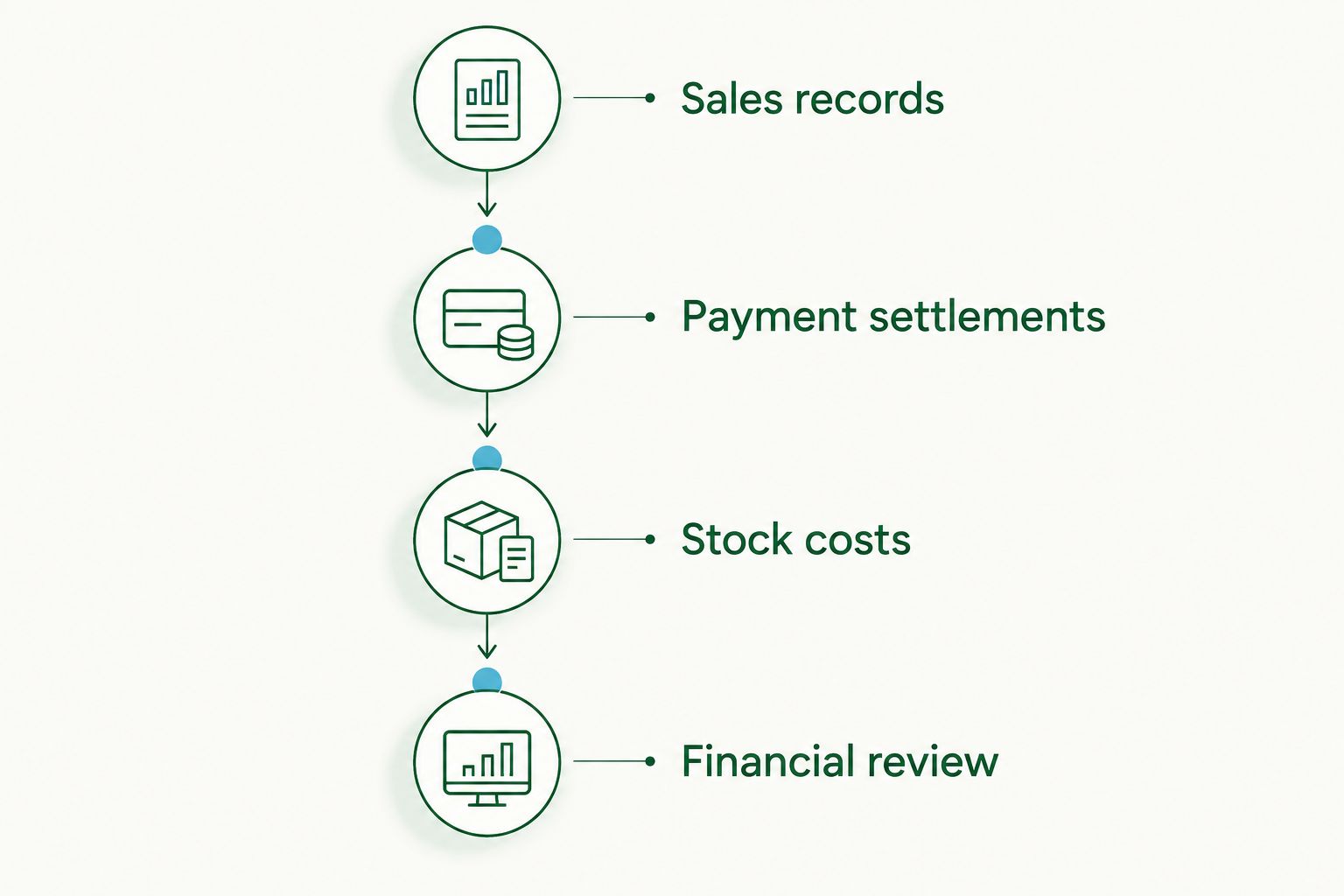
Check the complete retail accounting workflow
Use a real settlement example before approving a new accounting setup. A clean demonstration of an invoice is not enough for a store that processes refunds, merchant fees and stock movements.
01. Sales records
Identify which system holds the authoritative sales record. Decide whether the accounting application receives individual transactions or summarised entries, and record how GST and discounts are represented.
The objective is completeness without duplication. Importing store sales and then coding their bank settlements as new sales counts the same activity twice.
02. Payment settlements
Trace gross customer payments through refunds, fees and other adjustments to the net bank deposit. Record where unsettled amounts remain until the payment provider transfers them.
A payment-provider clearing account can separate money awaiting settlement from money already received. It still needs reconciliation; an unexplained balance is not evidence that everything matches.
03. Stock costs
Choose where quantities and stock values are maintained. Then establish how cost of goods sold reaches the accounts and how returns or damaged stock are handled.
If inventory sits in a separate system, assign responsibility for checking that its valuation agrees with the accounting records. Software connections do not remove that responsibility.
04. Financial review
Review the profit and loss statement, balance sheet and outstanding reconciliation items together. Agree who investigates differences and who approves corrections.
Daintree Consulting’s accounting and advisory services are suited to Australian businesses that need bookkeeping, compliance and financial decision support considered together.
Australian checks to include in your 2026 setup
Australian GST is generally 10% on taxable supplies. Businesses generally need to register when GST turnover reaches $75,000 per year; exceptions and specific rules apply. These are tax settings to assess, not reasons to apply one tax code to every transaction.
Your accountant should review GST registration, the nature of your sales and the treatment of relevant expenses. Overseas transactions, mixed sales and refunds require attention to their circumstances rather than blanket coding rules.
Keep accounting profit separate from available cash. Supplier payments, inventory purchases and payment-provider settlement timing affect what you can spend, even when the profit and loss statement shows a profit.
As a practical planning step, prepare a 13-week cash flow forecast alongside the accounts. Use expected settlement dates and payment commitments, then update the forecast against actual bank movements. This is a recommended planning horizon, not a software feature requirement.
Which accounting software should you choose?
Choose Xero as the default shortlist leader when your priority is accountant-led retail bookkeeping. Choose MYOB Business when payroll requirements lead the decision, or QuickBooks Online when direct owner involvement in reporting is the main priority.
Do not change systems simply because another retailer uses a different brand. First establish whether your problem is missing functionality, an unsuitable integration, incorrect setup or unfinished reconciliation work. Replacing software does not automatically fix the latter three.
Before committing in 2026, request a written scope covering imports, stock accounting, payroll, GST setup, historical balances and ongoing review. Name the person responsible for each task so the implementation has clear ownership.
Clarify your retail accounting setup
Discuss bookkeeping, tax and advisory support around your online retail operation.
FAQ
What's the best accounting software for online retailers in Australia?
Xero is the default recommendation in this guide for accountant-led retail bookkeeping. MYOB Business suits a payroll-centred selection process, while QuickBooks Online suits owners who want direct involvement in reporting. Confirm the settlement, GST and stock workflow before choosing.
Is Xero better than MYOB Business for an online store?
Neither is better for every online store. This guide favours Xero for accountant-led bookkeeping and MYOB Business when payroll requirements lead the decision. Compare the relevant packages using your actual sales and settlement process.
Can QuickBooks Online handle Australian GST?
QuickBooks Online includes Australian GST functionality. Correct reporting still depends on registration settings, transaction coding and review of sales, refunds and expenses.
Do I need separate inventory software for my online store?
You need separate inventory software when your stock requirements exceed the accounting package's capabilities. Assess stock locations, product assembly, purchasing and returns, then decide which system will maintain the authoritative stock record.
Should I record payment-provider deposits as sales?
Do not automatically record a net payment-provider deposit as sales. Reconcile the deposit against gross sales, refunds, fees and other adjustments so revenue and expenses are not omitted or duplicated.
Can accounting software prepare my BAS without an accountant?
Accounting software can support BAS preparation, but it does not establish that the underlying tax treatment is correct. Arrange a review when you are uncertain about GST coding, registration or adjustments.
Should I switch accounting software in 2026?
Switch accounting software in 2026 only when the replacement addresses a defined operational requirement. First distinguish a genuine capability gap from incorrect setup, incomplete reconciliation or a process that needs clearer ownership.
One last thing
Before approving a software change, ask to see a settlement that includes a refund. Trace it from the sales record through the payment provider to the bank, then check its effect on GST and revenue.
Choose the setup you can explain, not just the dashboard you prefer. That single exercise gives you a more useful basis for the decision than a long list of features.
Talk to Daintree about your accounting
Our ex-Big 4 team gives clear, senior-reviewed advice so you can act with confidence.
Book a free consultation →
Or explore our accounting services.
