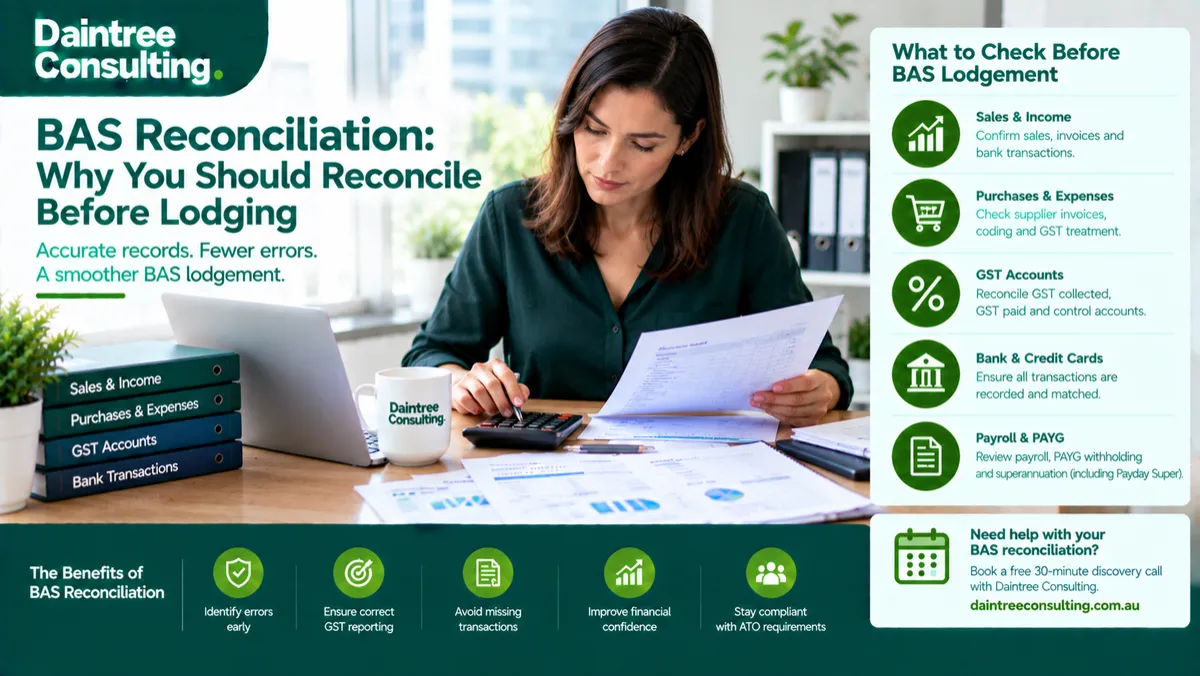
Why Reconciling Your Accounts Before BAS Lodgement Matters
Lodging a Business Activity Statement (BAS) is not simply a matter of opening your accounting software, accepting the figures and submitting the form.
Before you lodge, the underlying records should make sense.
Want expert help? Daintree Consulting's tax and BAS services can take this off your plate. Book a free consultation.
That means checking that sales, purchases, GST, bank transactions and other relevant accounts have been recorded correctly and that the figures used to prepare the BAS agree with your accounting records.
This is where BAS reconciliation matters.
A proper reconciliation can help identify missing transactions, incorrect GST coding, duplicate entries, timing differences and other discrepancies before they become part of a lodged BAS.
For Australian businesses, this is an important part of maintaining reliable financial records and reporting GST accurately. The Australian Taxation Office (ATO) specifically recommends reconciling sales with bank statements and keeping records that support GST reporting.
Quick answer: Why is BAS reconciliation important?
BAS reconciliation is the process of checking that the figures being reported on your BAS agree with the underlying accounting records and supporting information.
It matters because it can help your business:
identify errors before lodging
confirm GST has been coded correctly
check sales and purchases are complete
identify missing or duplicated transactions
reconcile GST control accounts
investigate unexpected changes in GST
improve the accuracy of BAS reporting
maintain better records for future tax and financial reporting
reduce the risk of having to correct an avoidable BAS error later.
The ATO's GST governance guidance specifically describes a BAS reconciliation as a check between BAS figures and business system data, including sales, GST on sales and GST on purchases.
In other words, reconciliation gives you an opportunity to check the numbers before they become lodged numbers.
What Is BAS Reconciliation?
BAS reconciliation is a review of the accounting information used to prepare a BAS.
The exact process depends on the business, accounting system, GST reporting method and transactions during the reporting period. However, the underlying principle is straightforward:
The figures reported on the BAS should be supported by the business's accounting records.
For example, a business may compare:
sales recorded in the accounting system against bank activity
GST collected against the GST control account
GST paid on eligible purchases against supporting transactions
purchases recorded in the ledger against supplier invoices
PAYG withholding information against payroll records, where applicable
BAS figures against relevant general ledger accounts
unusual movements against previous reporting periods.
The ATO has highlighted the importance of reconciling GST control accounts to the net amount reported on the BAS and investigating differences where the amounts do not agree.
This does not mean every business needs the same reconciliation checklist.
Instead, the reconciliation process should reflect the business's transactions, reporting obligations and accounting systems.
Why Should You Reconcile Before Lodging Your BAS?
1. It helps identify errors before lodgement
One of the biggest advantages of reconciliation is timing.
An error found before lodgement can generally be investigated while the relevant transactions and documents are still relatively easy to identify.
For example, you might discover that:
an invoice has been entered twice
a supplier bill has been missed
a transaction has been coded as GST-free when GST applies
a private expense has been incorrectly treated as a business purchase
a sale has been recorded in the wrong reporting period
a bank transaction has not been entered
a GST adjustment has been overlooked.
Without reconciliation, these issues can remain hidden inside the accounting records.
The BAS may still appear to produce a plausible figure, but plausible does not necessarily mean correct.
2. It checks that GST coding makes sense
GST reporting depends heavily on how transactions have been classified.
A business can have hundreds or thousands of transactions during a reporting period. Not every transaction will necessarily receive the same GST treatment.
Depending on the circumstances, transactions may involve:
taxable supplies
GST-free supplies
input-taxed supplies
purchases that include GST
purchases that do not include GST
private or non-business expenses
adjustments
transactions requiring specific GST treatment.
The ATO's GST testing guidance includes checking whether the business's systems correctly classify sales and purchases and apply the appropriate GST treatment.
A BAS reconciliation therefore isn't simply about making sure the final number looks reasonable.
It is also about checking whether the transactions feeding into that number have been treated appropriately.
3. It helps reconcile GST control accounts
GST control accounts are particularly important when reviewing BAS figures.
Your accounting system may contain accounts such as:
GST collected
GST paid
GST payable
GST receivable
GST clearing or suspense accounts.
The exact account structure will depend on the accounting system and how the business maintains its ledger.
The key question is whether the relevant GST accounts support the amount being reported.
The ATO describes reconciliation of GST control accounts to the net amount reported on the BAS as an important control and says differences should be investigated.
If the BAS says one amount is payable but the underlying GST accounts indicate something materially different, that difference deserves attention before lodgement.
4. It can uncover missing transactions
A BAS is only as reliable as the information used to prepare it.
If sales or purchases are missing from the accounting records, the BAS calculations may not reflect the complete reporting period.
This can happen for practical reasons.
For example:
an invoice was issued but not entered
a supplier invoice was received by email but not processed
a business credit card transaction has not been imported
a bank feed failed
a transaction was entered into the wrong accounting file
a manual transaction was overlooked
an adjustment was made outside the normal workflow.
Comparing accounting records with bank and other supporting information can help identify these gaps.
The ATO recommends keeping records of sales, fees, expenses, wages and other business costs and reconciling sales with bank statements.
What Should You Check Before BAS Lodgement?
The exact BAS reconciliation process should be tailored to the business, but there are several areas worth reviewing.
Sales and income
Start by checking whether sales recorded for the BAS period appear complete.
Consider:
sales invoices
point-of-sale transactions
online sales
recurring invoices
credit notes
refunds
deposits
unusual revenue movements.
If sales in the accounting system do not appear consistent with the business's other records, investigate the difference before relying on the BAS figures.
Purchases and expenses
Review purchases and expenses for the period.
Look for:
missing supplier invoices
duplicate bills
unusual expenses
incorrectly coded transactions
credit notes
business versus private expenditure
transactions that may require specific GST treatment.
The objective isn't to question every transaction unnecessarily. It is to identify items that could affect the BAS or indicate a problem with the underlying bookkeeping.
GST collected
Check the GST associated with taxable sales.
Large or unexpected movements can be worth investigating, particularly if sales have not changed by a similar amount.
For example, if revenue is relatively stable but GST collected suddenly changes significantly, there may be a transaction, coding issue or timing difference that needs explanation.
GST paid
Review GST included in eligible business purchases.
This can help identify:
missing purchase invoices
incorrectly coded expenses
duplicate transactions
transactions without supporting documentation
purchases where GST treatment requires further consideration.
Bank accounts and credit cards
Bank and credit-card reconciliations can provide another layer of confidence.
The purpose is not necessarily to make the bank balance equal the BAS.
Instead, the reconciliation helps establish whether the transactions feeding the accounting records are complete and correctly recorded.
This is particularly useful for businesses that have high transaction volumes or rely heavily on bank feeds.
Payroll and PAYG withholding
Where PAYG withholding is reported through the BAS, payroll records should also be considered as part of the review process.
For businesses using Single Touch Payroll (STP), payroll information reported to the ATO can affect pre-filled activity statement information. If payroll reporting is incorrect, the underlying STP information may need to be corrected.
This makes payroll-to-BAS checks particularly useful where payroll is a significant part of the business's obligations.
BAS Reconciliation vs Bank Reconciliation
These two processes are related, but they are not the same.
A bank reconciliation generally compares transactions recorded in the accounting system with transactions shown by the bank.
A BAS reconciliation goes further by checking whether the accounting information used for GST and other activity statement reporting is complete, appropriately classified and consistent with the figures being reported.
For example, a bank reconciliation may identify that a payment has not been entered.
A BAS reconciliation then considers whether that missing transaction could affect the GST treatment or another amount reported on the BAS.
This is why accurate bookkeeping and BAS preparation work together.
Good bookkeeping provides the foundation. Reconciliation provides an additional review before reporting.
What Happens If the BAS Figures Don't Reconcile?
A difference does not automatically mean that the BAS is wrong.
There can be legitimate reasons why accounting figures and GST figures do not match exactly.
For example, differences may arise because of:
GST-free transactions
input-taxed transactions
timing differences
private or non-business transactions
adjustments
accounting treatments that differ from GST treatment
transactions outside the BAS reporting period.
The important point is that unexplained differences should not simply be ignored.
The ATO has described approaches for analysing differences between accounting and GST results, including comparing revenue and expenses in financial accounts with GST reported through BAS information.
A reconciliation is therefore not about forcing every number to match.
It is about understanding why the numbers differ and determining whether the difference is appropriate.
How Often Should You Perform BAS Reconciliation?
For many businesses, the most practical approach is to reconcile as part of each BAS preparation cycle.
Waiting until the end of the financial year can make problems harder to identify.
A regular process may involve:
Keeping bookkeeping up to date.
Reconciling bank and credit-card accounts.
Reviewing sales and purchases.
Checking GST coding.
Reviewing GST control accounts.
Investigating unusual movements.
Preparing the BAS.
Reconciling the BAS figures back to the accounting records.
Reviewing the completed BAS.
Lodging and retaining supporting records.
The more consistent the process, the easier it generally becomes to identify unusual transactions.
For businesses with high transaction volumes, more frequent internal reviews may also make sense.
Why BAS Reconciliation Matters Beyond the BAS
BAS reconciliation is not only about GST compliance.
It can also improve the quality of your broader financial information.
If sales, purchases, GST and balance sheet accounts are regularly reviewed, business owners can have greater confidence when using financial reports for decisions.
That matters because the same underlying accounting records may be used for:
management reporting
cash-flow analysis
budgeting
tax preparation
financial forecasting
funding applications
financial statement preparation
year-end reporting.
A BAS error can sometimes be a symptom of a broader bookkeeping or accounting process problem.
For example, repeated reconciliation issues might indicate that:
GST codes are not configured correctly
bookkeeping is falling behind
staff need clearer procedures
invoices are not being processed consistently
accounting software is not integrated properly
review responsibilities are unclear.
Addressing the underlying process can be more valuable than simply correcting individual transactions.
A Simple BAS Reconciliation Checklist
Before lodging a BAS, consider whether you have:
Updated bookkeeping for the entire reporting period
Reconciled relevant bank accounts
Reconciled credit cards and other relevant accounts
Reviewed sales and income transactions
Reviewed purchases and expenses
Checked GST coding
Investigated unusual GST movements
Checked GST control accounts
Reviewed relevant payroll and PAYG information
Checked for missing or duplicate transactions
Investigated unexplained differences
Confirmed supporting records are available
Reviewed the final BAS figures before lodgement.
This checklist should be adapted to your business rather than treated as a universal BAS procedure.
Common BAS Reconciliation Problems
Some reconciliation issues appear repeatedly in growing businesses.
Bookkeeping is not up to date
If transactions from the reporting period have not been entered, there is no reliable basis for completing the reconciliation.
Bank accounts have not been reconciled
Unreconciled bank transactions can make it difficult to establish whether sales, expenses and other transactions are complete.
GST codes are inconsistent
Different staff may classify similar transactions differently, particularly when accounting processes are not documented.
Supporting invoices are missing
A transaction may exist in the accounting system but lack the documentation needed to properly support its treatment.
BAS figures are accepted without review
Accounting software can make BAS preparation faster, but software does not remove the need to review the underlying information.
Differences are carried forward without explanation
A small unexplained difference can become a recurring issue if nobody investigates where it came from.
Can Accounting Software Replace BAS Reconciliation?
Accounting software can make reconciliation significantly easier, but it does not remove the need for review.
Modern accounting platforms can automate tasks such as:
bank feeds
transaction matching
GST calculations
reporting
recurring transactions
invoice processing
activity statement preparation.
Automation can reduce manual work.
However, the quality of the result still depends on how transactions are entered, classified and reviewed.
If the wrong GST code is applied to a transaction, software may consistently calculate the wrong result.
That is why reconciliation remains an important control even when much of the bookkeeping process is automated.
When Should You Get Help With BAS Reconciliation?
You may benefit from professional accounting support if:
your BAS takes hours to prepare each period
your GST accounts regularly don't reconcile
you frequently discover errors after lodgement
bookkeeping is falling behind
your business has multiple bank accounts or entities
you have complex sales or purchasing arrangements
several people enter transactions into your accounting system
you are unsure how particular transactions should be treated
your BAS figures change significantly without an obvious explanation
you want stronger processes before handing information to your accountant.
For a growing business, the goal should not simply be to lodge the BAS on time.
It should be to have a repeatable process that produces reliable information and gives you a reasonable opportunity to identify issues before lodgement.
How Daintree Consulting Can Help With BAS Reconciliation
BAS preparation works best when it starts with reliable underlying records.
Daintree Consulting can support Australian businesses with accounting, bookkeeping coordination, GST and BAS compliance, reconciliations and financial reporting.
The focus is not simply on producing a BAS figure.
It is on helping businesses maintain accurate records, understand their obligations and establish practical processes around their financial information.
Depending on your needs, support may include:
bookkeeping and account reconciliation
GST and BAS preparation
review of accounting records
financial reporting
month-end processes
coordination between bookkeeping and accounting
support with ATO correspondence
broader tax and accounting requirements.
If your current BAS process involves last-minute corrections, unexplained differences or too much manual work, it may be worth reviewing the process behind the BAS rather than treating each reporting period as a separate task.
Book a free 30-minute discovery call with Daintree Consulting to discuss your accounting and BAS requirements.
Frequently Asked Questions About BAS Reconciliation
What is BAS reconciliation?
BAS reconciliation is the process of checking the figures used for a BAS against the underlying accounting records and supporting information. It helps identify errors, missing transactions, incorrect GST coding and unexplained differences before lodgement.
Should I reconcile before lodging my BAS?
Yes. Reviewing and reconciling the relevant accounting information before lodgement can help identify problems before they are reported to the ATO. The exact reconciliation process depends on your business and GST reporting circumstances.
What accounts should be reconciled before BAS?
This depends on the business, but may include bank accounts, credit cards, GST control accounts, sales, purchases, payroll-related accounts and other accounts relevant to BAS reporting.
What if my BAS doesn't match my accounting records?
Do not automatically assume that either figure is wrong. First identify the reason for the difference. GST-free transactions, input-taxed transactions, timing differences, adjustments and other treatments can create legitimate differences. Unexplained differences should be investigated.
Can my accountant reconcile my BAS?
Yes. An accountant can help review the accounting records, GST treatment, reconciliation process and BAS preparation, depending on the scope of the engagement.
How often should BAS accounts be reconciled?
For many businesses, reconciliation should form part of each BAS preparation cycle. Businesses with more complex or high-volume transactions may also benefit from more frequent internal reviews.
Final Takeaway
BAS reconciliation is a simple but important control between your bookkeeping and your BAS lodgement.
It helps answer a basic question:
Do the figures we are about to report actually agree with the financial information behind them?
Taking the time to reconcile sales, purchases, GST accounts, bank transactions and other relevant information can help identify errors before lodgement and improve the reliability of your broader accounting records.
The aim is not to make every accounting and GST figure identical.
The aim is to understand the numbers, investigate differences and make sure the BAS is supported by reliable records.
For Australian businesses, that process can make BAS preparation more controlled, more transparent and easier to manage as the business grows.
Important Publishing Note: BAS, GST and tax requirements can depend on your business structure, GST registration, reporting method, transactions and other circumstances. Tax and GST rules can also change. This article provides general information only and should not be treated as individual tax advice. Businesses should confirm their current obligations with the ATO or an appropriately qualified tax professional.
Talk to Daintree about your tax and BAS
Our ex-Big 4 team gives clear, senior-reviewed advice so you can act with confidence.
Book a free consultation →
Or explore our tax and BAS services.
