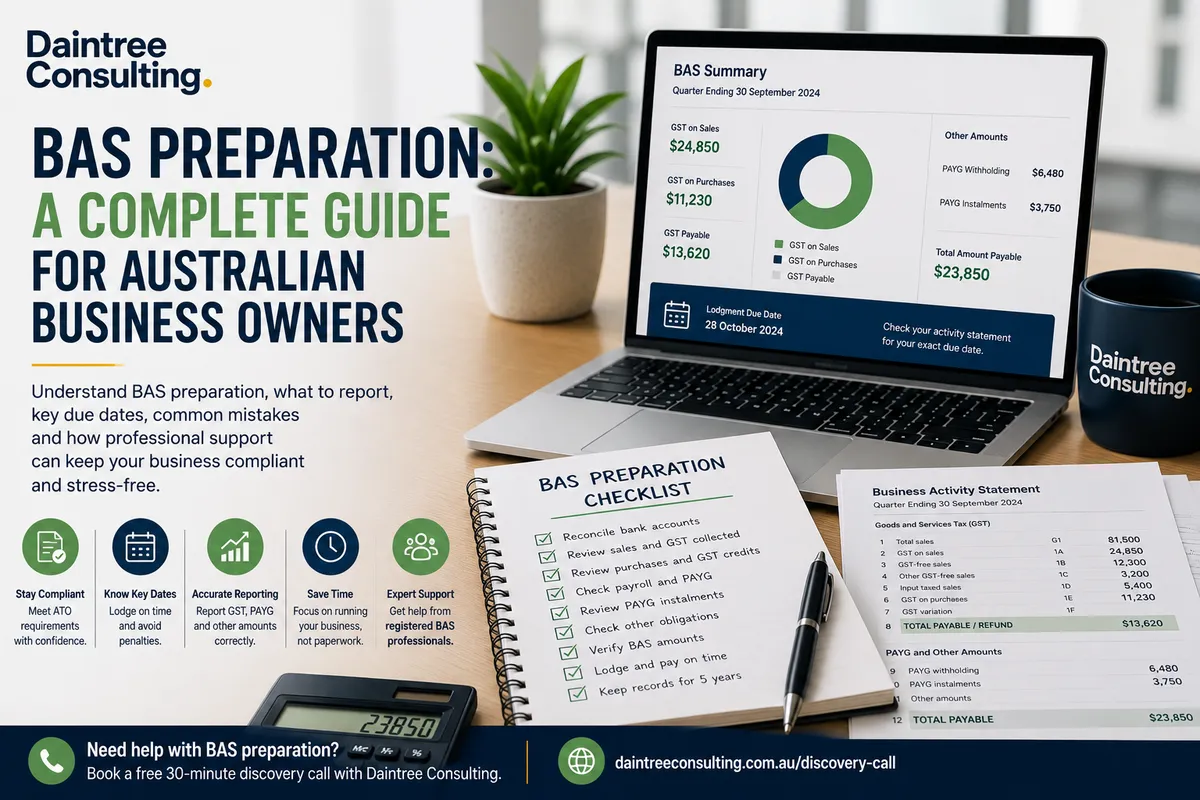
BAS Preparation: A Complete Guide for Australian Business Owners
If you run a business in Australia, BAS preparation is one of those jobs that is easy to underestimate.
A Business Activity Statement (BAS) is not simply a form you complete at the end of a quarter. It is the result of your bookkeeping, GST coding, payroll records, PAYG calculations and supporting documentation coming together accurately.
Want expert help? Daintree Consulting's tax and BAS services can take this off your plate. Book a free consultation.
When those records are clean, BAS preparation can be relatively straightforward. When they are incomplete or incorrectly coded, the process can become stressful — and mistakes can lead to incorrect GST reporting, missed obligations, adjustments and unnecessary contact with the ATO.
The Australian Taxation Office (ATO) states that BAS information must be complete and accurate and that good record keeping helps businesses meet their BAS requirements and claim the GST or other credits they are entitled to.
This guide explains how BAS preparation works, what records you need, what to check before lodging, common mistakes to avoid and when it makes sense to use a registered BAS agent.
Quick Answer: What Is BAS Preparation?
BAS preparation is the process of collecting, checking and reconciling your business records before completing and lodging your Business Activity Statement with the ATO.
Depending on your business and registrations, your BAS may involve reporting items such as:
GST on sales
GST on business purchases
Total sales
PAYG withholding
PAYG instalments
Other applicable tax obligations
For small businesses using Simpler BAS, the GST reporting requirements are generally reduced to total sales, GST on sales and GST on purchases.
The important point is that the BAS itself is only the final step.
Good BAS preparation starts with accurate bookkeeping throughout the reporting period.
What Is a Business Activity Statement?
A Business Activity Statement is the reporting mechanism businesses use to report and pay certain tax obligations to the ATO.
The exact information you need to report depends on your business structure, registrations and circumstances.
For example, a GST-registered business may need to report its GST position, while a business with employees may also have PAYG withholding obligations.
Some businesses may also have PAYG instalments or other amounts included on their activity statement.
The ATO provides businesses with their applicable activity statement and due date.
That means you should not assume that every business has the same BAS requirements.
How Often Do Businesses Need to Lodge BAS?
The frequency of your BAS depends on your circumstances and the reporting cycle assigned by the ATO.
For many Australian small businesses, BAS is lodged quarterly.
Some businesses lodge monthly, while certain businesses may be eligible for annual GST reporting.
Your activity statement will specify the relevant reporting period and due date.
For quarterly activity statements, the standard due dates are generally around:
28 October for the September quarter
28 February for the December quarter
28 April for the March quarter
28 July for the June quarter
However, eligible businesses using a registered tax or BAS agent may receive additional time under the relevant lodgement concessions.
Always check the due date shown on your activity statement or confirm it with your registered agent.
The ATO's published guidance confirms that the due date for lodging and paying is displayed on the BAS itself.
What Does BAS Preparation Actually Involve?
BAS preparation should be more than simply opening your accounting software and pressing "prepare."
A proper process generally involves several stages.
1. Bring Your Bookkeeping Up to Date
Before preparing your BAS, your bookkeeping should be current.
This means making sure transactions for the reporting period have been entered and appropriately categorised.
Your bookkeeper or accountant may need to review:
Sales
Purchases
Business expenses
Bank transactions
Credit card transactions
Accounts receivable
Accounts payable
Payroll
GST coding
Asset purchases
Loans and financing transactions
If your books are incomplete, your BAS figures may be incomplete as well.
2. Reconcile Your Bank Accounts
Bank reconciliation is an important part of BAS preparation.
Your accounting records should be compared with the actual transactions appearing in your business bank accounts.
This can identify:
Missing transactions
Duplicate entries
Incorrect amounts
Incorrect transaction dates
Unrecorded fees
Incorrect GST treatment
Transactions that have been incorrectly allocated
A BAS prepared from unreconciled accounts may look complete while still containing errors.
3. Review GST Coding
GST coding is one of the areas where businesses can make costly mistakes.
Not every transaction is treated the same way for GST purposes.
Depending on the transaction, it may be:
Taxable
GST-free
Input-taxed
Outside the scope of GST
Subject to another specific GST treatment
Your accounting software may automatically apply GST codes, but automation does not eliminate the need for review.
Particular attention should be given to unusual transactions, large purchases, asset acquisitions, private-use components and transactions involving overseas suppliers or customers.
4. Check Sales and GST Collected
Your sales records should be reviewed before the BAS is finalised.
This includes checking whether:
All sales have been recorded
GST has been applied correctly
Credit notes have been processed
Refunds have been accounted for
Cancelled invoices have been treated correctly
Cash and electronic sales have been captured
Any unusual transactions have been reviewed
For businesses using Simpler BAS, total sales and GST on sales are among the core GST amounts reported.
5. Check Purchases and GST Credits
The other side of the GST calculation is your eligible GST credits.
Review business purchases and expenses to make sure GST has been treated correctly.
This may include:
Supplier invoices
Software subscriptions
Professional fees
Office expenses
Equipment
Advertising
Business travel
Vehicle-related expenses where applicable
You should also retain appropriate supporting documentation.
The ATO emphasises the importance of keeping records that support BAS reporting and GST claims.
A transaction appearing in your bank feed does not automatically mean you can claim a GST credit.
6. Review Payroll and PAYG Withholding
If your business has employees, BAS preparation may also involve PAYG withholding information.
Payroll records should be consistent with the amounts reported through your payroll system and other records.
Before lodging, check that:
Payroll has been processed correctly
PAYG withholding amounts are accurate
Employee payments have been recorded correctly
Payroll journals have been posted correctly
Any payroll adjustments have been accounted for
This is another reason why accurate bookkeeping and payroll processes matter.
A discrepancy between payroll records and your BAS can create unnecessary questions and corrections later.
7. Review PAYG Instalments Where Applicable
Some businesses also have PAYG instalment obligations reported through their activity statement.
The ATO notes that PAYG instalments are generally paid quarterly for many taxpayers, with the activity statement or instalment notice showing the relevant amount and due date.
If your circumstances have changed significantly, your adviser may also need to consider whether the instalment amount should be varied.
This is an area where professional advice can be valuable because changing an instalment without understanding the broader tax position can create another problem later.
BAS Preparation Checklist
Before lodging your BAS, work through a simple checklist.
Bookkeeping
All transactions for the period have been entered
Bank accounts have been reconciled
Credit cards have been reconciled
Accounts receivable has been reviewed
Accounts payable has been reviewed
Major transactions have supporting documentation
GST
Sales have been reviewed
GST on sales has been checked
Purchases have been reviewed
GST on purchases has been checked
GST-free and input-taxed transactions have been correctly classified
Unusual transactions have been investigated
Payroll
Payroll has been completed
PAYG withholding has been checked
Payroll records agree with the accounting system
Any payroll adjustments have been processed
Other BAS obligations
PAYG instalments have been reviewed where applicable
Other activity statement obligations have been considered
Previous BAS adjustments have been identified
Any outstanding ATO issues have been considered
Final review
BAS figures have been reviewed
Supporting records are available
The correct reporting period has been selected
The due date has been confirmed
The person authorised to lodge has reviewed the statement
Common BAS Preparation Mistakes
Many BAS problems are caused by relatively simple bookkeeping issues.
Using unreconciled accounts
If your bank accounts are not reconciled, your BAS may be based on incomplete information.
Assuming every expense includes GST
Some expenses do not contain GST, while others may have different GST treatment.
Do not automatically claim GST on every business expense.
Forgetting adjustments
Credit notes, refunds, bad debts, asset purchases and other adjustments can affect your BAS.
Ignoring unusual transactions
Large or unusual transactions deserve additional review rather than being automatically accepted by the accounting software.
Leaving bookkeeping until BAS time
Trying to reconstruct three months of transactions immediately before a deadline creates unnecessary pressure.
The better approach is to maintain accurate records throughout the period.
Lodging without reviewing the numbers
Even when software produces a BAS automatically, the numbers still need to make commercial sense.
A significant change in GST payable or refundable should prompt a review.
What Records Should You Keep for BAS Preparation?
Your supporting records depend on your business and the obligations you have.
They may include:
Sales invoices
Purchase invoices
Receipts
Bank statements
Credit card statements
Expense records
Payroll records
GST calculations
Accounting reports
Contracts
Asset purchase documents
Loan records
Import and export documentation where relevant
Records supporting adjustments
The ATO states that good records help businesses meet BAS requirements and claim GST and other applicable credits.
Your records should allow the amounts reported on your BAS to be supported if questions arise later.
Can Accounting Software Do BAS Preparation for You?
Cloud accounting software can make BAS preparation significantly easier.
Platforms such as Xero and MYOB can automate transaction feeds, GST coding, reconciliations and reporting.
But software is only as reliable as the information going into it.
If a transaction is coded incorrectly, the software may simply include the incorrect classification in your BAS report.
That is why the strongest process is usually:
Accurate bookkeeping → reconciliation → GST review → BAS preparation → review → lodgement.
Technology reduces administrative work.
It does not replace professional judgement.
When Should You Use a BAS Agent?
Some business owners prepare and lodge their own BAS.
Others prefer to use a registered BAS agent or tax professional.
Professional BAS support can make sense when:
Your bookkeeping is becoming difficult to manage
You are unsure about GST treatment
Your business has multiple entities
You have complex transactions
You have payroll and PAYG obligations
You are frequently behind on bookkeeping
BAS deadlines create stress
You have received an ATO query
You need help correcting previous BAS errors
You want someone else to review the numbers before lodgement
The benefit is not simply having someone complete the form.
The bigger benefit is having a process that connects your bookkeeping, GST reporting and compliance obligations.
What Happens If You Lodge Your BAS Late?
Late lodgement can result in penalties, and unpaid tax obligations can also attract interest.
The exact consequences depend on the circumstances.
If you know a BAS is going to be late, do not simply ignore the deadline.
Contact your registered adviser or the ATO and address the outstanding obligation as soon as possible.
Even when there is nothing to pay, an activity statement may still need to be lodged.
The ATO provides specific processes for lodging nil activity statements and dealing with mistakes or adjustments.
What If You Discover a BAS Mistake?
Finding an error does not necessarily mean you need to panic.
The correct treatment depends on the type of mistake, the amount involved and the circumstances.
Some BAS errors can be corrected on a later activity statement, while other situations may require a revision.
The important thing is to identify the issue and determine the correct correction process rather than simply ignoring it.
The ATO provides guidance on fixing BAS mistakes and making adjustments.
If you are unsure, speak with a registered BAS or tax professional.
How Daintree Consulting Can Help With BAS Preparation
For Australian business owners, BAS preparation should ideally be part of a broader financial process rather than an isolated quarterly task.
Daintree Consulting provides taxation and BAS support alongside bookkeeping and accounting services. Its stated process is to confirm the relevant entities, registrations, history and deadlines, collect and reconcile the required information, prepare the work, resolve material questions, and then review, authorise and lodge through the appropriate process.
This approach helps businesses move from:
Messy records → clean bookkeeping → reviewed BAS → timely lodgement.
Daintree's taxation and BAS service includes BAS preparation and lodgement support, GST and PAYG compliance support, year-end tax planning discussions, ATO correspondence support within scope, and coordination with bookkeeping and accounting services.
For business owners, that means less time trying to work out whether the numbers are right and more visibility over what the business actually owes.
Final BAS Preparation Checklist
Before your next BAS is lodged, ask yourself:
Are the books up to date?
Have all bank and credit card accounts been reconciled?
Has GST coding been reviewed?
Do sales records agree with the accounting system?
Have business purchases been checked for GST treatment?
Has payroll been reconciled?
Have PAYG obligations been reviewed?
Are unusual or high-value transactions supported by documentation?
Have previous BAS adjustments been considered?
Is the BAS due date confirmed?
Has someone appropriately qualified reviewed the figures before lodgement?
If you can confidently answer yes, your BAS preparation process is likely in much better shape.
Frequently Asked Questions About BAS Preparation
What is BAS preparation?
BAS preparation is the process of reviewing business records, reconciling transactions, checking GST and other applicable obligations, and preparing the Business Activity Statement for lodgement with the ATO.
How often do I need to prepare a BAS?
The frequency depends on your business circumstances and ATO reporting requirements. Many small businesses lodge quarterly, while some businesses lodge monthly or annually.
What information is needed for BAS preparation?
Depending on your obligations, you may need sales records, purchase records, bank reconciliations, GST information, payroll records, PAYG information and supporting documentation.
Can I prepare my BAS myself?
Yes, businesses can lodge their own BAS where appropriate. However, professional assistance can be valuable when your GST, payroll or accounting circumstances are more complicated.
Can my bookkeeper prepare my BAS?
A bookkeeper may assist with BAS preparation, but paid BAS services must be provided by an appropriately registered BAS agent or another person who is legally authorised to provide the service.
What is the biggest BAS preparation mistake?
One of the most common problems is preparing the BAS from incomplete or unreconciled bookkeeping records. The quality of the BAS depends heavily on the quality of the underlying financial data.
What should I do if my BAS is overdue?
Address it as soon as possible. Review the outstanding periods, determine what needs to be lodged or corrected, and seek assistance from your BAS agent or tax adviser if necessary.
Can Daintree help with BAS preparation?
Yes. Daintree Consulting provides BAS preparation and lodgement support as part of its taxation and compliance services for Australian businesses.
Important: BAS due dates and reporting requirements
BAS reporting requirements, lodgement frequency and due dates can vary depending on your business circumstances and reporting obligations. The information in this article is provided as general guidance only and should not be relied on as a substitute for checking your specific BAS or ATO correspondence.Always check the due date shown on your current BAS or confirm the applicable date with your registered tax or BAS agent. The ATO confirms that the due date for lodging and paying your BAS is displayed on the activity statement.
Ready to Make BAS Preparation Easier?
If BAS deadlines regularly create stress, the problem may not be the BAS itself. It may be the bookkeeping and financial processes happening before it.
Daintree Consulting can help assess your current setup, identify where the process is breaking down and determine a practical next step.
Book a free 30-minute discovery call to discuss your bookkeeping, BAS and compliance requirements. Daintree describes the call as a focused, no-obligation conversation designed to understand the current situation and identify whether its support is appropriate.
