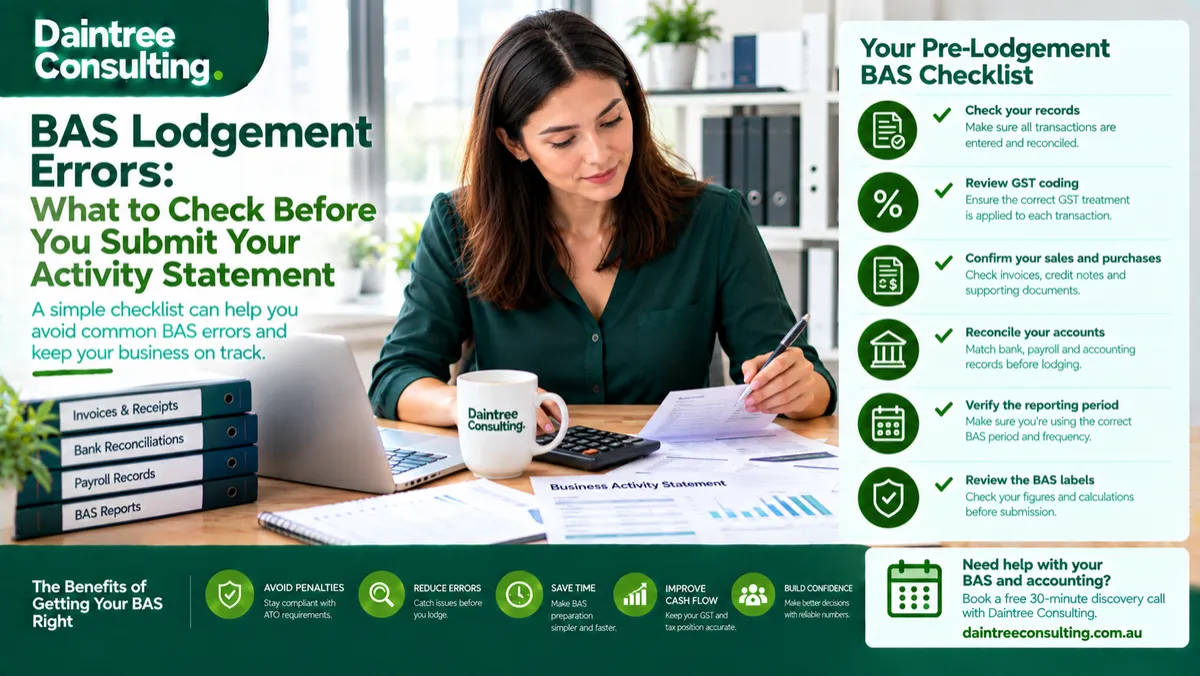
BAS Lodgement Errors: What to Check Before You Submit Your Activity Statement
Submitting a Business Activity Statement (BAS) is a routine part of running many Australian businesses. But a BAS is only as reliable as the records and calculations behind it.
A small coding mistake, missing transaction, incorrect GST treatment or unreconciled account can affect the figures you report. In some cases, the problem may not become obvious until after the BAS has been lodged.
Want expert help? Daintree Consulting's tax and BAS services can take this off your plate. Book a free consultation.
The good news is that many BAS lodgement errors can be reduced with a consistent review process before you submit.
This guide explains what to check before lodging your BAS, where businesses commonly make mistakes, how accounting records should support the figures reported, and what to do if you discover an error after lodgement.
Quick answer: What should you check before lodging a BAS?
Before submitting your BAS, check that:
the correct reporting period has been selected
your accounting records are up to date
sales and purchases have been recorded completely
GST has been coded correctly
GST-free and input-taxed transactions have been treated correctly
GST on purchases is supported by appropriate records and tax invoices where required
private or partly private expenses have been considered
bank accounts and relevant balance sheet accounts have been reconciled
GST figures agree with your accounting records
PAYG withholding figures, where applicable, agree with payroll and reporting records
previous BAS errors or adjustments have been properly considered
the BAS labels have been reviewed before submission
you have retained a copy of the BAS and supporting records.
The ATO specifically recommends checking that applicable GST labels have been completed, calculations are accurate and amounts have been transferred correctly from your records before lodging.
The exact checks required will depend on your business, accounting method, GST registration and the obligations included on your activity statement.
Why do BAS lodgement errors happen?
BAS errors are often not caused by one major accounting problem.
Instead, they can result from several smaller issues accumulating during the reporting period.
For example, a business might have:
transactions sitting unreconciled in the accounting software
expenses coded to the wrong GST category
sales recorded without GST when GST should have been reported
GST claimed on an expense that is not creditable
duplicate transactions
missing invoices
incorrect treatment of refunds or credit notes
private-use expenses recorded as fully business-related
payroll figures that do not agree with the relevant reporting records
transactions entered into the wrong reporting period.
This is why preparing a BAS should not simply mean opening the activity statement and accepting the figures generated by accounting software.
Software can make BAS preparation more efficient, but it relies on the underlying transactions being recorded and classified correctly.
The ATO notes that accounting software can help produce reports of GST liabilities and credits, but businesses still need appropriate accounting and record-keeping processes.
1. Check that your accounting records are up to date
Before reviewing the BAS itself, start with the accounting records.
If transactions are missing, duplicated or unreconciled, your BAS figures may not reflect the business's actual activity for the reporting period.
Review:
sales invoices
supplier bills
expenses
bank transactions
credit card transactions
cash transactions
refunds
customer credits
supplier credits
asset purchases
relevant payroll transactions.
It is also worth checking whether transactions have been entered into the correct reporting period.
For example, a transaction recorded in the wrong month or quarter could cause the GST to appear in the wrong BAS.
The ATO advises businesses to keep records that contain enough information to calculate and support amounts reported on activity statements and tax returns.
A simple pre-BAS test
Ask:
Could another person review my accounting records and understand where the BAS figures came from?
If the answer is no, the records may need more work before the BAS is lodged.
2. Reconcile your bank and relevant accounts
Bank reconciliation is one of the most useful checks before BAS lodgement.
Your accounting software may show a GST position, but unreconciled transactions can affect the reliability of that position.
Before lodging, consider reconciling:
business bank accounts
credit cards
payment platforms
clearing accounts
payroll-related accounts
GST accounts
accounts receivable
accounts payable
other relevant balance sheet accounts.
The objective is not simply to make the accounting software balance.
You want to identify transactions that may have been:
missed
duplicated
incorrectly coded
entered for the wrong amount
allocated to the wrong account
allocated to the wrong reporting period.
A reconciliation can therefore be both an accounting control and a BAS preparation check.
3. Review GST on sales
GST on sales is an obvious area to check, but it can become complicated when a business has different types of income.
Review your sales and ask:
Are all relevant sales included?
Has GST been applied correctly?
Are GST-free sales treated correctly?
Are any supplies input taxed?
Are refunds or credit notes accounted for correctly?
Are there transactions that require special GST treatment?
Are sales recorded in the appropriate reporting period?
For businesses using the ATO's Simpler BAS reporting method, the core GST labels include G1 for total sales, 1A for GST on sales and 1B for GST on purchases.
That does not mean every business has exactly the same BAS obligations. Activity statements are tailored to the tax obligations that apply to the business.
If the nature of your transactions has changed, it is worth checking whether the GST treatment still reflects the business's current activities.
4. Check GST on purchases
Purchases and expenses are another common source of BAS errors.
A business should not assume that every expense containing a GST amount automatically creates a GST credit.
Review purchases for:
valid supporting documentation
the correct GST treatment
business versus private use
GST-free purchases
input-taxed expenses
mixed-purpose expenses
asset purchases
unusual or high-value transactions.
The ATO explains that input tax credits depend on whether an acquisition is for a creditable purpose and other applicable requirements. Some acquisitions may need to be apportioned where they have both business and private or other uses.
This is particularly important for expenses that are partly business-related.
For example, if an expense has both business and private use, you may need records that support the business portion rather than simply claiming the entire GST amount.
5. Check your tax invoices and supporting records
If your business is claiming GST credits, supporting documentation matters.
Review whether significant purchases have appropriate records and tax invoices where required.
Look particularly closely at:
large purchases
equipment
professional services
motor vehicle expenses
property-related expenses
recurring supplier expenses
unusual one-off transactions.
The ATO states that business records should include evidence of sales and purchases and documents relating to GST. It also recommends checking that tax invoices received for purchases that include GST are valid.
If the accounting system shows a GST credit but the supporting documentation is incomplete, that transaction deserves attention before the BAS is submitted.
6. Look for GST coding mistakes
Incorrect GST coding can create BAS errors even when the transaction amount itself is correct.
For example, an expense may have been entered as:
GST applicable when it should be GST-free
GST-free when GST should have been applied
fully creditable when it is partly private
no GST when GST should have been claimed
the wrong transaction type altogether.
This is why reviewing a GST report or transaction list can be useful before lodging.
Don't just look at the final GST payable or refundable amount.
Look at the transactions that make up the amount.
If a figure looks unusually high or low compared with previous periods, investigate it rather than assuming it is correct.
7. Compare the BAS with previous reporting periods
A comparison with the previous BAS can help identify unusual movements.
For example, you might notice:
sales have increased substantially
GST on sales has fallen unexpectedly
GST on purchases has jumped
a normally recurring expense has disappeared
PAYG withholding has changed significantly
the expected payment or refund is very different from normal.
A change is not automatically an error.
Your business may genuinely have had a different quarter.
But an unusual movement creates a useful reason to investigate.
The ATO has also developed validation and analytical approaches to identify potential BAS anomalies, highlighting the value of reviewing unusual figures before lodgement.
8. Check the reporting period
One surprisingly simple BAS error is working with the wrong reporting period.
Before finalising, check:
the start date
the end date
the reporting frequency
whether transactions belong to this BAS
whether transactions have accidentally been included from another period.
Businesses can have different reporting arrangements depending on their circumstances.
For example, GST may be reported monthly, quarterly or annually in certain circumstances. The ATO publishes different due dates and rules depending on the reporting arrangement.
Don't assume that the BAS period is correct simply because the accounting software has generated a report.
9. Check PAYG withholding figures where applicable
A BAS may include more than GST.
If your business has employees, PAYG withholding can also form part of the activity statement reporting process.
Before lodging, compare the relevant PAYG withholding amount with your payroll records and reporting information.
Look for:
payroll totals
PAYG withholding
pay periods
employee changes
corrections or adjustments
STP reporting information.
Where PAYG withholding information is pre-filled, it is still important to understand where the amount came from and whether your underlying payroll records agree.
If payroll reporting has been corrected or updated, check whether that correction affects the activity statement.
10. Check adjustments, refunds and credit notes
Adjustments are another area where BAS preparation can become confusing.
A GST adjustment can arise when something happens after a sale or purchase has been reported that changes the GST amount.
This is different from a mistake that existed when the original BAS was lodged.
The ATO distinguishes between a GST error and a GST adjustment. A GST error involves an amount that was incorrect at the time of lodgement, while an adjustment generally relates to something that occurred later and changed an amount that was originally reported correctly.
Examples of transactions that may require additional attention include:
credit notes
refunds
changes to consideration
cancelled transactions
changes in the use of an acquisition
other events affecting previously reported GST.
If you are unsure whether something is an error or an adjustment, professional advice may be appropriate.
11. Investigate unusual GST results before lodging
A large BAS payment is not necessarily a mistake.
Likewise, a large GST refund is not necessarily incorrect.
But a result that is significantly different from what the business normally experiences should prompt a review.
Ask:
Did sales genuinely change?
Did the business make a large purchase?
Were there unusual asset purchases?
Were there refunds or credit notes?
Did the GST coding change?
Are transactions missing?
Are transactions duplicated?
Has the reporting method changed?
Has a prior-period adjustment been included?
The objective is not to force the BAS to resemble the previous period.
The objective is to understand why it is different.
12. Don't rely blindly on accounting software
Modern accounting software can make BAS preparation much easier.
Automated bank feeds, GST coding, transaction rules and reporting can reduce manual work.
But automation does not remove the need for review.
A software system can process an incorrectly coded transaction just as efficiently as a correctly coded one.
Common problems can include:
incorrect bank-feed rules
duplicate transactions
incorrectly mapped accounts
outdated GST settings
transactions allocated to the wrong tax code
incomplete integrations
manual journals affecting GST accounts.
The more automated the bookkeeping process becomes, the more important it can be to understand the controls behind the automation.
13. Keep your BAS working papers and supporting records
Once the BAS has been prepared, keep the information used to support it.
This can include:
the lodged BAS
GST reports
transaction reports
bank reconciliations
tax invoices
receipts
sales records
purchase records
adjustment calculations
relevant payroll records
reconciliation workpapers.
The ATO generally requires businesses to retain relevant business and tax records for at least five years, although some records may need to be kept longer depending on the circumstances.
Good record keeping also makes future BAS preparation easier because you can trace reported figures back to the underlying transactions.
What are the most common BAS lodgement errors?
While every business is different, common areas to review include:
1. Incorrect GST coding
Transactions are assigned the wrong GST treatment.
2. Missing transactions
Sales or purchases have not been entered before the BAS is prepared.
3. Duplicate transactions
The same transaction appears more than once, often because of bank-feed or manual-entry issues.
4. Incorrect private-use treatment
An expense with private use is treated as entirely business-related.
5. Missing supporting documentation
A business claims a GST credit without having the appropriate records to support the claim.
6. Wrong reporting period
A transaction is included in the wrong BAS.
7. Incorrect adjustments
Refunds, credit notes or other changes are not reflected correctly.
8. Unreconciled accounts
Bank or other relevant accounts have not been reconciled before the BAS is prepared.
9. Payroll discrepancies
PAYG withholding figures do not agree with payroll or reporting records.
10. Assuming software-generated figures are automatically correct
The accounting system produces a BAS report, but nobody reviews whether the underlying transactions have been coded correctly.
What should you do if you discover a BAS error after lodgement?
Don't simply ignore it.
The correct treatment depends on the nature of the problem, the amount involved, the reporting period and the applicable ATO rules.
The ATO distinguishes between correcting a mistake in an earlier BAS and making an adjustment where a later event changes an amount that was correctly reported at the time.
Depending on the circumstances, an error may be corrected through a later BAS or by revising the earlier activity statement.
There are specific rules and limits that apply, so businesses should not assume that every error can be handled in exactly the same way.
If the error is material, complicated or relates to a compliance review, getting professional advice before making the correction can help ensure the issue is dealt with appropriately.
A practical BAS pre-lodgement checklist
Before you submit your next BAS, work through this sequence:
Step 1 — Confirm the period
Make sure you are working on the correct BAS period.
Step 2 — Complete the bookkeeping
Enter all relevant sales, purchases, expenses, receipts and other transactions.
Step 3 — Reconcile accounts
Reconcile bank accounts, credit cards and other relevant accounts.
Step 4 — Review GST coding
Check GST, GST-free, input-taxed and other relevant classifications.
Step 5 — Review sales
Confirm sales figures and GST on sales are complete and accurate.
Step 6 — Review purchases
Check GST credits, supporting documentation and private-use considerations.
Step 7 — Review payroll
Where applicable, compare PAYG withholding and payroll information with the relevant records.
Step 8 — Investigate unusual movements
Compare the current BAS with previous periods and investigate significant differences.
Step 9 — Review adjustments
Check refunds, credit notes and other GST adjustments.
Step 10 — Review the BAS itself
Check the labels, calculations and transferred amounts before submission.
Step 11 — Save supporting records
Keep the BAS and the records used to prepare it.
Step 12 — Lodge and pay on time
Check the applicable due date for your reporting arrangement. The ATO publishes current BAS lodgement and payment dates based on the relevant reporting cycle.
How better bookkeeping can reduce BAS errors
BAS preparation becomes much easier when bookkeeping is maintained throughout the reporting period rather than rushed immediately before the deadline.
A strong process might include:
regular bank reconciliations
consistent GST coding
timely invoice processing
organised receipts and tax invoices
regular review of accounts receivable and payable
payroll reconciliation
monthly review of GST reports
documented treatment for unusual transactions
review of significant transactions before BAS time.
This approach turns BAS preparation from a last-minute exercise into a controlled review process.
It can also make it easier to identify problems before they affect the lodged activity statement.
When should you get professional BAS support?
Some businesses can manage routine BAS preparation internally, particularly when their transactions are straightforward and their bookkeeping systems are well maintained.
Professional support may become more valuable when:
the business is growing quickly
transaction volumes have increased
multiple GST treatments apply
the business has employees
there are complex or unusual transactions
bookkeeping is falling behind
previous BAS errors have been identified
the business has received an ATO communication
management does not have confidence in the reported figures
the owner is spending too much time preparing and checking BAS information.
The benefit is not simply having someone submit the form.
Good BAS support should also help improve the quality of the records and reconciliations that sit behind the BAS.
BAS preparation should start before the BAS arrives
The easiest way to reduce BAS lodgement errors is not to wait until the BAS deadline.
It starts with accurate bookkeeping throughout the reporting period.
When transactions are recorded promptly, accounts are reconciled regularly, GST treatment is reviewed and supporting records are organised, the final BAS review becomes much more straightforward.
For business owners, that can mean less time searching for missing information and more confidence that the figures being reported are supported by the accounting records.
If your BAS process regularly involves last-minute corrections, unexplained GST movements or uncertainty about whether the figures are right, it may be worth reviewing the process behind the BAS rather than simply fixing individual errors each quarter.
Need help preparing your BAS?
Daintree Consulting provides practical accounting, bookkeeping, payroll and BAS support for Australian businesses.
Our team can help with the records, reconciliations and reporting processes that sit behind BAS preparation, helping you work from more reliable financial information.
Book a free 30-minute discovery call with Daintree Consulting to discuss your accounting and BAS requirements.
Frequently Asked Questions
What are BAS lodgement errors?
BAS lodgement errors are mistakes or inaccuracies in an activity statement submitted to the ATO. They can involve GST, PAYG withholding or other amounts reported on the BAS, depending on the business's obligations.
Common causes include incorrect GST coding, missing transactions, duplicate entries, incorrect reporting periods, unsupported GST claims and unreconciled accounting records.
How can I avoid BAS errors?
Start by keeping your bookkeeping up to date and reconciling relevant accounts before preparing the BAS.
Then review GST coding, sales, purchases, supporting records, adjustments, payroll information where applicable and unusual movements before lodging.
Should I reconcile my accounts before lodging BAS?
Yes. Reconciling relevant accounts before preparing the BAS can help identify missing, duplicated or incorrectly coded transactions.
The exact accounts that should be reconciled will depend on the business and its accounting system.
What happens if I make a mistake on my BAS?
The treatment depends on what the mistake was and the circumstances.
The ATO distinguishes between GST errors and GST adjustments, and different rules can apply to correcting each type.
If you discover an error, review the applicable ATO guidance or speak with a registered tax or BAS agent before deciding how to correct it.
How long should I keep BAS records?
Most relevant business and tax records need to be kept for at least five years, although particular records or circumstances can require a longer retention period.
Keep the BAS and the records used to prepare it so that the reported figures can be supported if required.
Can accounting software prevent BAS errors?
Accounting software can reduce manual work and help with transaction processing, GST reporting and reconciliations, but it cannot guarantee that every transaction has been classified correctly.
The quality of the BAS still depends on the underlying records, coding, reconciliations and review process.
What is the difference between a BAS error and a GST adjustment?
A GST error generally relates to an amount that was incorrect when the BAS was lodged.
A GST adjustment generally occurs when a later event changes an amount that was correctly reported at the time.
The ATO treats these differently, so the distinction matters when deciding how an issue should be corrected.
Is BAS preparation only about GST?
No. Depending on the business and its registrations, an activity statement can include other tax obligations such as PAYG withholding and PAYG instalments.
The specific labels and obligations depend on the business's circumstances.
Important Publishing Note
BAS, GST, PAYG withholding and record-keeping requirements can change, and the correct treatment depends on the business, transaction and reporting circumstances. This article provides general information only and should not be treated as tax or financial advice. Verify current requirements with the ATO or a suitably qualified registered tax or BAS agent before publishing or relying on specific compliance information.
Talk to Daintree about your tax and BAS
Our ex-Big 4 team gives clear, senior-reviewed advice so you can act with confidence.
Book a free consultation →
Or explore our tax and BAS services.
