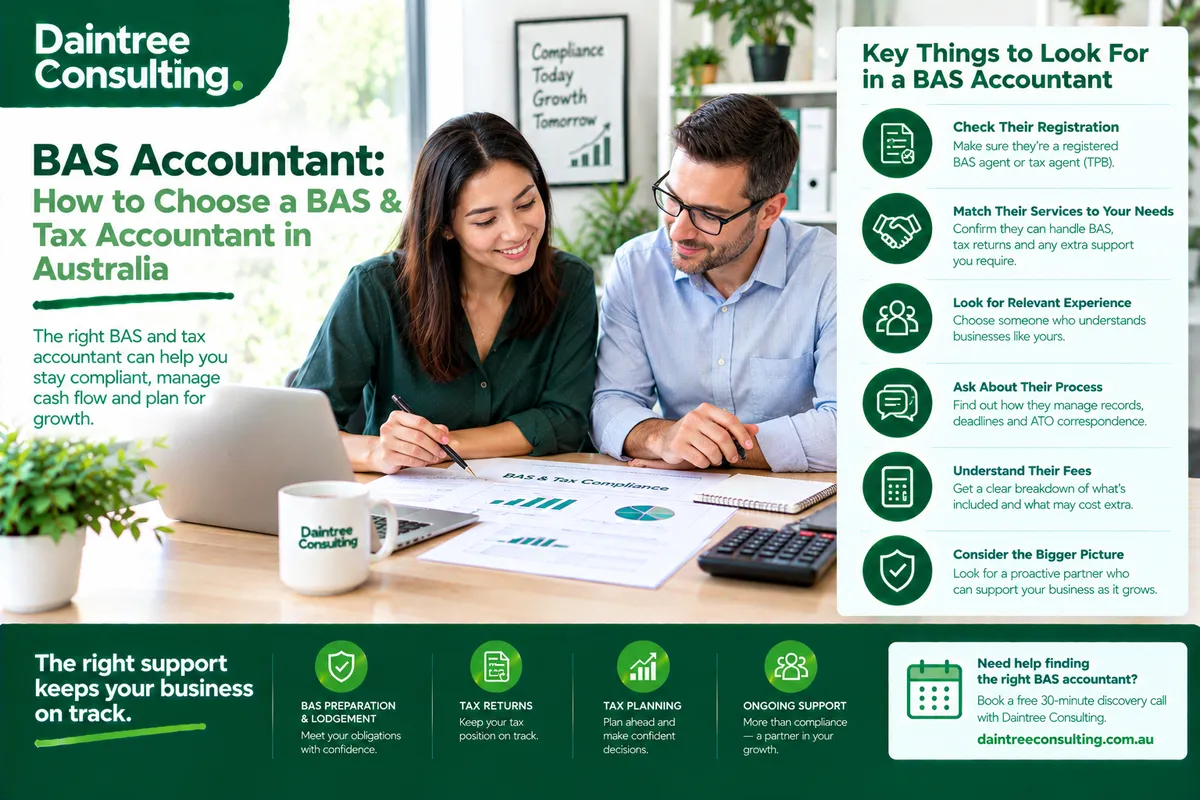
BAS Accountant: How to Choose a BAS & Tax Accountant in Australia
Choosing a BAS and tax accountant is not simply about finding someone who can lodge your paperwork.
For many Australian businesses, the right professional can become an important part of the broader finance process — helping keep records organised, preparing and lodging BAS and tax obligations, identifying issues before deadlines and giving the business clearer visibility over what needs to happen next.
Want expert help? Daintree Consulting's tax and BAS services can take this off your plate. Book a free consultation.
But not every accountant provides the same services.
Some focus primarily on annual tax returns. Others provide ongoing BAS and compliance support. Some combine bookkeeping, accounting and tax services, while others work alongside an existing bookkeeper or internal finance team.
Understanding what you actually need before choosing a provider can make the process much easier.
If you are searching for a BAS accountant, here are the key things to consider.
What Does a BAS and Tax Accountant Do?
The exact scope depends on the professional and the engagement, but BAS and tax support can include activities such as:
BAS preparation and lodgement
GST-related compliance
PAYG-related obligations
Business tax returns
Tax planning discussions
Reviewing financial records before lodgement
Reconciling relevant accounts
Responding to ATO correspondence within the agreed scope
Coordinating with bookkeeping and accounting providers
Helping identify information required for upcoming obligations
A registered BAS agent can provide certain BAS services for a fee, while a registered tax agent can provide a broader range of tax agent services, including preparing and lodging tax returns. The Tax Practitioners Board (TPB) specifically advises businesses to check a practitioner's registration and any conditions on that registration before engaging them.
That distinction matters when comparing providers.
If you need both ongoing BAS work and business tax returns, for example, you should confirm that the professional or firm you choose is appropriately registered and able to provide the services you require.
BAS Agent vs Tax Agent: What's the Difference?
The terms are sometimes used interchangeably, but they are not identical.
A BAS agent is registered to provide specified BAS services for a fee or reward.
A tax agent can provide a broader range of tax agent services, including preparing and lodging tax returns.
The TPB's current guidance confirms that registered BAS agents can provide some services that tax agents provide, but not all of them. For example, both can prepare and lodge BAS, while preparing and lodging tax returns is a tax-agent service.
This means you should not choose a provider based solely on the word "accountant" in their business name.
Instead, ask:
What services do I need, and is the person or firm appropriately registered to provide them?
1. Check Their Registration
This should be one of the first checks you make.
If you are paying someone to provide tax agent or BAS services, you should check whether they are registered with the TPB.
The TPB maintains a public register containing registered tax and BAS agents. The register can also show conditions imposed on a practitioner's registration and certain public disciplinary information.
This gives you a straightforward way to verify the professional you are considering.
Ask for their:
Registration type
Registration number
Business or firm details
Scope of services
Any relevant conditions on registration
Do not assume that someone who has experience with bookkeeping or accounting is automatically authorised to provide every type of tax or BAS service.
Registration requirements exist for a reason.
2. Make Sure Their Services Match Your Needs
Before comparing fees, make a list of what you actually want the accountant to handle.
For example, you may need:
BAS only
You may already have a bookkeeper and accountant but want a registered professional to prepare and lodge your BAS.
BAS and tax returns
You may want one provider to handle both recurring BAS obligations and annual business tax returns.
Ongoing tax compliance
You may want support throughout the year rather than only at tax time.
Bookkeeping, BAS and tax
You may want a more connected service where bookkeeping feeds directly into BAS preparation and year-end tax work.
Tax planning
You may also want to discuss tax considerations before the end of the financial year rather than simply calculating the result afterwards.
The right arrangement depends on your circumstances.
The important thing is to make sure the scope is clear from the beginning.
3. Look for Experience With Businesses Like Yours
An accountant does not necessarily need to specialise exclusively in your industry.
However, relevant experience can be useful.
Different businesses can have very different accounting and tax considerations.
For example, a professional-services business may need strong visibility over:
Contractor costs
WIP
Billing
Debtors
Staff costs
Practice profitability
A retail business may have greater focus on:
Inventory
Point-of-sale systems
Payment platforms
Cost of goods sold
Supplier payments
Stock movements
A growing business may need more attention on:
Cash flow
Payroll
GST
PAYG
Management reporting
Forecasting
Tax planning
Ask prospective providers whether they regularly work with businesses of similar size, structure and complexity.
You can also ask what they typically see as the biggest compliance or bookkeeping challenges for businesses like yours.
Their answer may tell you more than a generic list of services on a website.
4. Understand What Happens Before BAS Lodgement
A BAS should not simply be treated as a form that gets completed at the deadline.
The quality of the BAS depends heavily on the information supporting it.
A good process may involve:
Bookkeeping → Reconciliation → Review → BAS preparation → Client review/authorisation → Lodgement
The exact process will vary.
But you should understand what happens before the BAS is submitted.
Ask:
Who prepares the BAS?
Who checks the underlying records?
Are bank accounts reconciled first?
How are unusual transactions handled?
How are missing records identified?
Who asks questions when something does not look right?
How far in advance do you need to provide information?
Who is responsible for final approval?
This matters because a deadline-driven process can become stressful if questions only emerge immediately before lodgement.
5. Ask How They Handle Record Quality
Your accountant cannot create reliable tax and BAS outcomes from incomplete or inaccurate information.
The quality of the underlying bookkeeping matters.
That includes records such as:
Sales
Purchases
Bank transactions
Receipts
Tax invoices
Payroll information
GST-related transactions
Asset purchases
Loan transactions
Other supporting documents
The ATO encourages businesses to keep records organised and up to date, including checking that receipts and records match bank accounts.
A good BAS and tax accountant should therefore be willing to discuss the condition of your records rather than simply accepting whatever information arrives.
If records are incomplete, the first step may be to identify what is missing and establish a process for bringing the bookkeeping up to date.
6. Look for Clear Communication
Tax and BAS issues can become complicated quickly.
You do not necessarily need an accountant who uses technical terminology to demonstrate expertise.
You need someone who can explain:
What is required
Why it is required
What information they need
What deadlines apply
What you need to approve
What they recommend doing next
Good communication is particularly important when something goes wrong.
For example, perhaps:
A BAS is overdue
A transaction has been incorrectly treated
Records are incomplete
An ATO letter has arrived
A payment obligation is larger than expected
The business has changed structure
A new registration is required
You should be able to understand the issue and what needs to happen next.
7. Ask How They Manage Deadlines
BAS and tax obligations involve deadlines.
Your accountant should have a clear process for managing them.
Ask:
How will you remind me about upcoming obligations?
When do you need my information?
How much lead time do you normally require?
What happens if records are not ready?
Who contacts me if information is missing?
A useful compliance process should not depend entirely on the business owner remembering every deadline.
The ATO states that the due date for lodging and paying a BAS is displayed on the BAS itself, and businesses should lodge and pay on time. Depending on the circumstances and lodgement method, additional time may sometimes be available through a registered tax or BAS agent.
Your accountant should explain the applicable process rather than leaving you to work it out at the last minute.
8. Consider Whether You Need More Than BAS Lodgement
This is an important question when choosing a BAS accountant.
If you only need someone to prepare and lodge your BAS, a narrow compliance engagement may be enough.
But your business may have broader needs.
For example, you may also need help understanding:
Why tax liabilities have changed
How GST affects cash flow
Whether records are ready for year-end
How expenses are being treated
How the business is tracking against expectations
What tax planning discussions should happen before year-end
Whether changes to the business may affect its tax obligations
If these questions are becoming common, you may benefit from a more connected accounting and tax relationship.
That does not necessarily mean paying for services you do not need.
It means making sure the provider's capabilities match the stage and complexity of your business.
9. Ask About Bookkeeping and Accounting Coordination
BAS work often sits between bookkeeping and tax.
If your bookkeeper and accountant operate separately, there should still be a clear process for exchanging information.
Ask:
Who communicates with the bookkeeper?
Who resolves bookkeeping queries?
Who checks reconciliations?
Who prepares BAS?
Who prepares the annual tax return?
Who handles year-end adjustments?
Who communicates with the business owner?
Without clear responsibilities, the business can end up becoming the messenger between multiple providers.
A more connected process can reduce duplication and make it easier to identify issues.
This can be particularly useful when a business has grown beyond a simple owner-operated bookkeeping process.
10. Ask Which Accounting Software They Work With
Your accounting software does not need to determine your choice of accountant, but compatibility can make the relationship easier.
Ask whether the provider regularly works with your existing system and related tools.
You may also want to understand whether they can work with:
Bank feeds
Payroll systems
Point-of-sale systems
Payment platforms
Expense management tools
Document capture systems
Cloud accounting software
The objective is not to use every available technology.
It is to create a process where information can move efficiently from the transaction through to reconciliation, reporting and compliance.
11. Understand Their Fee Structure
Cost is obviously relevant when choosing a BAS accountant.
But comparing providers solely on price can make it difficult to compare like with like.
A low quoted fee may cover only BAS preparation.
Another provider's fee may include:
Bookkeeping review
Reconciliations
BAS preparation
BAS lodgement
Tax returns
ATO correspondence
Tax planning
Regular meetings
Financial reporting
Business advice
Ask exactly what is included.
You should also ask what may incur additional fees.
For example:
Catch-up bookkeeping
Overdue BAS
ATO reviews
Complex transactions
Additional tax returns
Business structure changes
Urgent work
Additional meetings
A clear fee structure makes it easier to understand the actual cost of the relationship.
12. Ask How They Handle ATO Correspondence
An ATO letter does not necessarily mean something has gone seriously wrong.
However, it should not simply be ignored.
If your accountant is responsible for helping with tax compliance, ask whether ATO correspondence is included in the engagement and what happens when a notice or review arrives.
You should understand:
Who receives the correspondence
Who reviews it
Who explains it to you
Whether responding is included
Whether additional work is charged separately
What information you need to provide
Daintree's Taxation & BAS Compliance service, for example, includes ATO correspondence and review support within the agreed scope.
The important point is to establish the scope before a problem occurs.
13. Consider Whether You Want a Proactive Relationship
There is a difference between an accountant who simply completes tasks and a professional relationship where issues are identified and discussed before they become urgent.
A proactive approach may involve asking questions such as:
Why has the tax position changed?
Why has GST payable increased?
Are records being maintained consistently?
Is the business keeping enough cash available for upcoming obligations?
Are there upcoming changes that should be discussed?
Has the business structure changed?
Are there transactions that require additional information?
Not every business needs extensive advisory support.
But most businesses benefit from knowing what their accountant is responsible for and when they can expect the accountant to raise issues.
14. Check Whether They Can Support Your Business as It Changes
The accountant you need today may not provide everything you need in three years.
Your business may eventually:
Hire employees
Expand interstate
Add new revenue streams
Acquire another business
Change structure
Take on finance
Add shareholders
Introduce more complex reporting
Need stronger cash-flow planning
You do not need to choose a provider based on everything you might possibly need in the future.
But it can be useful to ask whether the firm has the capability to support a business as its requirements become more complex.
This can reduce the need to change providers simply because your finance requirements have evolved.
15. Ask What They Need From You
The relationship works both ways.
An accountant can only work effectively if the business provides accurate and timely information.
Ask the prospective accountant:
What will you need from me each month or quarter?
What records should I provide?
How should documents be submitted?
When do you need them?
Who in my business should be your main contact?
This is particularly important if you want the accountant to work alongside an existing bookkeeper.
Clear expectations at the beginning can prevent confusion later.
Questions to Ask Before Choosing a BAS Accountant
Before making a decision, consider asking prospective providers:
Are you registered with the TPB as a BAS agent or tax agent?
What services are included in your engagement?
Do you prepare and lodge business tax returns?
Who will actually handle my BAS?
How do you review the underlying bookkeeping?
What records do you need from me?
How do you manage BAS and tax deadlines?
What accounting software do you work with?
Can you work with my existing bookkeeper?
How do you handle ATO correspondence?
What is included in your fees?
What work is charged separately?
How often will we communicate?
Can you provide tax planning or broader accounting support?
What happens if my business becomes more complex?
The answers should give you a clearer understanding of whether the relationship will work in practice.
Red Flags to Consider
There are also signs that a provider may not be the right fit.
Be cautious if:
Their registration cannot be verified.
They are vague about what services they provide.
You cannot get a clear explanation of their fees.
They rarely communicate until a deadline is approaching.
They do not explain what information they need.
Responsibilities between the accountant and bookkeeper are unclear.
They promise guaranteed tax outcomes.
They cannot explain who will actually work on your account.
They appear unfamiliar with the systems your business uses.
You are unsure who is responsible when something goes wrong.
A professional relationship does not need to be complicated.
You should understand who is doing what, what you are paying for and how issues will be handled.
Do You Need a BAS Accountant or a Full-Service Accountant?
It depends on the business.
A BAS-focused arrangement may make sense when:
Your bookkeeping is already well managed
Your tax returns are handled separately
You mainly need BAS preparation and lodgement
Your business has relatively straightforward requirements
A broader accounting relationship may make more sense when:
You need BAS and tax returns
Your records need more review
Your business is growing
You need regular financial reporting
Tax planning is becoming more important
You need help interpreting financial information
You want one provider coordinating accounting and compliance
There is no universal answer.
The right structure depends on what the business needs.
Why the Underlying Bookkeeping Still Matters
Choosing a good BAS accountant does not remove the need for good bookkeeping.
The accountant may be responsible for preparing and lodging the BAS, but the business still needs an appropriate process for capturing and maintaining its financial information.
That includes:
Recording sales
Recording expenses
Keeping supporting documents
Reconciling bank accounts
Maintaining payroll records
Tracking GST-related transactions
Identifying unusual transactions
Keeping records up to date
If the bookkeeping is consistently behind, BAS preparation becomes harder and more time-consuming.
This is why bookkeeping, accounting and tax compliance are often better viewed as connected parts of the finance function.
How Daintree Consulting Can Help
Daintree Consulting provides taxation and BAS compliance support for Australian businesses that want a more connected process between their records, compliance obligations and financial planning.
Its current service includes BAS preparation and lodgement support, business and eligible individual tax returns, GST and PAYG-related compliance support, year-end tax planning discussions, ATO correspondence and review support within scope, and coordination with bookkeeping and accounting services.
The process is designed around:
Accurate records → Reconciled information → Prepared compliance work → Review → Authorisation → Lodgement
This can be useful for businesses where BAS deadlines regularly create pressure, records are not ready when lodgements are due, or owners want a more connected approach to bookkeeping, accounting and tax compliance.
Daintree also provides bookkeeping and payroll, accounting, business advisory and outsourced CFO services, allowing the level of financial support to be matched to the needs of the business.
If you are reviewing your current BAS and tax arrangements, the first step is to understand what is working, where the gaps are and what level of support your business actually needs.
Book a free 30-minute discovery call with Daintree Consulting to discuss your BAS, tax and accounting requirements and determine whether the current process is giving your business enough clarity.
Frequently Asked Questions
What is a BAS accountant?
A BAS accountant is generally an accounting or tax professional who provides BAS-related services. When BAS services are provided for a fee or reward, the provider generally needs to be appropriately registered with the Tax Practitioners Board unless an exemption applies.
How do I check if a BAS accountant is registered?
You can search the Tax Practitioners Board's public register for the practitioner's registration details. The register can also show relevant registration conditions and certain public sanctions.
Should I use a BAS agent or tax agent?
That depends on the services you need. A registered BAS agent can provide specified BAS services, while a registered tax agent can provide a broader range of tax agent services, including preparing and lodging tax returns.
What should I ask a BAS accountant?
Ask about their registration, services, fees, deadlines, record requirements, accounting software, communication process, ATO correspondence and whether they can work with your existing bookkeeper.
How much does a BAS accountant cost?
Fees vary depending on the number and complexity of transactions, the services included, the business structure and the amount of bookkeeping or tax work required. Ask for a clear scope of work and identify which services may incur additional fees.
Can a BAS accountant also do my business tax return?
A registered tax agent can provide tax return preparation and lodgement services. A registered BAS agent does not automatically have the same scope of authority. Confirm the provider's registration and the services included in your engagement.
Can a BAS accountant help with bookkeeping?
Some firms provide both bookkeeping and BAS services, while others focus on compliance and work with a separate bookkeeper. Confirm what is included rather than assuming bookkeeping is part of the BAS service.
Should my BAS accountant work with my bookkeeper?
They can, and a clear relationship between the two can make the process more efficient. Agree on who is responsible for bookkeeping, reconciliations, BAS preparation, tax work and resolving questions.
Can a BAS accountant help if my BAS is overdue?
Some professionals can assist with overdue lodgements, but the exact scope depends on the engagement. If BAS lodgements are overdue, it is sensible to contact the ATO or an appropriately registered tax or BAS professional promptly rather than allowing the issue to continue.
What happens if my accountant makes a mistake?
The appropriate response depends on the nature of the issue and the engagement. Discuss the issue with the practitioner, understand what needs to be corrected and determine whether an amended lodgement or other action is required.
The Bottom Line
Choosing a BAS and tax accountant is about more than finding someone who can submit a BAS.
You are choosing a professional relationship that may sit between your bookkeeping, tax obligations, financial reporting and business planning.
Before you engage someone, check their registration, understand their scope, ask how they manage records and deadlines, clarify fees and make sure their communication style works for your business.
Most importantly, choose a process that makes responsibilities clear.
Your business should know:
What needs to be done.
Who is responsible.
When it needs to happen.
What information is required.
What happens when something changes.
When those pieces are connected, BAS and tax compliance can become a more predictable part of running the business rather than a recurring source of last-minute pressure.
Talk to Daintree about your tax and BAS
Our ex-Big 4 team gives clear, senior-reviewed advice so you can act with confidence.
Book a free consultation →
Or explore our tax and BAS services.
