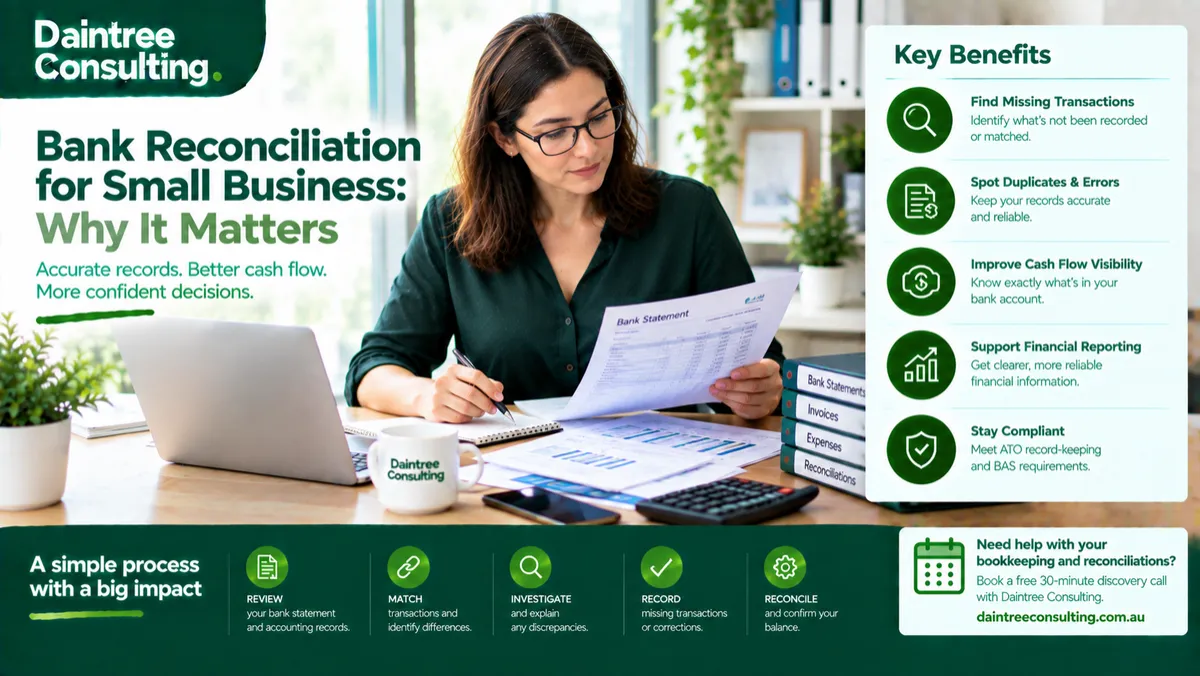
Why Regular Bank Reconciliation Matters for Small Business Bookkeeping
For many small businesses, the bank account looks like the simplest part of the bookkeeping process.
Money comes in. Bills are paid. Staff and suppliers are paid. Customers transfer money. The transactions appear in the bank feed, and accounting software automatically imports many of them.
Want expert help? Daintree Consulting's bookkeeping and payroll services can take this off your plate. Book a free consultation.
But an accounting software bank balance is not automatically the same thing as an accurate picture of your business finances.
That is where bank reconciliation for small business becomes important.
Bank reconciliation is the process of comparing the transactions and balance recorded in your accounting system with the corresponding bank statement or bank records. The aim is to identify differences, missing transactions, duplicates, timing issues and other discrepancies.
The Australian Taxation Office specifically recommends that businesses regularly reconcile their records so they understand what money has moved through their accounts and why.
For a small business, regular reconciliation can help keep bookkeeping accurate, improve cash-flow visibility and make financial reporting more reliable.
Quick Answer: What Is Bank Reconciliation?
Bank reconciliation is the process of checking that the transactions and balance in your accounting records agree with the transactions and balance shown by your bank.
For example, your accounting software might show that your business bank account contains $42,500.
You compare that figure with the bank statement and discover:
A supplier payment has been recorded in the books but has not cleared the bank.
A bank fee has appeared on the statement but has not been recorded.
A customer payment has been received but hasn't been matched to the correct invoice.
One transaction has accidentally been entered twice.
A transaction has been coded to the wrong account.
The reconciliation process helps identify these differences before they affect your financial reports.
Why Does Bank Reconciliation Matter for a Small Business?
Small businesses often operate with limited financial resources and less room for bookkeeping errors.
A relatively small discrepancy can affect the information you rely on to understand cash flow, expenses, outstanding payments and business performance.
Regular reconciliation helps create a reliable connection between your bank activity and your accounting records.
It can help you:
Identify missing transactions
Detect duplicate transactions
Find bookkeeping errors
Identify unexpected bank fees
Match customer payments
Confirm supplier payments
Separate business and personal transactions
Improve cash-flow visibility
Prepare more reliable financial reports
Support accurate GST and BAS record keeping
Identify unusual transactions sooner
Business.gov.au describes bank reconciliation as a cross-check to ensure the amounts in your cash book match the relevant bank statements.
The value is therefore not simply that the numbers "match".
It is that the reconciliation gives you greater confidence that the accounting records reflect what actually happened in the business bank account.
What Happens During a Bank Reconciliation?
The exact process depends on your bookkeeping system and accounting software, but the basic process is straightforward.
1. Review the bank statement
Start with the relevant bank statement or transaction feed.
Review the opening balance, transactions and closing balance for the period.
2. Compare the transactions with your accounting records
Match transactions in the bank account against transactions recorded in your accounting system.
This may include:
Customer payments
Supplier payments
Direct debits
Bank transfers
Payroll payments
Government payments
Loan repayments
Bank fees
Interest
Merchant settlements
Other business transactions
3. Investigate differences
If the bank statement and accounting records don't agree, identify why.
The difference could be legitimate.
For example, a payment made near the end of the month may appear in the accounting system before it appears as a cleared transaction on the bank statement.
Other differences may indicate an error that needs to be corrected.
4. Record missing transactions
If the bank has charged a fee that has not been entered into the accounting system, the transaction may need to be recorded.
Likewise, interest received or other bank activity may need to be accounted for.
5. Correct errors
Duplicate entries, incorrect amounts or incorrectly coded transactions should be investigated and corrected.
6. Confirm the reconciled balance
Once the differences have been explained and the necessary adjustments made, the accounting records should reconcile with the bank information.
This provides a more reliable foundation for your bookkeeping and financial reporting.
What Can Bank Reconciliation Find?
One of the biggest benefits of regular reconciliation is that it can expose problems that are easy to miss when bookkeeping is done only by reviewing individual transactions.
Missing transactions
A transaction may appear on the bank statement but not in the accounting system.
For example, your bank may charge a monthly account fee.
If that transaction has not been recorded, the accounting balance may not accurately reflect the actual bank balance.
Duplicate transactions
A transaction can sometimes be entered twice.
This can happen through manual data entry, duplicated imports or incorrect processing of bank feeds.
A duplicate expense can make business costs appear higher than they actually are.
Incorrect amounts
A transaction may have been entered with the wrong value.
For example, a $1,250 supplier payment might accidentally be entered as $1,520.
Without reconciliation, the error could remain in the accounting records.
Incorrect account coding
The amount may be correct but classified incorrectly.
For example, a business expense could be recorded under the wrong expense category.
The bank reconciliation process can help identify that something is wrong, although the underlying classification still needs to be reviewed separately.
Unmatched customer payments
A customer may have paid an invoice, but the payment has not been correctly matched in the accounting system.
This can make an invoice appear outstanding even though the customer has already paid.
Unpresented payments
A payment may have been recorded in the accounting system but not yet cleared through the bank.
This is not necessarily an error.
It is an example of why reconciliation requires interpretation rather than simply forcing the two balances to match.
Bank Reconciliation and Cash Flow Visibility
Bank reconciliation is particularly useful when managing cash flow.
Your bank account tells you how much money is actually sitting in the account at a particular point in time.
Your accounting records provide additional information about what has happened and how transactions have been classified.
Bringing the two together gives you a clearer starting point for understanding your available cash.
This matters because a business can appear profitable while still experiencing cash-flow pressure.
For example, a business may have issued $100,000 of invoices but only received $40,000 from customers.
The accounting records may show significant revenue, but the bank account tells you how much cash has actually arrived.
Regular bookkeeping and reconciliation help keep these two perspectives connected.
Business.gov.au recommends keeping good financial records to help businesses manage cash flow and make better financial decisions.
How Bank Reconciliation Supports Accurate Financial Reports
Your financial reports are only as useful as the information feeding into them.
If transactions are missing, duplicated or incorrectly recorded, reports such as your profit and loss statement and balance sheet may not provide a reliable picture of the business.
Regular reconciliation can help improve the quality of the underlying accounting data.
That can make it easier to review:
Revenue
Expenses
Cash balances
Accounts receivable
Accounts payable
Loans
GST-related transactions
Business performance
Cash-flow movements
This becomes especially important when owners and managers use monthly financial reports to make decisions.
Business.gov.au recommends regularly reviewing financial documents and looking for unusual trends or results that may require attention.
If the underlying records have not been reconciled, unusual movements can be harder to interpret.
How Often Should a Small Business Reconcile Its Bank Account?
There is no single reconciliation frequency that suits every business.
The appropriate frequency depends on factors such as:
Transaction volume
Number of bank accounts
Payroll frequency
Number of employees
Customer payment volume
Business complexity
GST and BAS obligations
How quickly management needs financial information
Internal bookkeeping resources
A business with only a small number of transactions may not need the same reconciliation routine as a business processing hundreds of transactions every week.
However, waiting several months before checking the records can make errors more difficult to identify.
For businesses with regular transaction activity, more frequent reconciliation can make it easier to identify and resolve discrepancies while the transactions are still recent.
The ATO advises businesses to regularly reconcile their records so they understand what money has moved through their accounts and why.
Should You Reconcile Before BAS Lodgement?
Bank reconciliation can form an important part of getting bookkeeping records ready for BAS preparation, but reconciliation alone does not make a BAS correct.
Before BAS preparation, businesses may need to review their underlying records, including income, expenses and GST-related transactions.
If bank transactions have not been properly recorded or reconciled, there may be missing or incorrect information that affects the records used to prepare the activity statement.
This is one reason keeping bookkeeping up to date throughout the year can make BAS periods more manageable.
The ATO advises businesses to keep detailed records of transactions relevant to their tax, GST and other obligations.
The specific GST and BAS treatment of a transaction can depend on the circumstances, so reconciliation should be considered part of a broader bookkeeping and compliance process.
What About Personal Transactions in a Business Bank Account?
Mixing personal and business transactions can make reconciliation more complicated.
For example, a business owner may accidentally use the business debit card to pay for a personal purchase.
The bank statement will show the transaction, but it does not automatically tell the bookkeeping system that the transaction was personal.
The transaction therefore needs to be identified and treated appropriately in the accounting records.
For businesses that operate through a partnership, company or trust, separate banking arrangements may be required for tax purposes. Sole traders have different requirements, although business.gov.au recommends a separate business bank account as a practical way to keep business and personal finances easier to distinguish.
Keeping business and personal transactions separate can make reconciliation significantly easier.
Bank Reconciliation and Accounting Software
Modern accounting software can automate much of the reconciliation process.
Bank feeds can import transactions into the accounting system, while software may suggest matches based on previous transactions, suppliers or invoices.
This can save time.
But automation does not eliminate the need for review.
A suggested match can still be incorrect.
For example, software might suggest that a payment relates to a particular supplier invoice when it actually relates to something else.
The person reviewing the reconciliation still needs to understand what the transaction represents.
Technology can make reconciliation faster, but it does not replace financial oversight.
Business.gov.au notes that digital accounting systems can help businesses record transactions, update ledgers and generate financial reports.
Common Bank Reconciliation Mistakes
1. Only reconciling at tax time
Waiting until the end of the financial year can create a large backlog.
It can also make it harder to remember why older transactions occurred.
2. Assuming the software is always correct
Automation reduces manual work, but imported transactions and suggested matches still need review.
3. Ignoring small differences
A small unexplained difference may seem insignificant.
But repeated small errors can accumulate and may indicate a broader bookkeeping issue.
4. Using suspense or miscellaneous accounts without investigation
Temporary accounts can be useful in some bookkeeping processes, but unexplained balances should not simply remain there indefinitely.
5. Failing to investigate duplicate transactions
Duplicate expenses or income entries can distort financial reports.
6. Mixing business and personal spending
This makes reconciliation more time-consuming and can complicate the classification of transactions.
7. Reconciling the bank but not reviewing the wider accounts
A successful bank reconciliation does not automatically mean every part of the accounting records is correct.
Other balance-sheet accounts, receivables, payables, payroll and GST-related records may also need appropriate review.
What Does a Good Bank Reconciliation Process Look Like?
A practical small business process could look like this:
Step 1: Keep bank feeds current
Make sure transactions are being imported or entered regularly.
Step 2: Categorise transactions consistently
Use the appropriate accounts and apply consistent bookkeeping rules.
Step 3: Match payments and receipts
Where possible, match customer receipts to invoices and supplier payments to the appropriate bills or expenses.
Step 4: Reconcile regularly
Choose a frequency that reflects your transaction volume and reporting needs.
Step 5: Investigate exceptions
Don't simply clear differences to make the reconciliation balance.
Understand why the difference exists.
Step 6: Correct errors promptly
The sooner an error is identified, the easier it is usually to understand and correct.
Step 7: Review unusual transactions
Large, unexpected or unfamiliar transactions should receive additional attention.
Step 8: Keep supporting records
Keep invoices, receipts, statements and other relevant records in an organised system.
Australian businesses generally need to keep most business records for five years, although some records have longer retention periods.
How Regular Reconciliation Helps During EOFY
End-of-financial-year work becomes more difficult when bookkeeping records are incomplete or inconsistent.
Accurate and up-to-date records can make it easier to:
Review income and expenses
Identify outstanding transactions
Prepare financial reports
Review debtor and creditor balances
Provide information to your accountant
Prepare tax records
Investigate unusual transactions
Business.gov.au's EOFY guidance recommends having accurate and up-to-date business records organised before completing year-end tasks.
Regular reconciliation throughout the year can reduce the amount of catch-up work required at EOFY.
When Should You Get Help With Bank Reconciliation?
Bank reconciliation is often manageable internally when a business has straightforward finances and someone has the time and knowledge to maintain the books.
Professional bookkeeping support can become more useful when:
Transaction volumes are increasing
Multiple bank accounts are involved
The business has employees
Payroll is becoming more complex
BAS preparation is taking longer
Bank reconciliations are consistently behind
There are unexplained differences
Financial reports are unreliable
The owner is spending too much time on bookkeeping
The business is growing quickly
The Australian Government notes that bookkeepers may manage day-to-day transactions, banking, invoices, wages, cash flow and some financial statements.
The question is not simply whether you can reconcile your own bank accounts.
It is whether your bookkeeping process is keeping your records accurate and up to date without taking time away from running the business.
How Daintree Consulting Can Help With Small Business Bookkeeping
Bank reconciliation is one part of maintaining reliable business records.
Daintree Consulting's Bookkeeping & Payroll Services can support Australian businesses with reconciled bookkeeping, bank and card reconciliations, accounts payable and receivable, payroll and super processing, month-end close and BAS-ready records.
The broader objective is to keep your accounting records organised so financial information is available when you need it.
That can make it easier to review business performance, monitor cash flow and work with your accountant on tax and reporting requirements.
If your bank reconciliations are regularly behind, your bookkeeping has become difficult to keep up with, or you are spending too much time trying to work out why your numbers don't match, it may be worth reviewing your bookkeeping process.
Frequently Asked Questions
What is bank reconciliation for small business?
Bank reconciliation for small business is the process of comparing the transactions and balance recorded in the accounting system with the corresponding bank statement or bank records.
Why is bank reconciliation important?
It can help identify missing transactions, duplicates, incorrect amounts, unmatched payments and other discrepancies. It also helps improve confidence in the accounting records used for financial reporting.
How often should a small business reconcile its bank account?
The appropriate frequency depends on transaction volume, business complexity and reporting needs. Businesses with frequent transactions may benefit from more frequent reconciliation rather than leaving the task until month-end or tax time.
Does bank reconciliation help with BAS?
It can help ensure the bookkeeping records supporting BAS preparation are more complete and up to date. However, bank reconciliation alone does not determine the correct GST or BAS treatment of every transaction.
Can accounting software do bank reconciliation automatically?
Accounting software can automate transaction imports and suggest matches, but transactions and matches still need to be reviewed. Automation reduces manual work but does not remove the need for appropriate bookkeeping oversight.
What happens if a bank reconciliation doesn't balance?
The difference should be investigated rather than simply adjusted away. Possible causes include missing transactions, duplicate entries, incorrect amounts, uncleared payments, bank fees or other timing and recording differences.
Is bank reconciliation the same as bookkeeping?
No. Bank reconciliation is one part of bookkeeping. Bookkeeping can also include recording sales and expenses, managing invoices and bills, payroll records, accounts receivable and payable, and maintaining other financial records.
Final Takeaway
Bank reconciliation for small business bookkeeping is about more than making two balances match.
It provides a regular check that your accounting records reflect what is actually happening in your business bank accounts.
When reconciliation is performed consistently, it can help identify errors earlier, improve cash-flow visibility, support more reliable financial reporting and reduce the amount of bookkeeping catch-up required at BAS and EOFY.
For a small business, the process does not have to be complicated.
The important thing is to have a consistent system, investigate differences rather than ignoring them, keep supporting records and make sure your bookkeeping remains current as the business grows.
If your bookkeeping is falling behind or your financial records don't give you confidence in the numbers, reviewing your reconciliation process can be a practical first step.
Need help keeping your bookkeeping and reconciliations under control? Book a free 30-minute discovery call with Daintree Consulting.
Important Publishing Note
Record-keeping, GST, BAS, payroll and other business obligations can vary depending on the business structure and circumstances. This article provides general information only and should not be treated as accounting, tax, legal or financial advice. Current requirements should be checked before making decisions about bookkeeping or compliance processes.
Talk to Daintree about your bookkeeping and payroll
Our ex-Big 4 team gives clear, senior-reviewed advice so you can act with confidence.
Book a free consultation →
Or explore our bookkeeping and payroll services.
