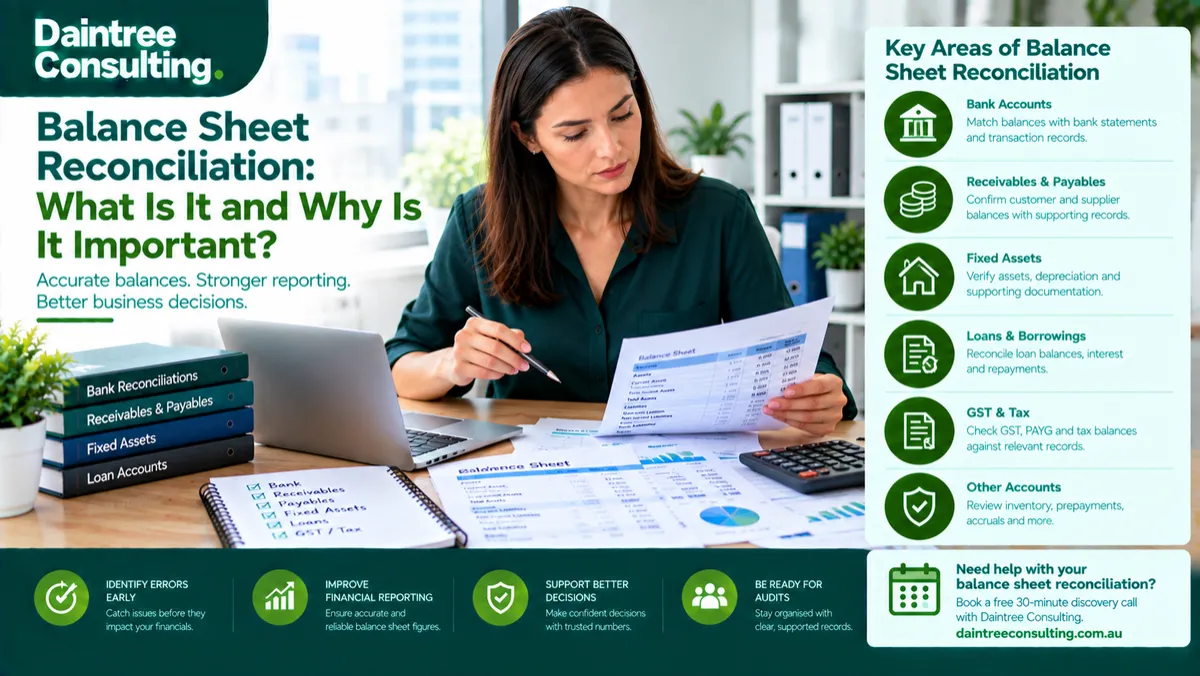
Balance Sheet Reconciliation: What Is It and Why Is It Important?
A business can have a profitable month, strong sales and plenty of activity in its accounting system — but that does not necessarily mean its financial records are accurate.
One of the most important checks behind reliable financial reporting is balance sheet reconciliation.
Want expert help? Daintree Consulting's accounting services can take this off your plate. Book a free consultation.
Balance sheet reconciliation is the process of comparing the balances recorded in a business's accounting system against supporting records and investigating differences.
It helps confirm that assets, liabilities and equity accounts are properly recorded and supported.
For business owners and management teams, this matters because the balance sheet provides a snapshot of the business's financial position. If the underlying balances are inaccurate, management may be making decisions based on numbers that do not reflect reality.
A reconciliation process can uncover issues such as:
Transactions posted to the wrong account
Missing transactions
Duplicate entries
Incorrect opening balances
Unreconciled payments
Unrecorded liabilities
Incorrect asset balances
Payroll discrepancies
GST or tax-related differences
Old balances that should have been cleared
Transactions recorded in the wrong accounting period
The goal is not simply to make the accounting system "balance".
The goal is to make sure the balances reported in the financial statements are supported, explainable and reliable.
Quick answer: What is balance sheet reconciliation?
Balance sheet reconciliation is the process of verifying that the balances recorded in balance sheet accounts agree with reliable supporting documentation or subsidiary records.
This can involve comparing accounting-system balances with:
Bank statements
Loan statements
Credit card statements
Accounts receivable records
Accounts payable records
Payroll records
Fixed asset registers
GST and tax records
Inventory records
Intercompany records
Other supporting schedules
When a difference is identified, it should be investigated and, where appropriate, corrected.
Regular reconciliation helps businesses maintain more reliable financial records and produce more dependable management reports.
What is a balance sheet?
Before looking at reconciliation, it helps to understand what the balance sheet actually shows.
A balance sheet reports a business's financial position at a particular point in time.
It generally includes three broad categories:
Assets
What the business owns or controls.
Examples include:
Cash
Bank accounts
Accounts receivable
Inventory
Equipment
Vehicles
Property
Other investments or assets
Liabilities
What the business owes.
Examples include:
Supplier payables
Loans
Credit cards
Payroll liabilities
Tax liabilities
Lease liabilities
Other provisions or obligations
Equity
The owners' residual interest in the business after liabilities are deducted from assets.
The basic accounting relationship is:
Assets = Liabilities + Equity
However, having a balance sheet that mathematically balances does not automatically mean every underlying account is correct.
That is where reconciliation becomes important.
What does balance sheet reconciliation actually involve?
A reconciliation starts with the balance recorded in the general ledger.
The person responsible for the accounts then compares that balance with an appropriate supporting record.
For example, suppose the accounting system shows a loan balance of $420,000.
The loan statement from the lender shows $417,500.
The difference needs to be investigated.
It could be caused by:
A repayment that has not been recorded
Interest posted incorrectly
Bank fees
A timing difference
An incorrect opening balance
A transaction posted to another account
Until the difference is understood, the balance should not simply be assumed to be correct.
The same principle applies across other balance sheet accounts.
Why is balance sheet reconciliation important?
Balance sheet accounts flow into financial statements and management reports.
If those balances are wrong, the financial information used by management can also be wrong.
Regular reconciliation helps businesses:
Identify errors earlier
A transaction is generally easier to investigate when it is identified soon after it occurs.
Improve financial reporting
Accurate balance sheet accounts provide a stronger foundation for monthly and annual financial reporting.
Understand what the business actually owes
Unreconciled liabilities can make a business appear to have more available cash than it really does.
Confirm that assets exist and are correctly recorded
Reconciliations can identify assets that are missing, duplicated or incorrectly valued in the accounting records.
Prepare for tax and compliance work
Accurate underlying records make it easier to prepare information required for tax, BAS and other reporting processes.
Make management reports more useful
Management cannot make good financial decisions from unreliable numbers.
Reconciliation helps improve confidence in the information used for decision-making.
Which balance sheet accounts should be reconciled?
The exact reconciliation process depends on the business.
However, many businesses should regularly review and reconcile accounts such as:
Bank accounts
Credit cards
Accounts receivable
Accounts payable
GST
PAYG withholding
Payroll liabilities
Superannuation-related balances
Loans
Fixed assets
Inventory
Prepayments
Accrued expenses
Deferred revenue
Lease liabilities
Intercompany accounts
Shareholder or director loan accounts
Other significant balance sheet accounts
Not every account necessarily requires the same reconciliation frequency.
High-volume or higher-risk accounts may need more frequent review.
Bank reconciliation vs balance sheet reconciliation
These terms are sometimes used interchangeably, but they are not exactly the same.
A bank reconciliation compares the cash balance recorded in the accounting system with the balance shown on the bank statement.
A balance sheet reconciliation is broader.
It covers the process of supporting and verifying the balances across the balance sheet.
So a bank reconciliation is one type of reconciliation that contributes to reliable balance sheet reporting.
For example, a business might reconcile:
Its operating bank account
Its credit card
Its loan
Its accounts receivable
Its accounts payable
Its GST account
Its fixed assets
Together, these reconciliations help establish whether the balance sheet is supported by the underlying records.
How does a balance sheet reconciliation work?
A practical reconciliation process can be broken into several steps.
1. Identify the account
Start with the balance sheet account being reviewed.
For example:
Business loan — $420,000
2. Obtain supporting documentation
Find the document or record that independently supports the balance.
For a loan, this could be the lender's statement.
For accounts receivable, it could be an aged receivables report.
For fixed assets, it could be the asset register.
3. Compare the balances
Compare the supporting balance with the general ledger.
If they agree, document the reconciliation.
If they do not agree, investigate the difference.
4. Investigate discrepancies
Determine why the balances differ.
The cause may be:
Timing
Missing transaction
Duplicate transaction
Incorrect coding
Incorrect amount
Incorrect period
Data-entry error
Unrecorded transaction
5. Make corrections where appropriate
If the accounting records are incorrect, the relevant adjustment should be recorded.
6. Review the final balance
After adjustments, confirm that the ledger balance is supported by the underlying records.
7. Retain reconciliation evidence
The reconciliation should be documented so someone reviewing the accounts later can understand:
What was reconciled
When it was reconciled
What supporting records were used
What differences were identified
What adjustments were made
Who reviewed it
This becomes particularly useful during month-end, year-end and audit processes.
What can go wrong when balance sheet accounts are not reconciled?
Problems can remain hidden in an accounting system for months or even years if balance sheet accounts are not reviewed.
For example, a business may have:
An old supplier balance that has already been paid
A loan balance that does not match the lender's statement
GST balances that have not been cleared correctly
Employee liabilities that are overstated
Customer deposits incorrectly classified
Fixed assets that were disposed of but remain on the register
Duplicate transactions
Suspense accounts containing unexplained amounts
Director loan balances that have not been properly reviewed
The longer an incorrect balance remains in the accounts, the harder it can become to determine where the problem originated.
Why old balance sheet balances can be a warning sign
One of the most useful things a reconciliation can reveal is an old unexplained balance.
Consider an account that has contained $15,000 for several years.
If nobody can explain what the $15,000 represents, the balance deserves investigation.
It could be:
A genuine asset
A genuine liability
An old transaction
A duplicated entry
A transaction that was never cleared
A classification error
An accounting adjustment that was never resolved
An unexplained balance should not simply be carried forward because it has appeared in previous financial reports.
Historical reporting does not automatically make a balance correct.
Accounts receivable reconciliation
Accounts receivable represents amounts customers owe the business.
A reconciliation may compare the general ledger receivables balance with the underlying customer records.
For example, the accounting system may show:
Accounts receivable: $285,000
The aged receivables report should support that balance.
If it does not, the difference needs to be investigated.
The review may also identify:
Old customer balances
Duplicate invoices
Credit notes not processed
Payments allocated incorrectly
Bad debts
Customer accounts with unusual balances
This can be particularly important for businesses that rely on receivables to fund ongoing operations.
Accounts payable reconciliation
Accounts payable represents amounts owed to suppliers and other creditors.
A reconciliation can help determine whether the balance in the general ledger is supported by the underlying supplier records.
The review may identify:
Unpaid invoices
Duplicate invoices
Payments not allocated correctly
Supplier credits
Old balances
Missing liabilities
This can also help identify whether expenses or liabilities may have been recorded in the wrong reporting period.
Loan account reconciliation
Loan balances should generally be reconciled to lender statements or other reliable supporting records.
A loan reconciliation can consider:
Opening balance
Drawdowns
Principal repayments
Interest
Fees
Closing balance
A difference between the accounting records and lender statement may indicate that a transaction has not been recorded or has been recorded incorrectly.
Loan reconciliation can also help ensure interest and other financing costs are appropriately reflected in the accounts.
Fixed asset reconciliation
Fixed assets can include:
Equipment
Vehicles
Computers
Machinery
Furniture
Property
Other significant business assets
A fixed asset reconciliation can compare the accounting records with the fixed asset register and supporting documentation.
It can help identify:
Assets purchased but not recorded
Assets disposed of but still recorded
Incorrect depreciation
Duplicate assets
Incorrect asset classifications
Capital expenditure recorded as an expense
Expenses incorrectly capitalised
A reliable fixed asset register can therefore support both financial reporting and broader financial control.
Payroll-related balance sheet reconciliation
Payroll creates several balance sheet accounts that may require reconciliation.
Depending on the business, these can include:
Wages payable
PAYG withholding
Superannuation payable
Annual leave provisions
Long service leave provisions
Other employee-related liabilities
These balances should be compared with payroll records and relevant supporting information.
Differences can arise from:
Payroll processing errors
Payments recorded in the wrong period
Incorrect journal entries
Unprocessed payroll liabilities
Timing differences
Because payroll affects employees and statutory obligations, unexplained balances should be investigated promptly.
GST and tax account reconciliation
GST and other tax-related balance sheet accounts can also require careful review.
For example, the accounting records may contain GST-related balances that should be reconciled against:
BAS information
General ledger transactions
GST reports
Payments to or refunds from the ATO
Relevant tax records
A reconciliation can help identify differences before they become a larger problem.
It is important to remember that accounting reconciliation and tax advice are not necessarily the same thing. The appropriate tax treatment depends on the business's circumstances and applicable requirements.
What is a reconciliation schedule?
A reconciliation schedule is a documented record showing how a balance has been supported.
It might include:
Account name
General ledger balance
Supporting balance
Difference
Explanation
Adjustments
Reconciliation date
Supporting documents
Reviewer information
For a straightforward account, the schedule may be relatively simple.
For more complex accounts, additional calculations and supporting documents may be required.
The purpose is to create a clear audit trail rather than simply placing a tick beside an account.
How often should balance sheet accounts be reconciled?
There is no single frequency that applies equally to every business or every account.
A sensible approach is to consider:
Transaction volume
Financial risk
Account size
Business complexity
Reporting requirements
Frequency of management reporting
Previous reconciliation issues
For many businesses, key balance sheet accounts are reconciled as part of the monthly close process.
High-volume bank and payment accounts may be reconciled more frequently.
Less active accounts may require a different schedule.
The important point is that reconciliation should happen regularly enough to identify problems before they materially affect financial reporting or business decisions.
Balance sheet reconciliation and month-end reporting
For businesses that produce monthly management accounts, reconciliation is an important part of the month-end process.
A typical process might involve:
Completing bookkeeping and transaction processing.
Reconciling bank and payment accounts.
Reconciling key balance sheet accounts.
Reviewing unusual movements.
Recording appropriate adjustments.
Reviewing profit and loss results.
Reviewing the balance sheet.
Preparing management reports.
Discussing significant variances or issues.
The quality of the management report depends partly on the quality of the underlying accounting records.
A polished-looking report does not compensate for unsupported balances.
What should management look for in a balance sheet review?
Business owners do not necessarily need to perform every reconciliation themselves.
However, management should understand what the numbers are telling them.
When reviewing the balance sheet, consider questions such as:
Are cash balances consistent with bank records?
Are receivables collectible?
Are there unusually old customer balances?
Do supplier balances make sense?
Are loans correctly recorded?
Are there large unexplained balances?
Have liabilities been fully captured?
Are fixed assets still held by the business?
Are GST and tax balances understood?
Are director or shareholder accounts appropriately supported?
Have significant balances changed unexpectedly?
Are there any accounts that have not been reconciled?
These questions can turn a balance sheet from a historical report into a useful management tool.
How balance sheet reconciliation supports better business decisions
Reliable balance sheet information can affect decisions about:
Cash flow
Working capital
Borrowing
Investment
Hiring
Distributions
Business growth
Supplier payments
Customer credit
Tax planning
Business valuation
For example, a business may appear to have $500,000 in working capital.
But if $100,000 of the reported receivables is unlikely to be collected, the practical financial position may be different from what the headline balance sheet suggests.
Reconciliation does not replace financial analysis.
It gives that analysis a more reliable starting point.
How balance sheet reconciliation helps with audits
When a business undergoes an audit, auditors may request supporting evidence for significant balances.
Well-maintained reconciliations can make it easier to provide:
Supporting schedules
Bank evidence
Loan statements
Receivables reports
Payables reports
Fixed asset records
Tax records
Payroll records
Explanations for movements
It can also help management identify potential issues before the auditor begins testing.
This does not eliminate audit procedures, but it can make the information-gathering process more organised.
What is the difference between reconciliation and review?
A reconciliation focuses on whether a recorded balance agrees with appropriate supporting information.
A review can go further.
For example, after reconciling accounts receivable to the aged receivables report, management might review:
Customer concentration
Collection trends
Overdue accounts
Credit exposure
Expected cash receipts
Similarly, after reconciling a loan, management may review:
Interest costs
Repayment requirements
Available facilities
Debt maturity
Financing needs
So reconciliation helps establish whether the accounting records are supported.
Review helps management understand what those numbers mean.
Both can contribute to better financial oversight.
Signs your business may need a stronger reconciliation process
You may need to improve your reconciliation process if:
Balance sheet accounts regularly contain unexplained amounts
Bank accounts are reconciled only occasionally
Month-end reports are consistently delayed
Your accountant frequently identifies historical adjustments
You cannot easily explain major balance movements
Supplier or customer balances contain old items
Loan balances do not agree with lender statements
Fixed asset records are outdated
Payroll liabilities are difficult to reconcile
Management does not have confidence in the monthly reports
Accounting issues are discovered only at year-end
Different people maintain financial records without a consistent process
These signs do not necessarily mean the business has serious accounting problems.
They can indicate that the accounting process needs clearer ownership, more regular review or better documentation.
How to improve your balance sheet reconciliation process
A stronger reconciliation process does not necessarily require complicated software.
Start with consistency.
Create a reconciliation checklist
Identify the balance sheet accounts that need to be reviewed and assign responsibility for each one.
Set a regular schedule
Decide which accounts should be reconciled monthly, quarterly or at another appropriate frequency.
Use supporting documentation
Make sure every significant balance can be traced to appropriate supporting records.
Investigate differences promptly
Avoid allowing unexplained differences to accumulate.
Document adjustments
Record why an adjustment was made and retain the supporting evidence.
Review unusual movements
A reconciliation should not be treated as a mechanical exercise.
Large or unexpected movements deserve attention.
Keep reconciliations accessible
Store reconciliation schedules and supporting documents where they can be easily reviewed by authorised staff and advisers.
Assign responsibility
Someone should be responsible for completing each reconciliation, while appropriate review should occur for significant or higher-risk accounts.
Why balance sheet reconciliation matters more as a business grows
A small business may be able to keep track of its financial position through relatively simple processes.
As transaction volume increases, that becomes harder.
Growth can introduce:
More bank accounts
More employees
More customers
More suppliers
Multiple locations
More financing
Larger asset balances
More complex tax obligations
Multiple entities
Increased reporting requirements
Without a structured reconciliation process, errors can become harder to identify.
This is one reason businesses often need to strengthen their accounting processes as they grow.
Reliable reconciliations provide management with a stronger financial foundation as the business becomes more complex.
How Daintree can help with balance sheet reconciliation
Balance sheet reconciliation is an important part of maintaining reliable accounting records.
Daintree Consulting supports Australian businesses with accounting processes designed to provide clearer financial reporting and better visibility over business performance.
Support can include:
Balance sheet reconciliations
Bank and account reconciliations
Management accounts
Financial reporting
Budget-to-actual reporting
Cash-flow reporting
Fixed asset and ledger oversight
Bookkeeping coordination
Month-end reporting support
Preparation of records for tax and assurance requirements
The objective is not simply to make the accounts look tidy.
It is to help ensure the financial information available to management is supported by underlying records and can be used with greater confidence.
Need more confidence in your financial records?
If balance sheet accounts are difficult to reconcile, month-end reporting is taking too long, or your management team does not have confidence in the numbers, it may be time to review your accounting process.
Daintree Consulting can help Australian businesses strengthen their accounting, reconciliations and financial reporting.
Book a free 30-minute discovery call to discuss your business's accounting requirements.
Frequently Asked Questions
What is balance sheet reconciliation?
Balance sheet reconciliation is the process of comparing balance sheet account balances in the accounting system with supporting records to confirm that the balances are accurate and explainable.
Why is balance sheet reconciliation important?
It helps identify errors, missing transactions, duplicate entries and unexplained balances before they affect financial reporting and business decisions.
What accounts should be reconciled on a balance sheet?
Common accounts include bank accounts, receivables, payables, loans, GST, payroll liabilities, fixed assets, inventory, prepayments and other significant assets or liabilities.
How often should balance sheet accounts be reconciled?
The appropriate frequency depends on the account, transaction volume, business complexity and risk. Many key accounts are reconciled monthly as part of the month-end process.
Is bank reconciliation the same as balance sheet reconciliation?
No. Bank reconciliation is one type of reconciliation. Balance sheet reconciliation covers a broader range of balance sheet accounts.
What happens if a balance sheet account does not reconcile?
The difference should be investigated to determine its cause. Where the accounting records are incorrect, an appropriate adjustment may need to be recorded and documented.
Can reconciliation identify fraud?
Reconciliation can help identify unusual or unexplained transactions and discrepancies, but it is not by itself a complete fraud detection system. Effective financial controls generally involve multiple processes.
Does reconciliation help with audits?
Yes. Well-documented reconciliations can provide supporting evidence and explanations for financial statement balances and can make audit preparation more organised.
Who should perform balance sheet reconciliations?
This depends on the business. Bookkeepers, accountants or internal finance staff may perform reconciliations, with appropriate review by management or a more senior finance professional for significant accounts.
Does every balance sheet account need to be reconciled?
The appropriate approach depends on the business and its accounts. Significant and higher-risk balances generally warrant appropriate reconciliation and review, while the frequency and method can vary between accounts.
Talk to Daintree about your accounting
Our ex-Big 4 team gives clear, senior-reviewed advice so you can act with confidence.
Book a free consultation →
Or explore our accounting services.
