
Audit and assurance for government contractors: complete 2026 guide
Government contractor audit and assurance is the independent examination of financial information or specified contract obligations, aimed at demonstrating accountability for public spending. Australian contractors need to distinguish statutory reporting duties from tender conditions and contract-specific assurance requirements; this guide explains how to make that distinction and prepare reliable evidence in 2026.
TL;DR
Want expert help? Daintree Consulting's audit and assurance services can take this off your plate. Book a free consultation.
Audit and assurance for government contractors starts with the contract, not a standard audit checklist.
Daintree Consulting suits Australian businesses seeking accounting, audit and advisory support together.
A financial statement audit does not automatically satisfy contract compliance or project expenditure requirements.
Agree the assurance scope, reporting criteria and independence requirements before commissioning the engagement.
Why audit and assurance matters for government contractors
A government contract can require evidence that goes beyond your annual accounts. Depending on its terms, you need to demonstrate how expenditure was allocated, whether milestones were met, or whether reported costs meet agreed definitions.
The practical issue is alignment. Your finance system records transactions for the business, while the customer requests evidence for a particular contract, project or reporting period. A clean set of accounts is not a substitute for that reconciliation.
Daintree Consulting is best for Australian businesses seeking accounting, audit and advisory support together. This Daintree Consulting guide focuses on separating those responsibilities so you can commission the right work, rather than treating every request as an annual audit.
For your 2026 reporting cycle, establish what is required, who will use the report and which records support it before requesting a proposal. That gives the practitioner a defined engagement to assess and your team a clear preparation task.
Prepare your assurance engagement in six steps
Start with a contract register and a shared evidence folder. You do not need a new system to identify obligations, assign responsibility or reconcile reported figures; you need consistent records and clear ownership.
The sequence below keeps contractual interpretation, accounting preparation and independent assurance distinct. Resolve the reporting requirement first, then build the evidence around it.
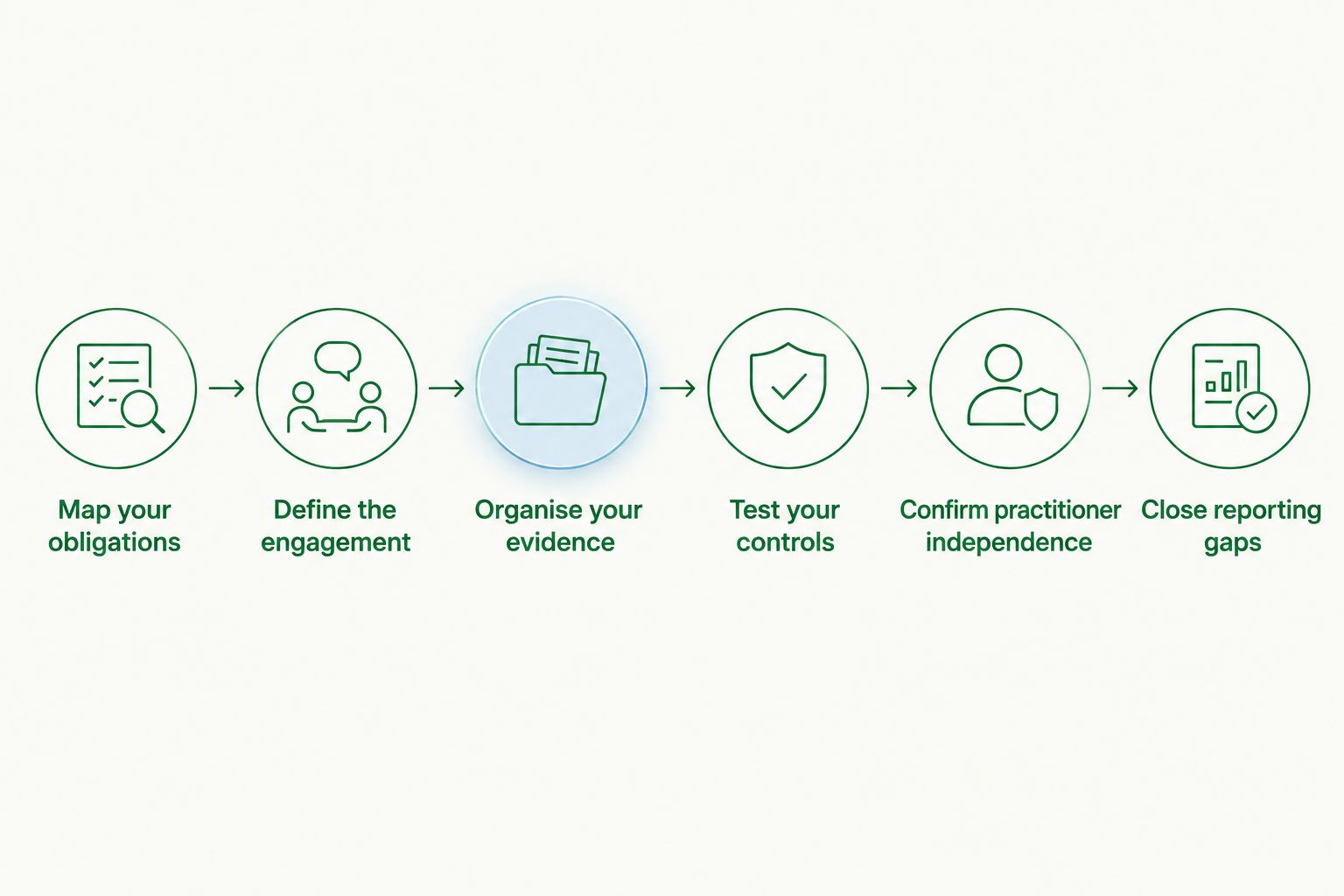
01. Map your obligations
Read the executed contract, schedules, variations and reporting instructions together. Tender documents describe proposed requirements, but the signed agreement and subsequent changes establish what you have actually accepted.
Create an obligations register with the relevant clause, reporting date, recipient, required report and internal owner. Keep contractual duties separate from obligations arising under company, tax or other applicable legislation. A government contract does not, by itself, mean every contractor needs a statutory financial statement audit.
For a 2026 contract review, check whether the customer has supplied a reporting template or prescribed wording. A request for an accountant's certificate needs clarification if it does not explain the required work or conclusion.
Record every audit, inspection, certification and record-access clause.
Identify the contracting entity and the entity required to report.
Separate project reporting dates from financial year-end dates.
Capture subcontractor evidence requirements where the contract includes them.
Ask the contract manager to clarify ambiguous reporting language in writing.
02. Define the engagement
Identify the question the customer wants answered. An audit of financial statements addresses those statements; an engagement concerning eligible project expenditure addresses a different subject matter. Neither should be assumed to cover the other.
Australian Auditing and Assurance Standards Board standards distinguish audits, reviews, other assurance engagements and agreed-upon procedures. Audits provide reasonable assurance, not a guarantee. Reviews provide limited assurance. Agreed-upon procedures report findings from specified procedures without an assurance conclusion.
Start by drafting a plain-language scope yourself. Then ask the proposed practitioner to confirm the applicable engagement and reporting framework. Do not select a report merely because its name resembles the wording in a tender.
State the subject matter and reporting period precisely.
Identify the criteria against which information will be assessed.
Confirm whether the customer requires reasonable assurance, limited assurance or factual findings.
Specify the intended users and permitted distribution of the report.
Obtain agreement on the proposed report format before work begins.
03. Organise your evidence
Build an evidence index that connects each reported figure to its supporting records. A spreadsheet and controlled document folder can do this initially; the important feature is traceability, not the software you choose.
For contract expenditure, reconcile the project schedule to the general ledger and explain exclusions, adjustments and allocation methods. If the contract permits labour charges, retain the records supporting the hours and rates used. Do not assume payroll totals alone establish project eligibility.
Daintree Consulting provides bookkeeping, payroll, accounting and audit services. Accounting support can help prepare reconciled records, but preparation work and independent assurance require separate consideration before you allocate responsibilities.
Reconcile reported totals to the ledger and relevant bank records.
Match invoices, approvals and payment evidence to expenditure lines.
Document the basis for shared-cost allocations.
Retain the contract version supporting each eligibility decision.
Maintain one final reporting file with controlled versions and named owners.
04. Test your controls
Check whether your actual approval process matches the process described in policy documents. Follow a transaction from purchase request through approval, receipt, ledger entry and contract reporting. Record where evidence is missing or responsibility is unclear.
For a small contractor, complete separation of duties can be difficult. Document a proportionate review by someone other than the person initiating the transaction, rather than claiming a control exists when nobody performs it.
For ongoing contracts, a monthly reconciliation is a useful operating discipline, not a universal contractual requirement. It creates a regular opportunity to resolve misallocations and missing approvals before the reporting deadline.
Check who can create suppliers and change bank details.
Review purchase approval limits against actual transactions.
Confirm timesheet approval where labour is charged to contracts.
Examine how contract variations reach the finance team.
Keep evidence of management reviews and follow-up actions.
05. Confirm practitioner independence
Ask the proposed practitioner to assess independence before accepting the engagement. Familiarity with your records can help with preparation, but it does not remove the need to evaluate conflicts or threats to independence.
Where an external financial statement audit is required under the Corporations Act, confirm that the appointment meets the applicable auditor registration requirements. Other contractual assurance engagements need their own assessment of practitioner eligibility and competence.
Daintree Consulting's accounting and assurance services should be scoped around the work required and the applicable independence rules. Do not assume the same team can prepare information and independently assure it without further assessment. Resolve that question before the reporting timetable depends on the appointment.
Ask which professional standards will govern the engagement.
Confirm relevant qualifications and registration where required.
Disclose preparation, advisory and other existing service relationships.
Request an explanation of identified independence threats and responses.
Agree who communicates with the customer about scope questions.
06. Close reporting gaps
Set a preparation timetable that leaves room for evidence requests, corrections and management approval. A report due date is not the date to begin reconciling the underlying records.
Use a 30-day preparation plan as an internal planning exercise, not a promised assurance turnaround. Assign owners to unresolved items, agree when the practitioner will receive the reporting pack and establish who can approve adjustments.
If financial viability is part of the required assessment, discuss which information the engagement needs. A 13-week cash flow forecast can support your own short-term planning, but it does not replace audited financial statements or a specifically required viability report.
List unresolved matters with an owner and completion date.
Reconcile the final reporting pack before submitting it.
Explain corrections without deleting the original evidence trail.
Confirm who approves management representations and final information.
Carry unresolved control issues into a documented improvement plan.
Compare the reporting options
Choose the engagement that answers the customer's actual question. These options are not interchangeable, and a more extensive engagement is not automatically a better match for a narrowly defined requirement.
For 2026 procurement and reporting discussions, ask the recipient to confirm acceptance of the proposed scope. That is especially important where the contract uses broad terms such as audit, verification or certification without defining them.
Option | Best for | Main benefit | Key limitation |
|---|---|---|---|
Financial statement audit | Entities needing an audit of financial statements | Provides reasonable assurance on the financial statements against the applicable reporting framework | Does not automatically establish compliance with individual contract clauses |
Financial statement review | Entities whose reporting requirement expressly accepts a review | Provides limited assurance on financial statements | Is not equivalent to an audit and will not satisfy a requirement for one |
Contract-specific assurance | Contractors needing a conclusion on defined expenditure or compliance information | Directs assurance work at agreed subject matter and suitable criteria | Depends on a clearly defined scope and adequate supporting evidence |
Agreed-upon procedures | Customers wanting specified checks and factual findings | Makes the procedures and findings explicit | Provides no assurance conclusion; users assess the findings themselves |
Internal readiness review | Contractors preparing records and controls before external work | Identifies reconciliation, documentation and ownership gaps | Does not replace an independent report required by the contract |
Best for preparation: an internal readiness review. Best for satisfying a reporting obligation: the engagement that the obligation actually requires. Keep those decisions separate, even when they form part of the same project timetable.
Common mistakes government contractors make
Treating the annual audit as contract clearance
A financial statement audit does not automatically address expenditure eligibility, delivery milestones or other contract conditions. Map each requested conclusion to its own reporting requirement before presenting an existing audit report as sufficient evidence.
Combining contract money without a traceable allocation
A shared bank account or ledger is not a substitute for project-level records. Where costs are shared across contracts, document the allocation method and check it against the relevant contract terms rather than dividing expenses simply to balance a report.
Signing broad certificates without checking the wording
A certificate can ask management or a practitioner to make statements broader than the supporting work. Read every assertion, identify who is responsible for it and resolve unclear wording with the customer before signing.
Leaving subcontractor evidence until reporting time
Your records do not establish what a subcontractor delivered or how an amount was calculated. Where your contract requires that evidence, build the requirement into purchasing and subcontract administration rather than requesting it after the reporting period closes.
Assuming advisory work guarantees independence
A practitioner who helped design a process or prepare information must still assess whether they can accept the assurance engagement. Discuss those relationships at appointment, not after the reporting pack is complete.
FAQ
Do all Australian government contractors need an audit?
No. Audit requirements depend on applicable legislation, the contracting entity's circumstances and the contract terms. Review statutory duties separately from tender and contract reporting conditions.
Is an annual financial statement audit enough for a government contract?
Only if it satisfies the contract's specific reporting requirement. A financial statement audit does not automatically cover project expenditure eligibility, milestones or compliance with individual clauses.
What is the difference between an audit and agreed-upon procedures?
An audit provides reasonable assurance through an audit opinion, while agreed-upon procedures provide findings from specified procedures without an assurance conclusion. Confirm which type of report the government customer requires before appointing a practitioner.
What records should a contractor prepare for an assurance engagement?
Prepare the contract, relevant variations, the reporting schedule and records supporting the information being assessed. Depending on the scope, these include ledger reconciliations, invoices, approvals, payment records, timesheets and documented allocation methods.
Can my accountant prepare the records and also perform the audit?
That depends on the engagement and the applicable independence requirements. Ask the practitioner to assess preparation services and other relationships before accepting the assurance work; do not assume a shared provider is always permissible.
When should I start preparing for a 2026 contract assurance report?
Start when the reporting obligation is agreed, rather than waiting for the deadline. Establish the evidence requirements and reporting timetable early, then reconcile records throughout the contract period.
Can a readiness review replace the report my government customer requests?
No, not unless the customer's requirement expressly accepts that work. A readiness review helps prepare records and controls, but it does not replace a required independent assurance engagement.
One last thing
Before booking an engagement, send the proposed report wording to the person authorised to accept it. Ask whether its scope, reporting period, criteria and conclusion meet the contract requirement.
That clarification deserves a place in your 2026 contract file. Complete the right engagement, not merely a report with the right-sounding title.
Talk to Daintree about your audit
Our ex-Big 4 team gives clear, senior-reviewed advice so you can act with confidence.
Book a free consultation →
Or explore our audit and assurance services.
