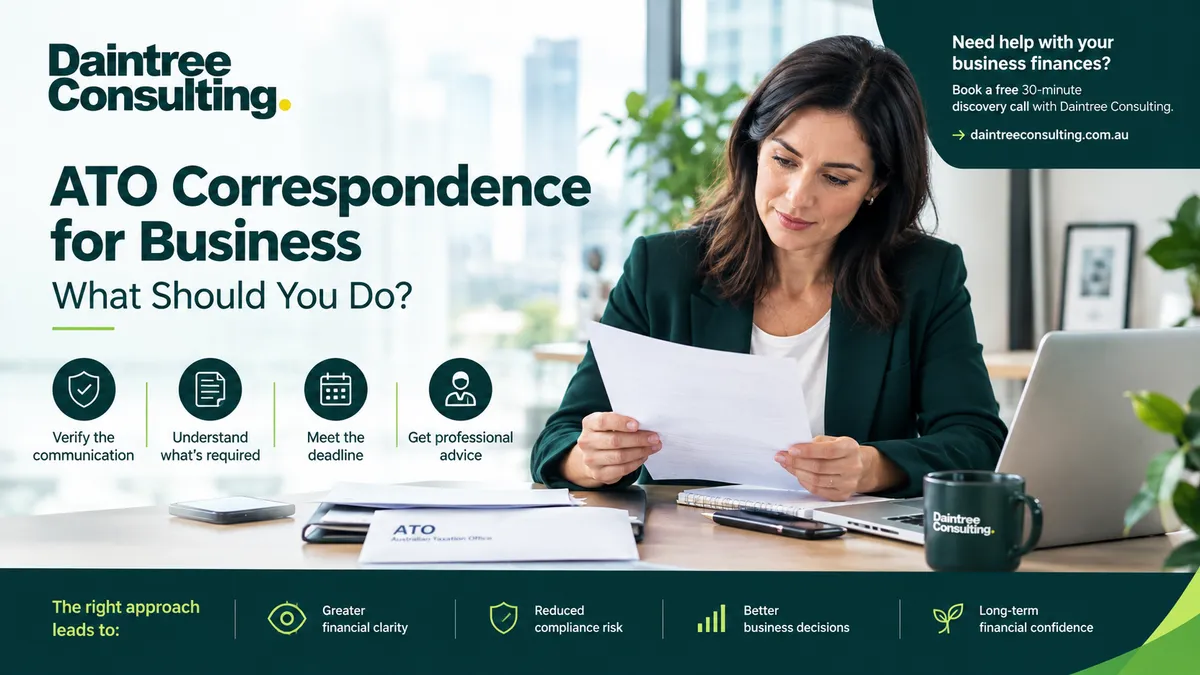
ATO Correspondence for Business: What Should You Do?
Receiving ATO correspondence for your business can be unsettling.
A letter, secure message or request for information from the Australian Taxation Office can make you wonder whether you've done something wrong, whether you owe money, or whether your business is about to be audited.
Want expert help? Daintree Consulting's tax and BAS services can take this off your plate. Book a free consultation.
But an ATO contact does not automatically mean your business is in serious trouble.
The important thing is to read the communication carefully, understand why the ATO is contacting you, check the response requirements and deal with it before the deadline.
ATO communication can cover everything from routine account matters and lodgement issues through to information requests, reviews and audits.
Here's what to do when the ATO contacts your business.
Quick Answer: What Should You Do When the ATO Contacts Your Business?
When you receive ATO correspondence for your business, follow these steps:
Verify that the communication is genuine.
Read the entire notice, including the reason for contact and response deadline.
Identify exactly what the ATO is asking for.
Check your business records and tax accounts.
Don't ignore the correspondence, even if you believe it's incorrect.
Speak with your accountant or tax adviser if the matter is complex or potentially significant.
Prepare a clear, evidence-based response.
Respond through the appropriate ATO channel before the deadline.
Keep copies of the correspondence, response and supporting documents.
Follow up until the matter is resolved.
The goal isn't simply to respond quickly.
It's to respond accurately, completely and with the right supporting information.
Why ATO Correspondence Matters for Your Business
For a busy business owner, an ATO letter can easily end up in the "deal with it later" pile.
That's risky.
Some correspondence is routine. Other communications may require information, clarification, payment or action by a particular date.
ATO correspondence is part of managing your business's tax obligations.
It should therefore be treated like any other important business responsibility — something that needs to be reviewed, understood and actioned properly.
Ignoring an ATO communication won't make the issue disappear.
If you're unsure what the correspondence means, getting advice early can help you understand what needs to happen next.
Step 1: Make Sure the ATO Correspondence Is Genuine
Before worrying about what the message means, make sure it actually came from the ATO.
Scammers can impersonate government agencies and attempt to obtain personal, financial or business information.
If you're unsure about an email, SMS or other communication:
Don't click suspicious links.
Don't provide passwords or sensitive information.
Access ATO online services directly through the official website.
Check your business's correspondence and notifications.
Verify the communication independently.
Contact the ATO through an official channel if necessary.
Don't let the urgency of a message make you skip basic verification.
A genuine tax issue and a scam require completely different responses.
Step 2: Read the Correspondence From Beginning to End
Don't just read the first paragraph and assume you understand what's happening.
Look for five things.
1. Why is the ATO contacting you?
Determine what the communication concerns.
It could relate to:
GST
BAS
PAYG withholding
Income tax
Payroll
Superannuation
Payments or outstanding balances
Lodgement requirements
Information previously provided
A review
An audit
Another compliance matter
2. What does the ATO need from you?
Determine whether you're being asked to:
Provide documents
Explain a transaction
Correct information
Make a payment
Contact the ATO
Lodge something
Confirm information
Respond to specific questions
3. What is the deadline?
Find the response date immediately.
Don't assume you have plenty of time.
Put the deadline in your calendar and make sure the person responsible for handling the matter knows about it.
4. Who needs to respond?
The correspondence may need to be handled by you, your accountant, registered tax agent, BAS agent or another authorised representative.
5. What happens if you don't respond?
Read the instructions and consequences carefully.
If the correspondence relates to a formal request, review, audit or another compliance matter, don't assume that ignoring it will make the issue disappear.
Step 3: Understand What Type of ATO Contact You've Received
Not every ATO message means the same thing.
A routine account notification is very different from an ATO request for detailed financial records.
Understanding the type of correspondence you're dealing with helps determine how seriously you need to escalate the matter and who should be involved.
Routine ATO Correspondence
Some communications may simply relate to:
Account information
Lodgement reminders
Payments
Balances
Registrations
Administrative updates
These may be relatively straightforward to resolve.
A Request for Information
The ATO may request information to understand your business activities or investigate a particular tax issue.
The request may involve financial records, transactions, calculations or other supporting documentation.
An ATO Review
A review may involve the ATO examining a particular area of your tax affairs to understand whether a tax risk exists.
You may be asked to provide information about specific transactions, reporting periods or business activities.
An ATO Audit
An audit generally involves more detailed verification of your tax affairs.
The ATO may ask for financial records, contracts, supporting documentation and explanations about your business processes or transactions.
The key point is simple: understand what you're dealing with before deciding how to respond.
Step 4: Don't Respond Before Understanding the Facts
One of the biggest mistakes a business owner can make is replying immediately without checking the underlying records.
For example, imagine the ATO asks your business about a particular GST transaction.
You might remember the transaction differently from how it appears in your accounting system.
Before responding, check:
The relevant BAS
General ledger
Invoices
Receipts
Bank transactions
Contracts
Payroll records
Tax calculations
Previous correspondence
Relevant accounting entries
Your response should be based on records, not memory.
This becomes especially important when the ATO asks detailed questions about historical transactions.
Step 5: Bring Your Accountant Into the Conversation When Appropriate
You don't necessarily need professional help for every ATO message.
However, there are situations where involving your accountant or tax adviser early can save significant time and reduce the risk of an incomplete response.
Consider getting professional help when:
The ATO is conducting a review.
You've received an audit notification.
The ATO has requested extensive records.
The issue involves a significant amount of tax.
You disagree with the ATO's position.
Penalties or interest may be involved.
There are complex GST issues.
Historical records are involved.
The correspondence concerns multiple tax periods.
You're unsure what the ATO is asking.
Your accountant can help you determine what the ATO is actually asking, what records support your position and how the response should be structured.
The earlier you understand the issue, the more clearly you can determine what needs to happen next.
Step 6: Prepare Your Response Around the ATO's Questions
Don't simply send the ATO a large folder of documents without explaining what they mean.
A stronger response connects the evidence to the questions being asked.
For example, if the ATO asks why an expense was claimed as a business deduction, your response should explain:
What the expense was.
Why it was incurred.
How it relates to the business.
How it was recorded.
What supporting evidence exists.
Then provide the relevant documents requested.
For larger information requests, create a simple response checklist.
ATO Request
Write down each individual question or document requested by the ATO.
Information Required
Under each request, note exactly what information is needed to answer it.
Supporting Documents
Identify the invoices, bank records, contracts, reports or other documents that support your response.
Status
Mark each item as:
Complete
In progress
Waiting on information
Requires accountant review
This simple process can help prevent you from overlooking one question buried inside a longer ATO notice.
Step 7: Keep Your Supporting Records Organised
If the ATO contacts your business, you may need to demonstrate how you arrived at particular tax positions.
Good record keeping makes this significantly easier.
Depending on the matter, relevant records could include:
Invoices
Receipts
Bank statements
Contracts
Payroll records
Accounting reports
BAS working papers
Tax returns
Reconciliations
Correspondence
Calculations
Supporting schedules
Don't wait until an ATO review arrives to discover that important documents are scattered across email accounts, accounting software and personal folders.
A good financial record-keeping system should make it possible to locate supporting evidence without rebuilding your financial history from scratch.
Step 8: Respond Through the Correct Channel
For many business matters, Online services for business is an important communication channel.
The exact response method will depend on the correspondence you receive.
Follow the instructions contained in the notice.
If you use an accountant or registered tax agent, coordinate with them so that responses aren't duplicated or contradictory.
A useful internal rule is:
One issue. One owner. One response record.
Your business should know:
Who is handling the matter.
What information has been provided.
When it was provided.
What remains outstanding.
What the next action is.
Whether the ATO has responded.
This creates accountability and reduces the chance of important correspondence being lost between the business owner and adviser.
Step 9: Never Ignore an ATO Notice Because You Think It's Wrong
You may believe the ATO has misunderstood your circumstances.
You may even have evidence supporting your position.
But that doesn't mean the best response is no response.
If you disagree with something in the correspondence:
Understand the ATO's position.
Gather evidence supporting your position.
Check the relevant tax records.
Discuss the matter with your adviser if necessary.
Respond within the required timeframe.
Explain clearly why you disagree.
Follow the appropriate review or objection process where applicable.
Disagreement is not the same as non-compliance.
You can challenge an issue while still engaging with the process.
What If You Don't Have the Documents the ATO Requested?
This is another reason not to leave ATO correspondence until the last minute.
If you're missing records, identify the gap immediately.
You may be able to:
Retrieve documents from your accounting system.
Obtain copies from suppliers or customers.
Locate bank records.
Reconstruct relevant information from available evidence.
Ask your accountant for historical working papers.
Contact the ATO to discuss the request and timeframe.
The important thing is to address the problem early.
Don't simply miss a deadline because you couldn't locate one document.
If you're struggling to provide information, discuss the situation with your adviser or the ATO as early as possible.
What Happens After You Respond?
The process depends on the type of correspondence.
A straightforward administrative matter may simply be resolved.
A review may continue while the ATO examines the information provided.
An audit may involve further questions, additional documents and more detailed discussions.
So don't assume that sending one response necessarily closes the matter.
Keep your records organised until you know what happens next.
If the ATO sends further correspondence, add it to the same file and keep track of any new deadlines.
A Practical ATO Correspondence Checklist for Business Owners
When an ATO message arrives, use this checklist.
First 15 Minutes
Verify that the communication is genuine.
Identify the tax type or issue.
Find the response deadline.
Read all questions and instructions.
Save a copy of the correspondence.
Next Step
Check the relevant accounting records.
Identify missing documents.
Compare the ATO's information with your records.
Decide whether your accountant needs to be involved.
Create a response checklist.
Before Responding
Answer every question.
Provide relevant supporting evidence.
Explain discrepancies clearly.
Check calculations.
Follow the required response method.
Save the final response and attachments.
After Responding
Record the date the response was sent.
Record who handled the matter.
Calendar any follow-up.
Keep subsequent ATO communications with the original file.
Example: ATO Correspondence Doesn't Have to Become a Business Crisis
Imagine a Brisbane construction business receives an ATO request asking for information about its GST reporting.
The owner immediately assumes an audit is coming.
Instead of reacting, the business takes a structured approach.
Its accountant reviews:
The relevant BAS periods
GST transactions
General ledger entries
Supporting invoices
Bank records
Previous adjustments
The review identifies that one transaction was coded incorrectly in the accounting system.
The business can then address the issue with the relevant supporting information rather than responding based purely on the owner's recollection.
The lesson isn't that every ATO enquiry will have a simple explanation.
It's that good financial records and a structured response give your business a much clearer starting point.
How to Make ATO Correspondence Easier to Manage
The best time to prepare for ATO correspondence is before you receive it.
Your business should ideally have several systems in place.
Have a Clear Financial Reporting Process
Your accounting records should be reconciled regularly rather than rebuilt whenever the ATO asks a question.
Keep Supporting Documentation Accessible
Important invoices, contracts and financial records should be easy to locate.
Assign Clear Responsibility
Someone should know who monitors ATO communications and who escalates important matters to your accountant.
Review Your Tax Reporting Regularly
Don't wait for the ATO to identify inconsistencies.
Regular reviews of BAS, GST, PAYG and income tax reporting can help identify issues earlier.
Work With an Adviser Who Understands Your Business
Your accountant should understand more than just the numbers.
They should understand your business model, cash flow, growth plans and the decisions behind your financial activity.
That's where accounting becomes more useful than simply keeping the books up to date.
Why Daintree Consulting?
When ATO correspondence becomes more complicated, business owners often need more than someone to simply forward an email.
They need someone who can look at the numbers, understand the business and help determine what needs to happen next.
Daintree Consulting is a Brisbane-based firm supporting businesses across Australia with integrated:
Accounting
Bookkeeping & Payroll
Taxation & BAS
Business Advisory
Outsourced CFO / Virtual CFO
Audit & Assurance
SMSF Accounting
Daintree's approach is built around financial clarity, practical advice and senior-led relationships, rather than a production-line accounting model. The firm's service model connects day-to-day financial records with reporting, advisory and CFO-level support. SKILL Daintree
That matters when an ATO issue touches more than tax.
A question from the ATO might reveal a bookkeeping problem.
A bookkeeping problem might point to a reporting issue.
A reporting issue might expose a cash-flow or management problem.
The right response isn't always just to answer the ATO.
Sometimes it's to understand why the issue happened in the first place and prevent it from happening again.
Don't Let an ATO Letter Sit Unopened
ATO correspondence doesn't automatically mean your business has done something wrong.
But it does mean something requires your attention.
The right approach is straightforward:
Verify it. Read it. Understand it. Check the records. Respond properly. Keep the evidence. Get advice when the issue warrants it.
Most importantly, don't let an important ATO communication sit unanswered because you're unsure what it means.
The earlier you understand the issue, the easier it is to decide what needs to happen next.
Need Help Responding to ATO Correspondence?
Book a free 30-minute discovery call. We'll look at where clarity is breaking down and identify a practical next step — with no pressure and no obligation.
Frequently Asked Questions
Does receiving ATO correspondence mean my business is being audited?
No. ATO correspondence can relate to many different matters, including routine account administration, payments, registrations, information requests, reviews and audits.
The nature of the communication should indicate what the ATO is asking you to address.
How should I respond to an ATO letter?
First, verify that the correspondence is genuine.
Then read the notice carefully, identify the deadline and determine exactly what information or action the ATO requires.
Check your records and involve your accountant or tax adviser where appropriate.
Can my accountant deal with the ATO for my business?
A registered tax or BAS agent may be able to act on your behalf where appropriately authorised.
Businesses can also manage many ATO interactions through Online services for business.
What should I do if I disagree with the ATO?
Don't ignore the correspondence.
Review the ATO's position, gather evidence supporting your position and respond within the applicable timeframe.
Depending on the matter, your adviser can help determine whether a review, objection or another response is appropriate.
What records should I keep for an ATO review?
The appropriate records depend on the issue.
They may include:
Accounting records
Invoices
Bank records
Contracts
BAS working papers
Calculations
Tax returns
Supporting schedules
Other documents supporting your tax position
What if I receive a suspicious ATO email or SMS?
Don't click suspicious links or provide sensitive information.
Access ATO services directly through official channels and verify the communication before taking action.
Talk to Daintree about your tax and BAS
Our ex-Big 4 team gives clear, senior-reviewed advice so you can act with confidence.
Book a free consultation →
Or explore our tax and BAS services.
