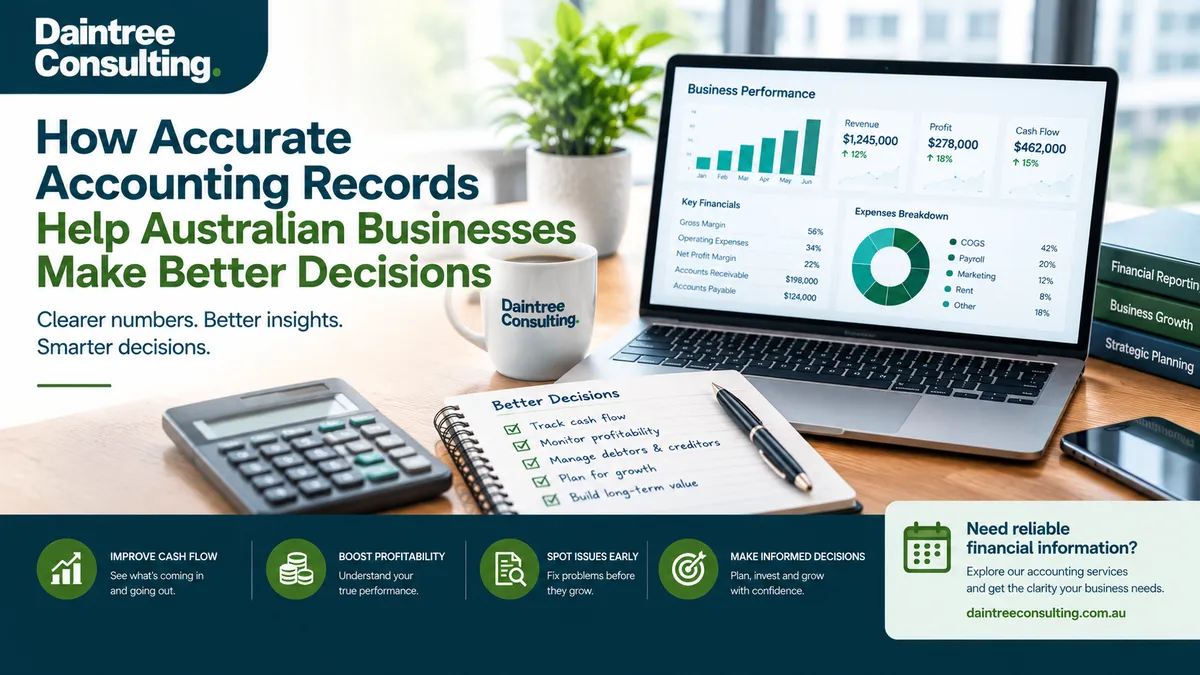
How Accurate Accounting Records Help Australian Businesses Make Better Decisions
Good business decisions rarely come down to instinct alone.
Whether you're deciding whether to hire another employee, invest in new equipment, expand into another market, increase marketing spend or simply slow down spending, the quality of the information behind that decision matters.
Want expert help? Daintree Consulting's accounting services can take this off your plate. Book a free consultation.
And that starts with something many business owners overlook: accurate accounting records.
When financial records are incomplete, outdated or difficult to understand, even experienced business owners can end up making decisions based on assumptions rather than facts.
When the numbers are accurate and current, the opposite happens. You can see what is happening in the business, understand where cash is going, identify problems earlier and make decisions with greater confidence.
The Australian Taxation Office also highlights the connection between accurate records and better business decisions, noting that complete records can help businesses monitor profitability, cash flow, amounts owed and their overall financial position.
This is where professional accounting services can become much more valuable than simply preparing accounts at tax time.
Quick Answer: Why Do Accurate Accounting Records Matter?
Accurate accounting records give business owners a reliable view of their financial position.
They help you understand:
How much the business is earning
What the business is spending
Whether revenue is actually translating into profit
How much cash is available
What customers owe you
What you owe suppliers
Whether costs are increasing
Which parts of the business are performing well
Whether you're ready to invest or grow
Where financial risks may be developing
The bigger your business becomes, the more difficult it is to manage these questions from memory, spreadsheets or bank balances alone.
Good accounting turns financial transactions into information you can actually use.
Accounting Records Are More Than Numbers for Tax
One of the biggest misconceptions about accounting is that its primary purpose is to prepare tax returns.
Tax compliance is important, but accounting can provide much more than that.
Your accounting records can become the foundation for:
Transactions → Financial records → Reporting → Analysis → Decisions
If the first stage is inaccurate, everything that follows becomes less reliable.
For example, imagine your business has generated $2 million in revenue over the year.
That sounds positive.
But what if:
Gross margins have fallen?
Customer payments are taking longer?
Payroll costs have increased faster than revenue?
One division is consistently losing money?
Inventory is tying up significant cash?
Expenses have increased without a corresponding increase in output?
Revenue alone won't tell you these things.
Accurate accounting records can.
1. Accurate Records Show Whether Your Business Is Actually Profitable
Revenue is not the same as profit.
A business can have strong sales and still experience financial pressure because of high operating costs, debt repayments, slow customer payments or poor margins.
Accurate accounting allows you to separate the different components of business performance.
You can look at:
Revenue
Cost of sales
Gross profit
Operating expenses
Net profit
Finance costs
Depreciation
Other significant expenses
This gives you a much clearer understanding of what is actually driving profitability.
For example, suppose revenue increased by 15% over the previous year.
That sounds encouraging.
But if wages increased by 25%, rent increased by 10% and other operating costs increased substantially, the business may not be in a stronger position despite the revenue growth.
Without reliable accounting records, these changes can be difficult to see.
2. Accurate Accounting Improves Cash Flow Visibility
Profit and cash are not the same thing.
A business can report a profit while still experiencing cash-flow pressure.
This can happen because of:
Slow-paying customers
Large inventory purchases
Tax obligations
Loan repayments
Capital expenditure
Timing differences between income and expenses
Significant accounts receivable
Supplier payment cycles
Accurate accounting records help business owners understand these movements.
You can see what has happened rather than simply looking at the bank balance and wondering where the money went.
The ATO specifically identifies accurate records as useful for monitoring cash flow and understanding money owed to and by the business.
That information becomes particularly valuable when making decisions about hiring, investment or expansion.
3. Better Records Help You Decide When to Hire
Hiring an employee is not simply a question of whether there is enough money in the bank today.
You need to consider the ongoing financial impact.
That can include:
Wages
Superannuation
Payroll-related costs
Leave obligations
Equipment
Software
Training
Office or operational costs
Additional management capacity
Accurate accounting records can help you understand whether current profitability and cash flow can reasonably support the additional commitment.
You can also compare the potential cost of the role against the revenue, productivity or capacity it is expected to create.
That makes the conversation much more commercial.
Instead of asking:
"Can we afford to hire someone?"
you can ask:
"What financial impact would this hire have, and what needs to happen for the investment to make sense?"
That is a much better business question.
4. Accurate Records Help You Understand Your Margins
Revenue growth can sometimes hide margin problems.
Suppose your business generates:
$500,000 in revenue in one period
$600,000 in the next
It may appear that performance has improved substantially.
But if the cost of delivering that revenue has increased disproportionately, the additional sales may not be creating the expected value.
Tracking gross margins and other relevant financial measures can help identify this.
Depending on the business, you may want to understand:
Gross profit margin
Product margins
Service margins
Customer profitability
Project profitability
Labour costs
Direct costs
Overheads
This can lead to better pricing, purchasing and resource-allocation decisions.
5. Good Accounting Makes Budgeting More Useful
A budget is only as useful as the information behind it.
If your historical financial records are unreliable, your budget may be built on assumptions that have little connection with reality.
Accurate records give you a stronger starting point.
You can review:
Previous revenue
Seasonal patterns
Recurring costs
Payroll trends
Gross margins
Customer payment behaviour
Capital expenditure
Cash-flow movements
You can then compare actual performance against your expectations.
This is where budget-to-actual reporting becomes useful.
Instead of simply creating a budget at the beginning of the year and forgetting about it, you can ask:
What did we expect to happen?
What actually happened?
Why was there a difference?
What should we do next?
That turns accounting information into management information.
6. Accurate Records Help Identify Problems Earlier
Financial problems rarely appear overnight.
Often, warning signs develop gradually.
For example:
Gross margins decline month after month.
Debtor days increase.
A particular expense category keeps growing.
Cash reserves become smaller.
A customer becomes increasingly overdue.
One business unit consistently misses its targets.
Inventory continues increasing.
Revenue grows while profitability stagnates.
If your accounts are updated and reconciled regularly, these patterns are easier to identify.
If financial reporting is six months behind, the business may already have made several decisions based on outdated information.
Daintree Consulting describes its accounting service around accurate, reconciled records, timely management accounts, cash-flow visibility and budget-to-actual reporting precisely because reliable information needs to support decisions—not simply satisfy year-end compliance requirements.
7. Accurate Accounting Helps You Manage Debtors and Creditors
Accounts receivable and accounts payable can have a significant effect on cash flow.
If customers owe your business money, you need to know:
How much is outstanding
Which invoices are overdue
How long customers typically take to pay
Whether particular customers are creating cash-flow pressure
Similarly, you need visibility over what your business owes suppliers and when those obligations are due.
Accurate accounting records provide a clearer picture of these balances.
That can help you make practical decisions about:
Credit terms
Collections
Supplier negotiations
Payment timing
Working capital
Cash reserves
Without this visibility, cash-flow management becomes reactive.
8. Better Records Make Growth Decisions Less Risky
Growth can be exciting.
But growth also consumes resources.
Expanding into a new location, hiring staff, purchasing equipment, increasing inventory or investing heavily in marketing can all require significant cash.
The question isn't simply whether growth is desirable.
It's whether the business has the financial capacity to support the next step.
Accurate accounting can help you assess:
Current profitability
Available cash
Working capital
Existing debt
Recurring costs
Investment requirements
Expected revenue
Margin assumptions
Potential downside scenarios
This doesn't eliminate uncertainty.
It gives you a better starting point for evaluating it.
9. Accurate Accounting Can Support Better Funding Conversations
If you're approaching a lender, investor or other funding source, financial information matters.
Potential funders may want to understand the business's:
Revenue
Profitability
Cash flow
Assets
Liabilities
Debt
Financial trends
Forecasts
Poorly maintained records can make that process slower and more difficult.
Reliable financial statements and supporting records can give external stakeholders greater confidence in the information being presented.
The ATO also notes that accurate records can help businesses demonstrate their financial position to lenders, business partners and prospective buyers.
Good accounting therefore isn't only about what happens inside the business.
It can influence how other people view the business.
10. Accurate Records Help You Ask Better Questions
Perhaps the biggest benefit of good accounting is not that it gives you answers.
It's that it helps you ask better questions.
Instead of:
"Why does cash always feel tight?"
you can ask:
"Why has our operating cash conversion weakened over the last three months?"
Instead of:
"Are sales going well?"
you can ask:
"Which products, services or customers are actually contributing to gross profit?"
Instead of:
"Can we afford another employee?"
you can ask:
"What level of additional revenue or capacity would justify the cost of this role?"
That shift—from general impressions to evidence-based questions—is where accounting starts becoming a strategic business tool.
What Should Accurate Accounting Records Include?
The exact records required will depend on the business and its circumstances.
However, a reliable accounting system may include information relating to:
Income
Sales invoices
Customer receipts
Other business income
Revenue by category where relevant
Expenses
Supplier invoices
Operating expenses
Payroll
Software subscriptions
Professional fees
Finance costs
Assets
Equipment
Vehicles
Property
Investments
Fixed assets
Liabilities
Loans
Trade creditors
Tax liabilities
Other obligations
Cash
Bank accounts
Credit cards
Petty cash where applicable
Reconciliations
Supporting documentation
Invoices
Receipts
Contracts
Statements
Loan documents
Other evidence supporting transactions
The ATO recommends keeping accurate and complete records as transactions occur, rather than attempting to reconstruct them later.
How Often Should Accounting Records Be Updated?
There is no single frequency that suits every Australian business.
The right reporting cadence depends on factors such as:
Business size
Transaction volume
Industry
Number of entities
Cash-flow requirements
Payroll activity
Management needs
Regulatory obligations
Growth rate
For some small businesses, periodic accounting may be appropriate.
For a growing business, monthly management accounts may provide a much more useful level of visibility.
Daintree's current accounting service states that reporting cadence is agreed around the business's decisions and obligations, commonly on a monthly or quarterly basis.
The important question is not:
"How often should my accountant send me reports?"
It's:
"How often do I need reliable financial information to make good decisions?"
Signs Your Accounting Records May Not Be Good Enough for Decision-Making
Your business may need to improve its accounting process if:
You don't know your current profit position.
Financial reports arrive long after the period has ended.
Your bank balance is your primary financial indicator.
You regularly find unreconciled transactions.
You can't easily explain major changes in expenses.
Customer debts are difficult to track.
You aren't sure what your gross margin is.
Budgets aren't compared with actual results.
You rely heavily on spreadsheets outside your accounting system.
Your accountant spends significant time correcting historical records.
You only review the numbers when tax or BAS deadlines approach.
You can't confidently answer basic financial questions from management.
None of these automatically means your business is in trouble.
They can simply indicate that the accounting function has not kept pace with the business.
Accounting Services Should Do More Than Record Transactions
This is where choosing the right accounting services matters.
There is a significant difference between:
Recording what happened
and
Helping management understand what happened.
Good accounting should create a reliable foundation for reporting and decision-making.
Depending on your business, that may include:
Reconciled financial records
Management accounts
Balance-sheet reconciliations
Budget-to-actual reporting
Variance analysis
Cash-flow reporting
Financial dashboards
Fixed-asset oversight
Ledger review
Coordination with bookkeeping
Coordination with tax and advisory work
Daintree Consulting's accounting service is designed around this connected approach, with support ranging from financial records and management reporting through to cash-flow visibility and financial oversight.
What If You Already Have a Bookkeeper?
You don't necessarily need to replace your existing bookkeeper.
Bookkeeping and accounting perform related but different functions.
A bookkeeper may focus heavily on keeping transactions recorded, reconciled and current.
Accounting and management reporting can then help turn those records into useful financial information.
Depending on your business, you may benefit from having:
Bookkeeping → Accounting → Reporting → Advisory
Daintree can work alongside an existing bookkeeper or internal team rather than requiring a complete change of providers.
That can be particularly useful for businesses that have good day-to-day bookkeeping but need stronger reporting, oversight or financial analysis.
What If Your Existing Records Are Messy?
You don't necessarily have to start from scratch.
Historical accounting records can sometimes be cleaned up before establishing an ongoing reporting process.
A sensible approach may be:
1. Assess the current records
Identify reconciliation issues, missing information and reporting gaps.
2. Prioritise the important problems
Not every historical issue needs the same level of attention.
3. Complete the agreed clean-up
Correct priority issues and establish a reliable financial baseline.
4. Establish a regular close
Create a repeatable process for keeping the records current.
5. Introduce useful reporting
Build management reports around the decisions the business actually needs to make.
Daintree's current accounting service specifically allows historical clean-up to be identified during the discovery process before ongoing reporting begins.
From Accurate Records to Better Decisions
The real value of accounting isn't the spreadsheet, accounting software or financial report itself.
It's what you can do with the information.
Accurate records can help you:
Understand what happened.
Identify what is changing.
Investigate why it changed.
Evaluate your options.
Decide what to do next.
That's why accounting should not be treated as something that only happens after the financial year is over.
When financial information is timely and reliable, it becomes part of how the business is managed.
Frequently Asked Questions
Why are accurate accounting records important for a business?
Accurate records help business owners understand revenue, expenses, profitability, cash flow, assets and liabilities. They also support tax and other obligations and can provide better information for business decisions.
How can accounting help with business decisions?
Accounting provides financial information that can help owners evaluate pricing, hiring, investment, spending, cash flow, growth and profitability decisions.
How often should business accounts be updated?
The appropriate frequency depends on the size, complexity and needs of the business. Growing businesses may benefit from monthly management accounts, while simpler businesses may require less frequent reporting.
Is bookkeeping the same as accounting?
Not exactly. Bookkeeping generally focuses on recording and maintaining financial transactions, while accounting can include financial reporting, analysis, reconciliations and interpretation of financial information.
Can an accountant work with my existing bookkeeper?
Yes. Accounting services do not necessarily require replacing your existing bookkeeper. Daintree, for example, can work alongside an existing bookkeeper or internal finance team.
Can accounting records help with cash flow?
Yes. Accurate records can help you monitor money coming into and leaving the business, amounts owed to you and amounts you owe, giving you better visibility over cash flow.
What if my accounting records are behind?
A clean-up process can identify historical gaps, reconcile priority accounts and establish a reliable starting point for ongoing reporting. Daintree can assess historical clean-up requirements as part of its accounting engagement process.
Need Accounting Services That Help You Make Better Decisions?
Your accounting records should do more than tell you what happened last year.
They should help you understand where the business is now and what your next decision should be.
Daintree Consulting provides accounting, management reporting and financial oversight for Australian businesses that need reliable numbers and clearer decisions. Support can include reconciled financial records, management accounts, budget-to-actual reporting, cash-flow reporting, financial dashboards and coordination with bookkeeping, tax and advisory work.
If your financial reports are late, difficult to understand or no longer giving you the visibility you need, a free 30-minute discovery call can be a practical place to start.
Daintree Consulting – Accounting Services
Talk to Daintree about your accounting
Our ex-Big 4 team gives clear, senior-reviewed advice so you can act with confidence.
Book a free consultation →
Or explore our accounting services.
