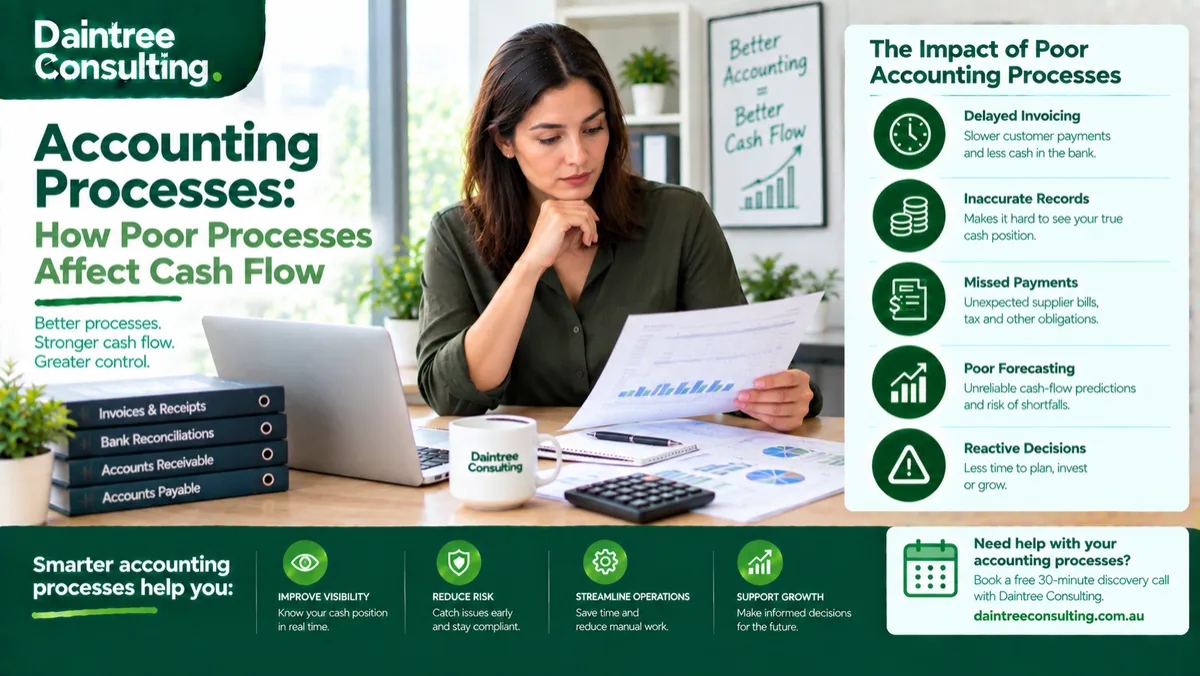
How Poor Accounting Processes Can Affect Business Cash Flow
Cash flow problems do not always start with a lack of sales.
Sometimes, the underlying problem is the way a business records, reconciles, reports and manages its financial information.
Want expert help? Daintree Consulting's accounting services can take this off your plate. Book a free consultation.
When accounting processes are inconsistent, slow or poorly controlled, business owners can lose visibility over what money is coming in, what needs to be paid and when cash pressures are likely to arise.
An invoice may not be issued promptly. Customer payments may not be followed up. Supplier bills may not be recorded correctly. Bank accounts may not be reconciled. Management reports may arrive weeks after the month has ended.
Individually, these issues can appear minor.
Together, they can make cash flow much harder to manage.
For Australian businesses, good financial records are important not only for understanding business performance but also for managing cash flow and meeting tax and other obligations. business.gov.au recommends keeping records of income, expenses, bank transactions and other relevant financial information, while the ATO highlights regular reconciliation as an important part of accurate business record keeping.
Quick answer
Poor accounting processes can affect business cash flow by making it harder to:
Collect money from customers on time
Understand how much cash is actually available
Track outstanding invoices and supplier bills
Identify upcoming tax and other payment obligations
Forecast future cash shortages
Detect errors or missing transactions
Control unnecessary spending
Understand the relationship between profit and cash
Make timely financial decisions
The problem is often not the accounting software itself.
It is the process around the software.
A business can have sophisticated accounting technology but still experience poor cash-flow visibility if transactions are not recorded accurately, accounts are not reconciled regularly and financial reports are not reviewed in time.
What are accounting processes?
Accounting processes are the systems and routines a business uses to record, organise, reconcile and report its financial activity.
They can include:
Recording sales and purchases
Issuing customer invoices
Processing supplier bills
Managing accounts receivable
Managing accounts payable
Reconciling bank accounts
Recording payroll
Tracking GST and other tax-related information
Maintaining financial records
Completing month-end processes
Preparing financial reports
Reviewing budgets against actual results
Monitoring cash flow
Maintaining supporting documentation
The exact process will depend on the size and structure of the business.
A small professional-services firm may have relatively simple transaction flows. A growing business with multiple bank accounts, employees, locations, suppliers and revenue streams may need significantly more structure.
The objective is the same: turn day-to-day transactions into reliable financial information that management can actually use.
Why accounting processes matter for cash flow
Cash flow is about the movement of money into and out of a business.
That sounds straightforward, but the underlying information can become complicated quickly.
business.gov.au describes cash flow as the money coming into and going out of a business and recommends using financial tools and reports to monitor it, including cash-flow statements and regular financial reviews.
Your accounting processes help determine whether you can see that movement clearly.
If the processes are working well, management can identify:
Who owes the business money
Which bills are due
What cash is available
What payments are coming up
Whether costs are increasing
Whether margins are changing
Whether tax obligations need to be funded
Whether a cash shortage could develop
If the processes are poor, these questions can become difficult to answer.
1. Slow invoicing can delay cash coming into the business
One of the simplest ways accounting processes can affect cash flow is through invoicing.
If completed work is not invoiced promptly, the business may have earned revenue but still be waiting for the cash.
For example, imagine a business completes a project at the end of the month but does not issue the invoice until several weeks later.
The revenue may eventually be recognised in the accounting records, but the cash has not yet entered the bank account.
That creates a timing problem.
A well-designed invoicing process should make it clear:
When work becomes billable
Who is responsible for issuing the invoice
What information the invoice must contain
What payment terms apply
When overdue invoices should be followed up
business.gov.au recommends sending invoices promptly and following up unpaid invoices because collecting customer payments faster can free up cash.
2. Poor accounts receivable processes can leave cash sitting outside the business
A business can be profitable on paper while having too much money tied up in unpaid customer invoices.
This is particularly relevant for businesses that provide services on credit or operate with longer payment terms.
If accounts receivable is not reviewed regularly, overdue invoices can build up without management realising how much cash is outstanding.
A useful accounting process should make it easy to identify:
Total accounts receivable
Current invoices
Overdue invoices
Long-outstanding balances
Customers approaching their payment limits
Unusual changes in debtor balances
This does not mean every overdue invoice will become a bad debt.
It means management should know where the cash is and when it is expected to arrive.
3. Inaccurate records can create a false picture of available cash
Your bank balance tells you how much money is currently in the account.
It does not necessarily tell you how much cash is actually available for discretionary spending.
There may be:
Supplier invoices waiting to be paid
Payroll obligations
Superannuation obligations
GST liabilities
PAYG withholding
Loan repayments
Upcoming asset purchases
Tax payments
Other committed expenses
This is why accounting processes need to capture both cash movements and financial obligations.
Good records help management understand not only what is in the bank today, but also what that cash needs to cover.
business.gov.au recommends planning for ongoing costs such as tax, employee costs, supplier invoices and loan repayments when managing cash flow.
4. Poor bank reconciliation can hide cash-flow problems
Bank reconciliation is one of the basic controls that supports reliable financial information.
The ATO states that business banking records show money coming into and going out of the business and recommends regularly reconciling records so the business understands exactly what money moves through its accounts and why.
Without regular reconciliation, a business may have difficulty identifying:
Missing transactions
Duplicate transactions
Incorrect entries
Unrecorded bank fees
Unexpected payments
Personal transactions incorrectly recorded
Timing differences
Errors in the accounting system
A small error may not seem significant.
But repeated errors can distort management reports and make cash-flow forecasting less reliable.
5. Delayed bookkeeping reduces the value of financial information
Accounting information is most useful when it arrives early enough to influence a decision.
Consider a business whose accounts are consistently three months behind.
Management may be making decisions based on outdated information.
By the time a report shows that:
Customer payments are slowing
Costs are increasing
Gross margins are falling
Overheads have increased
A major expense has been missed
the underlying cash-flow pressure may already be significant.
Good accounting processes create a rhythm where financial information is recorded and reviewed regularly.
The exact frequency depends on the business, but growing businesses often need more timely reporting as transaction volumes and financial complexity increase.
6. Poor accounts payable processes can cause unexpected cash pressure
Cash flow is not only about collecting money.
It is also about knowing what the business needs to pay and when.
If supplier invoices are not captured properly, management may underestimate upcoming cash requirements.
For example, a business might appear to have $150,000 available in its bank accounts.
But if $90,000 of supplier invoices, payroll and other commitments have not been properly reflected in its cash planning, the apparent cash position can be misleading.
A structured accounts payable process should help management understand:
What is owed
Who it is owed to
When payments are due
Which expenses are recurring
Which expenses are unusual
Whether supplier terms are being managed effectively
This does not mean delaying payments unnecessarily.
It means making payment decisions using reliable information.
7. Poor accounting processes can make tax obligations harder to plan for
Tax obligations can create significant cash-flow pressure when businesses do not plan for them.
Depending on the business, cash commitments can include GST, PAYG withholding, PAYG instalments, income tax and other obligations.
business.gov.au recommends putting money aside for taxes and updating cash-flow planning to account for upcoming tax payments.
If accounting records are incomplete or financial information is delayed, management may not have a clear picture of upcoming obligations.
This can result in a familiar problem:
The business has cash today, but not enough cash when the payment becomes due.
Better accounting processes can help identify these commitments earlier.
8. Poor processes can make cash-flow forecasting unreliable
A cash-flow forecast is only as useful as the information behind it.
business.gov.au explains that cash-flow forecasts estimate future sales and costs and can help businesses identify potential shortages and plan future payments.
If the underlying accounting data is unreliable, the forecast can also become unreliable.
For example, a forecast may underestimate:
Outstanding supplier bills
Customer payment delays
Payroll costs
Tax obligations
Loan repayments
Recurring expenses
Or it may assume that all outstanding invoices will be collected immediately.
A more useful forecasting process considers actual payment patterns and known commitments rather than simply carrying accounting figures forward.
9. Poor accounting processes can hide changes in profitability
Cash flow and profitability are connected, but they are not the same thing.
A business can have strong sales and still experience cash pressure.
It can also receive a large customer payment and temporarily appear cash-rich while profitability is deteriorating.
This is why management needs reliable financial reporting alongside cash-flow information.
Regular financial reporting can help identify:
Revenue trends
Gross margin changes
Rising overheads
Cost increases
Customer concentration
Changes in debtor days
Changes in supplier balances
Profitability by service or product
business.gov.au recommends regularly reviewing key financial documents, including the balance sheet, profit and loss statement, cash-flow statement and budget.
10. Poor processes can lead to reactive decision-making
When financial information is delayed or unreliable, business owners often end up managing cash reactively.
Instead of asking:
“What will our cash position look like in three months?”
the business is asking:
“Can we pay this bill today?”
That shift can affect growth decisions.
Management may postpone hiring, delay equipment purchases, reduce marketing expenditure or seek short-term funding simply because it does not have enough confidence in the numbers.
The issue may not necessarily be a lack of money.
It may be a lack of visibility.
Signs your accounting processes may be affecting cash flow
There are several warning signs that your accounting processes need attention.
You do not know your cash position
If you regularly need to check the bank balance before answering basic cash questions, your reporting may not be providing enough visibility.
Your books are consistently behind
If transactions are recorded weeks or months after they occur, management decisions may be based on outdated information.
Reconciliations are irregular
Unreconciled accounts can make it harder to trust the numbers.
Invoices are sent late
If there is no clear process for billing completed work, cash collection can be delayed.
Overdue invoices are increasing
A growing accounts receivable balance can indicate that cash is becoming tied up in customers.
Supplier bills appear unexpectedly
If management is regularly surprised by upcoming payments, accounts payable information may not be sufficiently visible.
BAS and tax obligations create cash surprises
Unexpected tax liabilities can indicate that financial information and cash-flow planning are not sufficiently connected.
You rely heavily on the bank balance
A bank balance is important, but it is only one part of the financial picture.
Management reports arrive too late
A report that arrives after an important decision has already been made may have limited practical value.
The business is growing but the processes have not changed
Accounting processes that worked for a small business may become inadequate as transaction volumes, employees, customers and suppliers increase.
How to improve accounting processes and cash-flow visibility
Improving cash flow does not always require a complete accounting system overhaul.
Start by looking at the underlying processes.
1. Map the flow of financial information
Document how a transaction moves through the business.
For example:
Sale → Invoice → Customer payment → Bank receipt → Reconciliation → Reporting
Then look at where delays or errors occur.
Do the same for purchases:
Supplier invoice → Approval → Recording → Payment → Bank reconciliation → Reporting
This can highlight process gaps that are otherwise easy to overlook.
2. Establish clear responsibilities
Every important accounting task should have an owner.
That might include:
Invoicing
Accounts receivable follow-up
Supplier invoice processing
Bank reconciliation
Payroll processing
BAS preparation
Month-end close
Financial reporting
Cash-flow forecasting
When responsibilities are unclear, tasks can be delayed or duplicated.
3. Reconcile accounts regularly
Do not wait until year-end to discover that accounting records do not agree with bank or investment records.
Regular reconciliation helps maintain more reliable financial information.
4. Review receivables and payables
Make accounts receivable and accounts payable part of the regular management routine.
Look at both the amount outstanding and the age of those balances.
5. Introduce a consistent month-end process
A structured month-end close can help ensure that important transactions are captured before management reviews the financial results.
Depending on the business, this may include:
Bank reconciliations
Credit card reconciliations
Accounts receivable review
Accounts payable review
Payroll reconciliation
GST review
Accruals
Prepayments
Fixed assets
Loan balances
Management reports
6. Use accounting software effectively
Digital accounting tools can improve visibility and reduce manual work when they are configured and maintained properly.
business.gov.au notes that digital accounting tools can help businesses monitor cash flow and compile financial reports.
But software is not a substitute for a sound process.
Incorrect coding, missing transactions or poor reconciliations can still produce unreliable information in an otherwise sophisticated system.
7. Connect accounting with cash-flow forecasting
Accounting reports tell you what has happened.
Cash-flow forecasting helps you think about what may happen next.
Using both can give management a more complete financial picture.
8. Review the process as the business grows
Accounting processes should evolve with the business.
More customers, employees, suppliers, entities, bank accounts and transactions can create additional complexity.
A process that once worked with 100 monthly transactions may not work effectively with 1,000.
When should a business review its accounting processes?
There is no single point at which every business needs to redesign its accounting processes.
However, a review can be worthwhile when:
Transaction volumes are increasing
Revenue has grown significantly
New employees have joined the finance function
The business has opened additional locations
New products or services have been introduced
There are multiple entities
Cash-flow visibility has deteriorated
Management reports are consistently late
Reconciliations are falling behind
The business is preparing for external funding
Tax or reporting work is becoming increasingly difficult
Owners are spending too much time dealing with bookkeeping issues
Growth is particularly important.
As the business becomes more complex, accounting needs to provide management with information that is timely enough to support decisions.
Accounting processes vs accounting software
It is easy to assume that poor accounting results from using the wrong software.
Sometimes it does.
But changing software will not necessarily fix an underlying process problem.
For example, if invoices are consistently issued late, a new accounting platform will not automatically solve the problem.
If bank accounts are not reconciled, better software will not eliminate the need for reconciliation.
If nobody reviews accounts receivable, automation will not necessarily result in faster customer payments.
The better question is:
Does the business have the right process, responsibility and review routine around its accounting system?
Technology should support the process rather than replace it.
How Daintree Consulting can help
Daintree Consulting helps Australian businesses strengthen their accounting processes, financial reporting and cash-flow visibility.
Depending on your business requirements, support can include:
Financial record oversight
Bank and balance-sheet reconciliations
Management accounts
Budget-to-actual reporting
Cash-flow reporting
Financial dashboards
Month-end processes
Accounts payable and receivable coordination
Accounting process improvements
Coordination with bookkeeping
Financial reporting for management decision-making
The goal is not simply to keep the books up to date.
It is to create a financial process that gives business owners and leadership teams reliable information when they need it.
If your business is growing, cash flow is becoming harder to predict or your accounting processes are no longer keeping pace, professional support can help identify where the gaps are and what needs to change.
Book a free 30-minute discovery call with Daintree Consulting to discuss your accounting and reporting requirements.
Frequently asked questions
Can poor accounting processes cause cash-flow problems?
Yes. Poor processes can contribute to delayed invoicing, inaccurate records, missed payment obligations, weak receivables management and unreliable cash-flow forecasting.
They may not be the only cause of a cash-flow problem, but they can make existing problems harder to identify and manage.
How does bookkeeping affect cash flow?
Accurate and timely bookkeeping helps businesses understand their income, expenses, receivables, payables and bank activity. This information supports cash-flow management and financial decision-making.
Does accurate accounting guarantee positive cash flow?
No.
Accurate accounting provides better information, but it cannot guarantee that a business will have positive cash flow.
Cash flow is also affected by factors such as sales, customer payment behaviour, pricing, expenses, financing, investment decisions, tax obligations and changes in working capital.
How often should accounting records be updated?
The appropriate frequency depends on the size, transaction volume and complexity of the business.
Businesses with significant transaction volumes or tight cash-flow requirements may benefit from more frequent updates and reconciliations.
What is the relationship between accounting and cash-flow forecasting?
Accounting records provide information about actual financial activity. Cash-flow forecasting uses financial information and assumptions to estimate future cash movements.
Using reliable accounting data can make forecasting more useful, but forecasts remain estimates and actual results can differ.
What is a month-end accounting process?
A month-end process is a structured routine for reviewing and finalising financial information for a particular month.
It may include reconciliations, accounts receivable and payable reviews, payroll checks, accruals, prepayments, fixed-asset updates and management reporting.
When should a growing business improve its accounting processes?
A review can be useful when transaction volumes increase, reporting becomes slower, cash-flow visibility deteriorates or the existing process becomes difficult to manage.
The earlier a business identifies process weaknesses, the easier it may be to address them before they become larger operational or financial problems.
Final takeaway
Poor accounting processes can affect cash flow in ways that are not always immediately obvious.
Late invoicing can delay customer payments. Poor reconciliations can reduce confidence in the numbers. Weak accounts payable processes can create unexpected payment pressure. Delayed reporting can prevent management from identifying problems early.
The solution is not necessarily more accounting work.
It is better accounting processes.
A reliable process should capture transactions accurately, reconcile accounts regularly, provide timely financial reporting and connect historical financial information with forward-looking cash-flow planning.
For Australian businesses, good financial records also support tax and other obligations and help owners understand the financial health of the business.
If your accounting processes are no longer giving you a clear view of cash flow, it may be time to review how your financial information is being captured, reconciled and reported.
Daintree Consulting can help you build clearer accounting processes and financial reporting that support better business decisions.
Talk to Daintree about your accounting
Our ex-Big 4 team gives clear, senior-reviewed advice so you can act with confidence.
Book a free consultation →
Or explore our accounting services.
