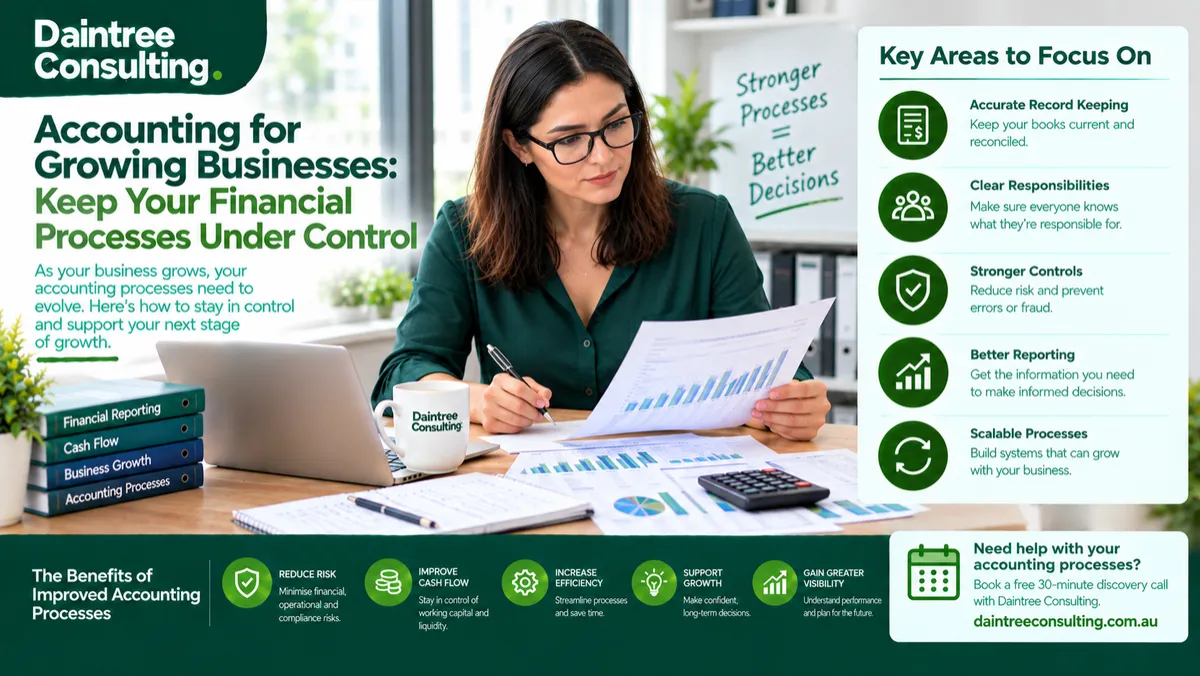
Accounting for Growing Businesses: How to Keep Your Financial Processes Under Control
Growth is usually a good sign.
More customers, higher revenue, additional employees and new opportunities can all indicate that a business is moving in the right direction.
Want expert help? Daintree Consulting's accounting services can take this off your plate. Book a free consultation.
But growth also creates a financial management problem that many business owners do not anticipate:
The accounting processes that worked when the business was smaller may not work as well at its current size.
A business might start with one person handling invoices, bills, payroll, bank reconciliations and financial reporting. As the business grows, that same approach can become increasingly difficult to manage.
Transactions increase. More people become involved. New systems are introduced. Customers take longer to pay. Payroll becomes more complex. Management needs more detailed reporting. Cash flow becomes harder to predict.
Without the right processes, accounting can become reactive rather than useful.
For growing Australian businesses, accounting for growing businesses is not simply about recording more transactions. It is about creating financial processes that remain accurate, organised and useful as the business becomes more complex.
The goal is to make sure the accounting function keeps up with the business — rather than becoming something management is constantly trying to catch up on.
Quick answer: How should accounting change as a business grows?
As a business grows, its accounting processes should generally become more structured, timely and clearly assigned.
This can include:
Establishing clear responsibilities for financial tasks
Keeping bookkeeping up to date
Performing regular bank and balance-sheet reconciliations
Strengthening accounts payable and receivable processes
Reviewing payroll processes
Producing regular management reports
Monitoring cash flow
Comparing actual results with budgets
Documenting important accounting procedures
Improving approval and financial controls
Reviewing accounting software and integrations
Separating operational and financial responsibilities where appropriate
Establishing a consistent month-end close process
Using financial information to support management decisions
The appropriate level of structure depends on the size, industry, business model and complexity of the organisation.
There is no point creating a finance department designed for a large corporation when a business only needs a small, well-organised accounting function.
The objective is appropriate financial control for the stage of the business.
Why accounting becomes more difficult as a business grows
Small businesses can sometimes operate with relatively informal processes.
The owner may know every customer.
They may personally approve most purchases.
They may know which invoices are outstanding.
They may review the bank account every morning.
They may work directly with the bookkeeper or accountant.
As the business grows, that personal visibility becomes harder to maintain.
A growing business might have:
More customers
More suppliers
More employees
Multiple bank accounts
Larger transaction volumes
More complex payroll
Increased inventory
Multiple locations
More significant assets
External finance
Investors or shareholders
Additional entities
More tax and reporting obligations
The accounting system now needs to provide information that the owner can no longer gather simply by being involved in every transaction.
This is where financial processes become increasingly important.
The Australian Taxation Office emphasises that accurate and complete records help businesses track income and expenses, make informed decisions and prepare activity statements and tax returns.
For a growing business, reliable records become the foundation for much more than tax compliance.
They support management reporting, cash-flow planning, budgeting, financing and strategic decision-making.
1. Establish clear responsibility for financial tasks
One of the first things a growing business should review is who is responsible for what.
When a business is small, responsibilities can overlap.
The owner might:
Approve purchases
Send invoices
Pay suppliers
Review payroll
Speak with the accountant
Monitor the bank account
That may be practical initially.
But as more employees become involved, unclear responsibilities can create errors and delays.
A growing business should be able to answer questions such as:
Who raises customer invoices?
Who follows up overdue accounts?
Who enters supplier bills?
Who approves payments?
Who processes payroll?
Who reconciles the bank accounts?
Who reviews the financial reports?
Who communicates with the accountant?
Who approves significant expenses?
Who has authority to access accounting systems?
Clear responsibilities make it easier to identify gaps and reduce unnecessary duplication.
They can also make it easier to establish appropriate controls around important financial transactions.
2. Keep bookkeeping up to date
A growing business cannot make reliable decisions from financial information that is several months behind.
This sounds obvious, but it can become a problem when transaction volumes increase faster than the finance process.
A business might have hundreds of transactions each month while still treating bookkeeping as an administrative task to catch up on when someone has time.
That creates several problems.
Management may not know:
How much cash is actually available
Which customers owe money
Which suppliers need to be paid
Whether expenses are increasing
Whether margins are changing
Whether the business is tracking against budget
Whether tax obligations are being adequately planned for
Business.gov.au recommends maintaining good financial records because they help businesses understand their financial position, manage cash flow and make better decisions.
For growing businesses, timely bookkeeping is therefore not just about keeping the accounting system tidy.
It is part of maintaining financial visibility.
3. Make reconciliations a regular process
Reconciliations are one of the simplest ways to identify discrepancies in accounting records.
At a minimum, businesses may need to regularly reconcile:
Bank accounts
Credit cards
Accounts receivable
Accounts payable
Payroll-related accounts
GST and tax-related accounts
Loan accounts
Clearing accounts
Other important balance-sheet accounts
The exact reconciliation process will depend on the business.
The important point is consistency.
A reconciliation that is performed only at year-end provides much less timely information than one that is completed as part of the normal monthly accounting process.
Regular reconciliation can help identify:
Missing transactions
Duplicate entries
Incorrect coding
Unexplained balances
Timing differences
Incorrect payments
Outstanding transactions
Data-entry errors
It can also make year-end accounting significantly easier.
4. Introduce a consistent month-end close
As a business grows, month-end should become more than simply waiting for the accountant to finish the accounts.
A structured month-end close creates a repeatable process for making sure the financial records are ready for management review.
Depending on the business, a month-end checklist might include:
Finalising sales transactions
Recording supplier invoices
Reconciling bank accounts
Reconciling credit cards
Reviewing accounts receivable
Reviewing accounts payable
Processing payroll-related entries
Checking balance-sheet accounts
Recording relevant accruals and prepayments
Reviewing unusual transactions
Finalising management reports
Reviewing significant variances
Not every business needs every step.
The important principle is that the process should be defined, repeatable and appropriate to the business.
This reduces reliance on memory and makes it easier for another person to understand what needs to happen each month.
5. Improve accounts receivable processes
Revenue growth does not automatically mean stronger cash flow.
A business can report increasing sales while customers take longer to pay.
That is why accounts receivable needs to be monitored as the business expands.
Growing businesses should have a clear process for:
Issuing invoices
Confirming invoice accuracy
Setting payment terms
Monitoring overdue invoices
Following up outstanding balances
Escalating long-overdue accounts
Reconciling customer balances
Reviewing doubtful or disputed debts
Business.gov.au identifies cash-flow management as an important part of running a financially healthy business and recommends using financial tools and reports to monitor money coming into and leaving the business.
A useful management report should therefore show more than total sales.
Management may also need visibility over:
Current receivables
Overdue receivables
Customer concentration
Average collection time
Large outstanding balances
Disputed invoices
This can highlight cash-flow pressure before it becomes a larger problem.
6. Strengthen accounts payable
The other side of the cash-flow equation is money leaving the business.
As supplier numbers increase, businesses need a reliable process for receiving, checking, approving and paying invoices.
A useful accounts payable process should help answer:
Was the purchase legitimate?
Was it approved?
Was the amount correct?
Has it already been paid?
When does it need to be paid?
A growing business may benefit from defined approval limits based on transaction size or type.
This does not necessarily mean creating excessive bureaucracy.
The objective is to establish enough control to reduce errors while keeping the payment process practical.
7. Review your chart of accounts
The chart of accounts is often overlooked as a business grows.
A structure that was appropriate when the business was small may become too basic as management needs more detailed information.
For example, management may eventually need to distinguish between:
Different revenue streams
Product categories
Locations
Departments
Direct and indirect costs
Marketing channels
Labour costs
Project-related costs
However, adding more accounts is not automatically better.
An overly complicated chart of accounts can create inconsistent coding and make reports harder to understand.
The objective should be to capture enough detail to support useful reporting without creating unnecessary complexity.
8. Create management reports that match the business
One of the biggest changes as a business grows is the need for better financial reporting.
A basic profit and loss statement may have been sufficient when the owner was directly involved in everything.
As the business becomes more complex, management may need a broader reporting pack.
Depending on the organisation, this could include:
Profit and loss statement
Balance sheet
Cash-flow report
Budget vs actual report
Accounts receivable ageing
Accounts payable ageing
Gross margin analysis
Key performance indicators
Department or location reporting
Working capital information
Business.gov.au recommends regularly reviewing financial documents such as the balance sheet, profit and loss statement, cash-flow statement and budget to understand business performance and identify unusual trends.
The key is not simply producing reports.
Management needs to understand what the reports are telling them.
For example:
Revenue increased by 15%.
That sounds positive.
But what if:
Gross margin decreased?
Debtor days increased?
Operating expenses grew faster than revenue?
Cash reserves declined?
Customer concentration increased?
A growing business needs reporting that helps leadership see beyond the headline number.
9. Keep cash flow under close control
Profit and cash are not the same thing.
This becomes particularly important during periods of rapid growth.
A business may need to spend money before it receives payment from customers.
For example, growth may require:
Hiring additional staff
Purchasing inventory
Increasing marketing expenditure
Expanding premises
Buying equipment
Paying suppliers earlier
Increasing working capital
Revenue can increase while cash becomes tighter.
Business.gov.au recommends planning cash flow and using financial information to identify potential cash shortages and manage money coming into and out of the business.
For a growing business, cash-flow reporting should therefore answer questions such as:
How much cash do we have?
What payments are due?
What customer receipts are expected?
What tax and employee obligations are coming up?
How much working capital is required?
What happens if sales are lower than expected?
What happens if customers take longer to pay?
This is where accounting information becomes a management tool rather than simply a record of what has already happened.
10. Build stronger financial controls
Growth usually means more people have access to financial information and systems.
That creates a need to review internal controls.
Controls might cover:
Payment approvals
Supplier creation
Bank access
Accounting-system permissions
Payroll changes
Expense claims
Customer refunds
Credit notes
Journal entries
Financial reporting
Reconciliations
The appropriate controls will depend on the size and complexity of the business.
A five-person business will not necessarily need the same control environment as a company with 100 employees.
However, the principle remains the same:
Important financial processes should have appropriate checks and accountability.
ASIC states that companies must keep financial records that correctly record and explain transactions and financial position and performance, and that companies need appropriate accounting policies, controls and processes to maintain complete and accurate records.
11. Document important accounting procedures
Growing businesses can become heavily dependent on individual employees.
Someone may know exactly how to:
Reconcile the bank
Process payroll
Run month-end
Prepare management reports
Upload payments
Complete BAS-related processes
Manage supplier records
Produce a cash-flow forecast
But if the process exists only in that person's head, the business has a knowledge risk.
Documenting important processes can provide continuity when:
Someone takes leave
An employee changes roles
A new person joins the finance team
A business outsources part of its accounting
The business changes accounting software
Responsibilities are redistributed
Documentation does not need to be unnecessarily complicated.
A clear checklist can sometimes be enough.
12. Review your accounting software as the business changes
Accounting software should support the business rather than force the business into inefficient processes.
As the business grows, it may need to review:
Accounting software
Payroll systems
Expense management
Invoicing
Inventory systems
Payment platforms
Banking integrations
CRM integrations
Reporting tools
However, adding software is not the same as improving accounting.
A business can have several sophisticated systems and still have poor financial processes.
Before introducing another platform, ask:
What problem are we trying to solve?
Who will own the process?
How will the information flow into accounting?
What controls are required?
How will the data be reconciled?
Will management actually use the resulting information?
Technology should simplify the financial process where possible, not create another layer of complexity.
13. Make tax and compliance processes part of the normal workflow
Tax and compliance should not be treated as something that happens only when a deadline approaches.
Growing businesses may have increasingly complex obligations involving:
GST
BAS
PAYG withholding
Payroll
Superannuation
Income tax
Fringe benefits tax where applicable
Company reporting
Other industry-specific obligations
The exact obligations depend on the business structure and circumstances.
Good accounting processes can make compliance easier by keeping the underlying records accurate and up to date.
The ATO notes that accurate and complete records support businesses in meeting tax and other obligations and help them make informed business decisions.
14. Separate bookkeeping from management accounting
As the business grows, there is an important distinction between recording financial information and using financial information.
Bookkeeping answers questions such as:
What transactions occurred?
What invoices were issued?
What bills were received?
What payments were made?
What is the bank balance?
Management accounting goes further.
It can help answer:
Why did profit change?
Which areas are performing?
Where are costs increasing?
Are margins changing?
How much working capital is required?
Are we tracking against budget?
What could happen over the next six months?
Can the business afford the planned expansion?
A growing business may need both.
Accurate bookkeeping provides the foundation. Management reporting and analysis help turn that information into something leadership can use.
15. Build accounting processes around decision-making
The purpose of a growing business's accounting function should not be limited to compliance.
Financial information should help management make decisions.
For example, if the business is considering opening another location, management may need to understand:
Current profitability
Available cash
Expected setup costs
Additional staffing costs
Working capital requirements
Expected revenue
Break-even point
Financing requirements
Downside scenarios
Without reliable accounting information, those decisions become more dependent on assumptions.
With better reporting, management can evaluate the financial implications more clearly.
ASIC emphasises that company directors need to understand their company's financial position and ability to meet financial obligations, even when tasks such as bookkeeping are delegated to others.
That makes financial visibility particularly important as businesses become larger and more complex.
What should a growing business review every month?
A practical monthly finance review can cover:
Financial performance
Revenue
Gross profit
Operating expenses
Net profit
Key margins
Cash position
Bank balances
Expected receipts
Upcoming payments
Tax obligations
Payroll and superannuation
Financing commitments
Working capital
Accounts receivable
Accounts payable
Inventory where relevant
Other short-term assets and liabilities
Budget performance
Actual revenue vs budget
Actual expenses vs budget
Major variances
Reasons for significant differences
Financial controls
Unusual transactions
Outstanding reconciliations
Large payments
Aged receivables
Aged payables
Access or approval issues
Forward-looking information
Cash-flow forecast
Expected major expenditure
Hiring plans
Capital expenditure
Funding requirements
Growth opportunities and risks
The exact reporting pack should reflect the business.
The important thing is to create a consistent rhythm rather than reviewing financial information only when a problem appears.
How to know when your accounting process needs more structure
You do not necessarily need to wait until the accounting system fails.
Warning signs can include:
Bookkeeping is regularly behind
Management reports arrive too late to be useful
Bank reconciliations are not completed consistently
The owner is still approving or checking almost everything
Customer debts are increasing
Supplier payments are becoming difficult to manage
Cash-flow surprises are becoming more frequent
Financial information differs between systems
Payroll requires frequent corrections
Employees are unclear about financial responsibilities
Important processes depend on one person
The business cannot easily explain significant changes in profit
Budget vs actual reporting is not available
Tax obligations are causing unexpected cash pressure
Management is making major decisions without current financial information
These signs do not necessarily mean the business has a serious accounting problem.
They can simply indicate that the financial processes need to evolve with the business.
A practical framework for improving accounting as you grow
If your business is expanding and the finance function feels increasingly difficult to manage, start with five questions.
1. Are the records accurate?
Review bookkeeping, reconciliations, transaction coding and supporting documentation.
If the underlying data is unreliable, management reports will also be unreliable.
2. Are the records up to date?
Information that is accurate but several months old is of limited value for current decision-making.
3. Can management understand performance?
Make sure the reporting explains more than revenue and profit.
Look at margins, cash flow, working capital and important business drivers.
4. Are financial responsibilities clear?
Document who owns important accounting tasks and who has authority to approve transactions.
5. Can the process scale?
Ask whether the current approach would still work if:
Revenue doubled
Employee numbers increased
Customer numbers increased
Transaction volumes increased
Another location opened
A key finance employee left
If the answer is no, the business may need to redesign the process before growth makes the problem harder to solve.
What happens when financial processes do not keep up with growth?
Poor financial processes do not always create an obvious problem immediately.
Instead, issues can accumulate.
A few unreconciled transactions become a larger backlog.
A few overdue invoices become a cash-flow problem.
A manual payroll process becomes increasingly difficult to manage.
An outdated report means management makes a decision using old information.
An employee who holds critical financial knowledge leaves without documented procedures.
Eventually, management may spend more time fixing financial problems than using financial information to manage the business.
ASIC has highlighted the importance of accurate, up-to-date financial records and early action when businesses experience financial pressure.
The earlier a business identifies process weaknesses, the more opportunity it generally has to address them before they become larger operational problems.
Accounting for growing businesses should evolve with the business
There is no single accounting structure that every growing business should adopt.
A business may start with:
Owner + bookkeeper + external accountant
As it grows, it may move towards:
Bookkeeper + finance support + accountant
Later, it may require:
Finance team + accountant + management reporting + CFO-level support
The right structure depends on the business.
What matters is that financial processes evolve as the organisation becomes more complex.
Growth should not mean that the owner loses visibility over the numbers.
Ideally, growth should create better systems for understanding those numbers.
How Daintree Consulting can help growing businesses
Daintree Consulting provides connected accounting, management reporting and financial oversight for Australian businesses that need reliable numbers and clearer decisions.
Support can include:
Reconciled financial records
Monthly or periodic management accounts
Budget-to-actual and variance reporting
Cash-flow reporting
Financial dashboards
Fixed-asset and ledger oversight
Coordination with bookkeeping
Financial process support
Business advisory
Outsourced CFO support where a business needs additional financial leadership
The focus is not simply on producing accounts.
It is on creating financial information that business owners and leadership teams can actually use.
If your business is growing and your current accounting processes are becoming harder to manage, it may be time to review how your finance function is structured.
Book a free 30-minute discovery call with Daintree Consulting to discuss where your accounting processes are today and what may need to change as your business grows.
Frequently Asked Questions
What is accounting for growing businesses?
Accounting for growing businesses involves managing financial records, reporting, cash flow, controls and accounting processes in a way that can support increasing transaction volumes and business complexity.
It goes beyond basic bookkeeping by providing management with reliable financial information for planning and decision-making.
When should a growing business improve its accounting processes?
There is no single revenue threshold that applies to every business.
A review may be appropriate when transaction volumes increase, financial reporting becomes delayed, cash flow becomes harder to manage, new employees or locations are added, or management no longer has sufficient visibility over financial performance.
What accounting processes should a growing business prioritise?
Start with accurate bookkeeping, regular reconciliations, clear financial responsibilities, accounts receivable and payable processes, cash-flow monitoring, management reporting and appropriate financial controls.
The exact priorities depend on the business.
How often should a growing business review its financial reports?
Many growing businesses benefit from monthly management reporting, although the appropriate frequency depends on the size, complexity and needs of the organisation.
The important point is that financial information should be available frequently enough to support meaningful decisions.
Does a growing business need an in-house accountant?
Not necessarily.
Some businesses use an internal finance team, while others combine bookkeeping, an external accountant and outsourced financial leadership.
The right structure depends on transaction volume, complexity, reporting needs and the level of financial support required.
What is the difference between bookkeeping and accounting for a growing business?
Bookkeeping primarily focuses on recording financial transactions and maintaining the accounting records.
Accounting can involve interpreting those records, preparing financial reports, analysing performance, supporting tax and compliance requirements and helping management understand the financial position of the business.
Growing businesses may need both functions working together.
How can accounting help a business manage growth?
Reliable accounting can help management understand profitability, cash flow, working capital, costs and financial performance.
This can support decisions about hiring, expansion, investment, pricing, funding and other growth-related activities.
What financial reports should a growing business receive each month?
Depending on the business, monthly reporting may include a profit and loss statement, balance sheet, cash-flow information, budget vs actual analysis, accounts receivable and payable ageing, and selected KPIs.
The reporting should be designed around the decisions management needs to make.
Final takeaway
Accounting for growing businesses is about building financial processes that can keep pace with change.
As a business grows, transaction volumes increase, responsibilities become more distributed and management needs better financial visibility.
The answer is not necessarily to create a complicated finance department.
It is to make sure the fundamentals are working:
Accurate and current records
Regular reconciliations
Clear financial responsibilities
Reliable accounts payable and receivable processes
Consistent month-end procedures
Appropriate financial controls
Useful management reporting
Cash-flow visibility
Documented processes
Financial information that supports decision-making
Good accounting should not slow down growth.
It should give the people running the business a clearer understanding of what is happening financially, where pressure is developing and what decisions need attention.
As your business changes, your accounting processes should change with it.
Need help getting your financial processes under control? Book a free 30-minute discovery call with Daintree Consulting.
Talk to Daintree about your accounting
Our ex-Big 4 team gives clear, senior-reviewed advice so you can act with confidence.
Book a free consultation →
Or explore our accounting services.
