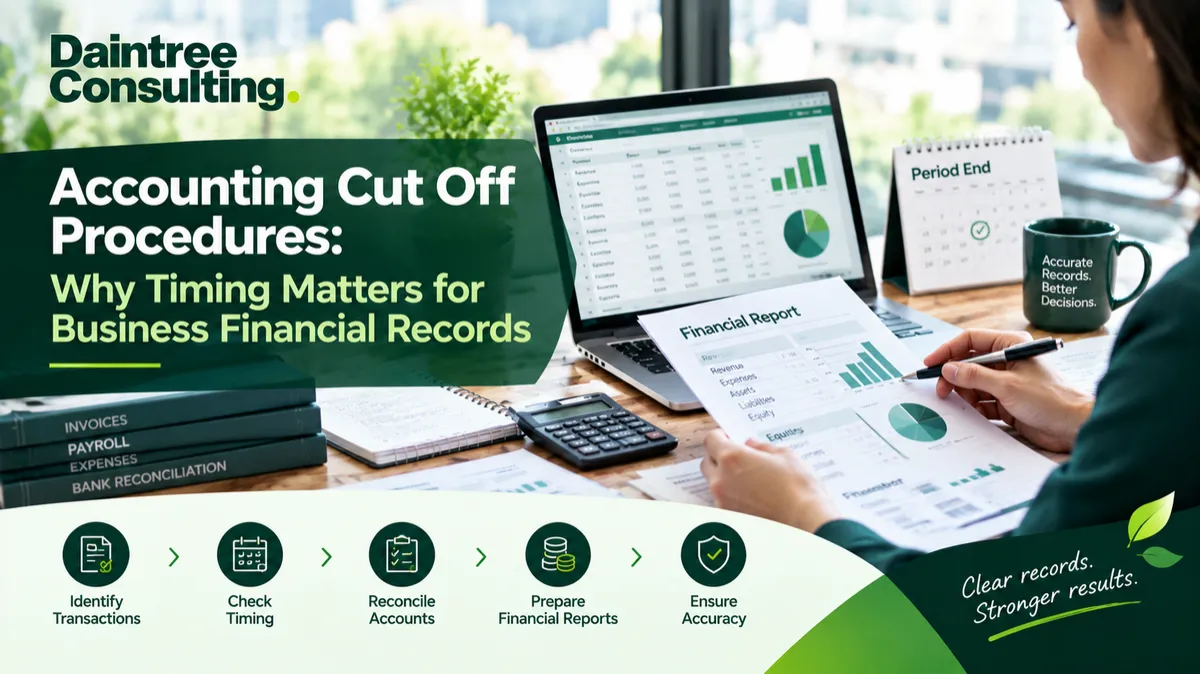
Accounting Cut Off Procedures: Why Timing Matters
When a business is growing, financial records can quickly become difficult to keep perfectly aligned with what is actually happening operationally.
A supplier invoice may arrive after month-end. A customer may be invoiced before work is completed. Employees may earn wages before the payroll is processed. Inventory may be received before the invoice arrives.
Want expert help? Daintree Consulting's accounting services can take this off your plate. Book a free consultation.
This is where accounting cut off procedures become important.
Cut-off procedures help a business determine whether transactions have been recorded in the correct accounting period. Done properly, they help management produce more reliable financial reports, identify liabilities and income at the appropriate time, and reduce avoidable adjustments during year-end or audit processes.
For Australian businesses, this matters because financial statements prepared under applicable Australian Accounting Standards generally use the accrual basis of accounting, meaning transactions are recognised based on when the relevant accounting criteria are met rather than simply when cash changes hands.
Quick answer: What are accounting cut off procedures?
Accounting cut off procedures are checks performed around the end of an accounting period to make sure income, expenses, assets and liabilities are recorded in the correct period.
A typical cut-off review may examine:
Sales and customer invoices immediately before and after period-end
Supplier invoices and unpaid expenses
Payroll and employee-related costs
Inventory received or dispatched around period-end
Prepayments and accrued expenses
Credit notes and refunds
Large or unusual transactions
Revenue recognition for services or contracts
Manual journals posted close to the reporting date
The objective is not simply to make the accounts balance. It is to make sure the financial records reflect the business activity that actually belongs in that reporting period.
Why does accounting cut-off matter?
The timing of a transaction can materially change what your financial statements appear to say.
Imagine a business completes $100,000 of work in June but records the revenue in July simply because the invoice was issued in July.
June revenue may be understated.
July revenue may be overstated.
If the business also has $40,000 of June expenses that were not recorded until July, the problem becomes larger. June's reported profit could look stronger than it really was, while July's results could look weaker.
This can affect management decisions about:
Profitability
Cash flow
Budget performance
Sales performance
Cost control
Working capital
Financing
Business valuation
Performance against targets
Accurate financial information is particularly important for businesses using monthly or quarterly management reporting. Daintree's current Accounting Services offering focuses on reconciled records, timely management accounts, reporting and dependable financial information for decision-making.
Accounting cut off procedures and the accrual basis
One of the key concepts behind cut-off is accrual accounting.
Under AASB 101, entities preparing financial statements under that standard use the accrual basis of accounting, except for cash flow information. Items are recognised when they meet the relevant definitions and recognition criteria rather than simply when cash is received or paid.
This creates an important distinction:
The date on an invoice is not automatically the date the transaction belongs in the accounts.
Instead, the accounting treatment needs to consider what actually happened.
For example, suppose:
A supplier provides services throughout June.
The supplier issues an invoice on 5 July.
The business receives the invoice on 6 July.
If the services relate to June, the business may need to recognise the June expense and corresponding liability, subject to the applicable accounting requirements and circumstances.
That is a cut-off issue.
What should accounting cut off procedures check?
A good cut-off process should be tailored to the business, but several areas commonly deserve attention.
1. Revenue and customer invoices
Revenue is one of the most important areas to review.
Businesses should examine sales and revenue transactions immediately before and after the reporting date.
The question is not simply:
"When was the invoice issued?"
The more important question is:
"When was the underlying good or service transferred or the relevant performance obligation satisfied?"
Under AASB 15, revenue is recognised when, or as, an entity satisfies a performance obligation by transferring the promised good or service to the customer.
For some businesses, this may mean reviewing:
Delivery dates
Service completion dates
Contracts
Project milestones
Customer acceptance
Work performed before period-end
Revenue recognised over time
Credit notes issued after period-end
This becomes particularly important for businesses with longer contracts, projects or services delivered across multiple reporting periods.
Example
A consulting business completes a project milestone on 28 June but does not issue the invoice until 4 July.
The invoice date alone should not determine the accounting period.
Management needs to assess the applicable revenue recognition requirements and the facts of the contract.
2. Supplier invoices and unpaid expenses
Expense cut-off is the other side of the process.
A business may have received goods or services before the reporting date but not yet received the supplier's invoice.
Without a review, the expense and liability may be missed.
Common examples include:
Professional services
Legal fees
Accounting fees
Contractors
Utilities
Freight
Marketing services
Software subscriptions
Repairs and maintenance
Interest
Other recurring services
A month-end or year-end review can identify services already received but not yet recorded.
Depending on the circumstances, an accrual or other appropriate accounting adjustment may be required.
3. Payroll and employee costs
Payroll is another area where timing can create differences between operational activity and accounting records.
Consider employees who work through 30 June but are not paid until early July.
The payment date falls in July, but the employees may have earned the wages in June.
A cut-off review should therefore consider:
Pay periods crossing month-end
Wages earned but unpaid
Bonuses
Commissions
Leave-related balances
Superannuation obligations
Payroll adjustments
Terminations occurring near period-end
The exact accounting treatment depends on the circumstances and applicable reporting requirements.
For businesses with growing teams, having clear responsibility for payroll and month-end processes can help prevent these timing issues from becoming recurring problems.
Daintree's Bookkeeping & Payroll service includes payroll processing, payroll records and month-end bookkeeping support.
4. Inventory received or dispatched around period-end
Businesses holding inventory need particularly careful cut-off procedures.
A common question is:
Did the inventory belong in the business's records at the reporting date?
The answer can depend on factors such as:
When goods were received
When goods were dispatched
Contractual terms
When control transferred
Whether goods were held on behalf of another party
Whether the transaction has been recorded correctly in the inventory system
For example, inventory physically received before year-end but invoiced afterwards should not automatically be ignored simply because the supplier invoice has not yet arrived.
Likewise, goods invoiced before year-end may require further consideration if they had not yet been delivered or control had not transferred.
Inventory cut-off can also affect cost of sales and gross profit, making it particularly important for businesses where stock is a significant part of operations.
5. Prepayments and expenses covering future periods
Not every payment made before period-end represents an expense belonging entirely to that period.
Consider a business that pays an annual insurance premium in June.
If the payment provides coverage extending into the following financial year, the entire amount may not belong in the current period's expense.
The relevant portion may need to be treated as a prepayment and recognised as an expense over the appropriate period.
Other examples can include:
Annual software subscriptions
Insurance
Rent
Service contracts
Memberships
Advertising arrangements
Maintenance agreements
Cut-off procedures therefore need to look at both what has happened and what period the payment relates to.
6. Credit notes, refunds and adjustments
Transactions occurring shortly after period-end can sometimes provide useful information when reviewing the previous period.
For example, a customer may receive a credit note shortly after year-end relating to a sale recorded immediately before year-end.
That does not automatically mean the original sale was incorrectly recorded.
However, it may be a useful transaction to investigate.
Businesses should consider reviewing:
Credit notes
Sales returns
Refunds
Cancelled invoices
Reversed transactions
Supplier adjustments
Post-period journal entries
The purpose is to understand whether the original transaction was recorded in the appropriate period and under the appropriate accounting treatment.
A practical accounting cut off procedures checklist
A useful process can be built around the reporting date.
Step 1: Establish the cut-off date
Clearly identify the reporting period being closed.
For example:
31 March
30 June
30 September
31 December
Monthly reporting dates
Everyone involved should understand when the period closes and which transactions require review.
Step 2: Identify transactions around the boundary
Review transactions immediately before and after the reporting date.
The exact review window should reflect the business and its risks.
Focus particularly on:
Large transactions
Unusual transactions
Manual journals
New contracts
Significant purchases
Major sales
Inventory movements
Transactions posted late
Step 3: Review unbilled revenue and uninvoiced expenses
Ask:
What work has been completed but not invoiced?
What services have been received but not invoiced?
Are there known commitments that relate to the period?
Are recurring expenses missing?
Are project costs complete?
This can help identify accruals, revenue adjustments or other necessary accounting entries.
Step 4: Review subsequent transactions
Look at selected transactions recorded shortly after period-end.
This can help identify transactions that may relate to the previous reporting period.
The review should be risk-based rather than an assumption that every post-period transaction requires adjustment.
Step 5: Reconcile key accounts
Cut-off is much easier when the underlying records are already organised.
Depending on the business, this may include reconciling:
Bank accounts
Accounts receivable
Accounts payable
Payroll
Inventory
Fixed assets
Loans
GST accounts
Intercompany balances
Step 6: Document adjustments
Where an adjustment is required, retain enough information to explain:
What was identified
Which period it relates to
Why the adjustment was made
How the amount was calculated
Who reviewed or approved it
What supporting evidence exists
This creates a clearer audit trail and makes future period-end processes easier.
Common accounting cut-off mistakes
Cut-off problems are often process problems rather than isolated accounting errors.
Mistake 1: Using the invoice date as the accounting date
An invoice date can be useful evidence, but it does not automatically determine the accounting period.
The underlying transaction and applicable accounting requirements matter.
Mistake 2: Waiting for the supplier invoice
If goods or services have already been received, waiting for the invoice can result in expenses or liabilities being omitted from the period.
Mistake 3: Ignoring transactions after year-end
Post-period transactions can sometimes provide useful evidence when investigating what happened around the reporting date.
Mistake 4: Treating every adjustment as a tax adjustment
Financial reporting cut-off and tax treatment are related but are not necessarily identical.
A business should not assume that an accounting adjustment automatically determines its GST, income tax or other tax treatment.
Where the tax implications are significant, the accounting and tax treatment should be considered separately.
Mistake 5: Making large late journals without review
Manual journals close to period-end deserve appropriate attention, particularly when they significantly affect revenue, expenses, assets or liabilities.
A strong process should require supporting evidence and appropriate review rather than treating late journals as automatically wrong.
How cut-off procedures improve financial reporting
The value of cut-off goes beyond producing cleaner year-end accounts.
A consistent process can improve the quality of monthly management reporting as well.
Without appropriate cut-off, management may see:
Revenue appearing higher or lower than it really is
Expenses shifting between months
Incorrect gross margins
Misleading project profitability
Unexpected liabilities
Inconsistent monthly results
Difficult-to-explain variances
This can make it harder to answer basic management questions.
For example:
Are margins actually improving?
Did this month's sales increase because of genuine growth or because transactions were recorded in a different period?
Are expenses increasing, or have some costs simply been pushed into the next month?
Is the business genuinely generating more profit, or does the reported result need adjustment?
Reliable cut-off procedures make these questions easier to answer because the reporting period has a more consistent basis.
Accounting cut-off and audit readiness
Cut-off is also an area auditors may examine.
Daintree's current blog content identifies revenue and expense cut-off problems as a common source of audit questions, particularly around transactions immediately before and after year-end.
Auditors may examine whether transactions have been recorded in the correct period and obtain evidence around the reporting date.
This is one reason businesses should avoid treating year-end preparation as something that starts only when the auditor sends a request list.
A better approach is to maintain disciplined processes throughout the year.
ASIC states that companies must keep financial records that correctly record and explain transactions and enable true and fair financial statements to be prepared and audited. ASIC also highlights the importance of appropriate accounting policies, controls and processes.
How to make accounting cut-off procedures more reliable
The best process is usually one that is repeatable.
Rather than rebuilding the year-end process from scratch, businesses can create a standard month-end or year-end checklist covering:
Reporting date confirmed
Bank and balance-sheet reconciliations completed
Sales cut-off reviewed
Purchases and supplier invoices reviewed
Accrued expenses considered
Revenue recognition reviewed where relevant
Payroll cut-off completed
Inventory movements reviewed
Prepayments reviewed
Credit notes and refunds reviewed
Significant post-period transactions reviewed
Manual journals reviewed
Adjustments documented
Management accounts reviewed
The precise checklist should reflect the business's size, industry, accounting framework, systems and transaction types.
A growing business may also need to formalise who owns each step.
For example:
Bookkeeping team — transaction processing and reconciliations
Finance manager — review and adjustments
Management — review of significant matters
External accountant — accounting or reporting support where engaged
Auditor — independent audit procedures where an audit applies
Clear ownership can reduce the risk of everyone assuming someone else has checked the issue.
When should a business review its cut-off procedures?
There is no single cut-off process that works for every organisation.
A review may be particularly useful when:
The business has grown significantly
Transaction volumes have increased
New accounting software has been introduced
The finance team has changed
Reporting deadlines have become tighter
Monthly management accounts are being introduced
The business has started holding significant inventory
Revenue arrangements have become more complex
There are recurring year-end adjustments
An audit has identified cut-off issues
Management does not have confidence in monthly results
Daintree's current Accounting Services approach specifically includes establishing a dependable close, reviewing the ledger and reporting controls, and agreeing an appropriate reporting timetable.
Why Daintree Consulting for accounting process support?
Cut-off procedures work best when they form part of a broader financial reporting process rather than being treated as a once-a-year exercise.
Daintree Consulting supports Australian businesses with accounting, bookkeeping and payroll, taxation and BAS compliance, business advisory, outsourced CFO and audit and assurance services. Its current approach is built around understanding the business, clarifying the financial position, establishing the appropriate scope and moving forward with practical support.
For businesses dealing with late reports, unreliable numbers or repeated month-end adjustments, the underlying issue may be broader than cut-off alone.
It may involve:
Reconciliations
Bookkeeping processes
Management reporting
Chart-of-accounts structure
Internal controls
Revenue processes
Accounts payable
Financial review procedures
Responsibility for month-end close
Addressing the wider process can make financial information more dependable throughout the year.
Need help improving your financial reporting process?
If your month-end or year-end accounts regularly require significant adjustments, it may be worth reviewing how transactions are captured, reconciled and closed.
Book a free 30-minute discovery call with Daintree Consulting. The conversation can focus on where financial clarity is breaking down and what a practical next step could look like — with no pressure or obligation.
Frequently Asked Questions
What are accounting cut off procedures?
Accounting cut-off procedures are checks performed around the end of an accounting period to ensure transactions are recorded in the appropriate period. They commonly cover revenue, expenses, payroll, inventory, accruals, prepayments and transactions immediately before and after period-end.
Why is cut-off important in accounting?
Cut-off helps financial reports reflect the business activity belonging to the relevant reporting period. Poor cut-off can shift revenue, expenses, assets or liabilities between periods and make management reports less reliable.
Is the invoice date the accounting date?
Not necessarily. The invoice date is one piece of evidence, but the appropriate accounting period depends on what the underlying transaction represents and the applicable accounting requirements. For revenue, AASB 15 can require consideration of when performance obligations are satisfied.
What is an example of an accounting cut-off error?
One example is recording a service expense entirely in July when the service was actually received in June. Another is recognising revenue in June simply because an invoice was issued in June when the relevant performance obligation was not satisfied until July.
Should businesses perform cut-off procedures every month?
For businesses relying on monthly management reporting, a regular month-end close and cut-off process can help produce more consistent financial information. The appropriate frequency and depth depend on the business and its reporting needs.
Does accounting cut-off determine tax treatment?
Not necessarily. Financial reporting and tax rules can have different requirements. A business should consider the applicable GST, income tax and other tax rules separately rather than assuming an accounting treatment automatically determines the tax result.
Talk to Daintree about your accounting
Our ex-Big 4 team gives clear, senior-reviewed advice so you can act with confidence.
Book a free consultation →
Or explore our accounting services.
