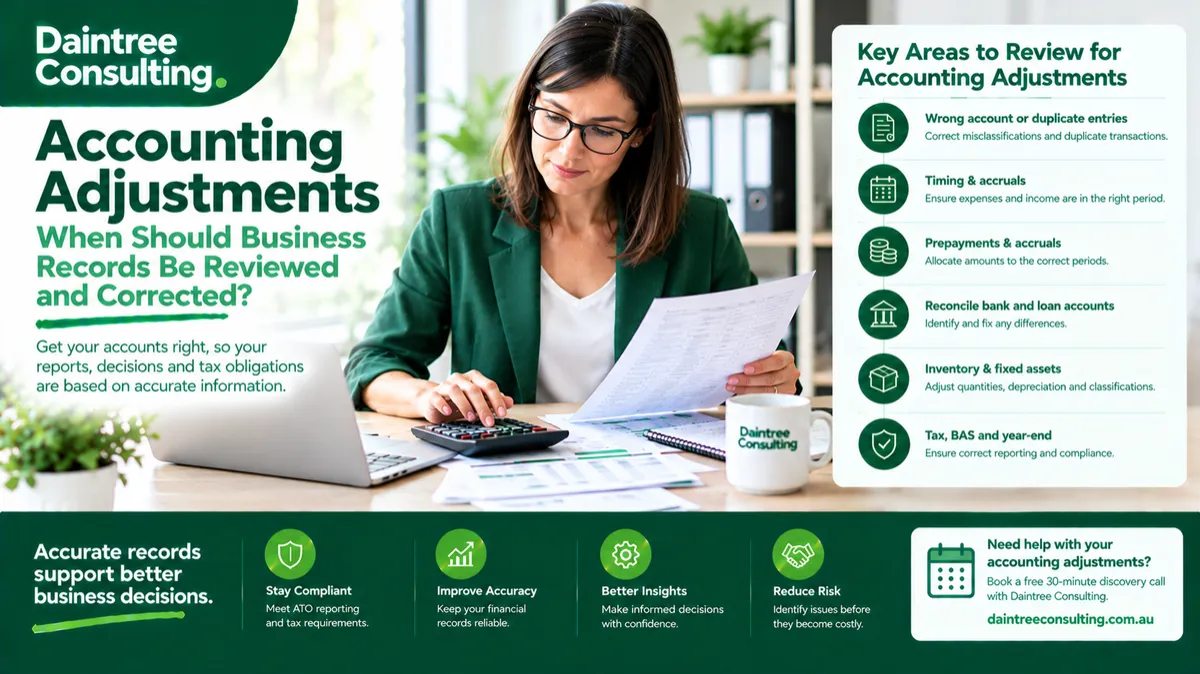
Accounting Adjustments: When Should Business Records Be Corrected?
Business accounting records do not always remain accurate simply because transactions have been entered into the accounting system.
An invoice may be posted to the wrong account. A bank transaction may be duplicated. An expense may have been recorded in the wrong period. A balance-sheet account may no longer reconcile. A fixed asset may have been treated as an ordinary expense. Or a year-end adjustment may be required before the financial statements accurately reflect the business.
Want expert help? Daintree Consulting's accounting services can take this off your plate. Book a free consultation.
These situations are where accounting adjustments become important.
An accounting adjustment is not necessarily a sign that something has gone seriously wrong.
Many adjustments are a normal part of maintaining accurate financial records, particularly when businesses use accrual accounting and need to account for transactions or balances that are not automatically captured correctly by day-to-day bookkeeping.
The important question is not whether a business ever needs adjustments.
It is whether the business has a process for identifying, reviewing, documenting and correcting adjustments before inaccurate information affects important decisions or reporting obligations.
For Australian businesses, regular review of accounting records can help improve the quality of management reporting, BAS preparation, financial statements and year-end accounting.
Quick answer: When should accounting records be adjusted?
Business records may need to be reviewed and corrected when:
A transaction has been posted to the wrong account.
An amount has been recorded twice.
A transaction is missing.
A bank or balance-sheet account does not reconcile.
An expense or income item is recorded in the wrong period.
An accrual or prepayment needs to be recognised.
A fixed asset has been incorrectly expensed or classified.
Depreciation needs to be recorded.
A loan balance does not agree with supporting records.
Accounts receivable or payable balances require correction.
A prior bookkeeping error has been identified.
A year-end adjustment is required.
Management reporting does not reflect the underlying financial position.
A BAS or tax reporting figure may have been affected.
New information changes the appropriate accounting treatment.
The appropriate adjustment depends on the transaction, accounting framework, reporting period and circumstances of the business.
What is an accounting adjustment?
An accounting adjustment is an entry made to correct, update or appropriately recognise an amount in a business's accounting records.
Some adjustments correct an error.
Others recognise information that was not captured through normal transaction processing.
For example, a business might have paid an annual insurance premium upfront.
The bank transaction has been correctly recorded.
But if the entire amount has been treated as an expense immediately, the accounts may not appropriately reflect the portion relating to future periods.
An accounting adjustment may therefore be required to allocate the expense to the appropriate periods.
Other adjustments can involve:
Accrued expenses
Accrued income
Prepayments
Depreciation
Bad debts
Inventory
Payroll
Loans
Interest
Fixed assets
Foreign currency transactions
Intercompany balances
GST-related corrections
Other balance-sheet items
The adjustment itself is only part of the process.
A good accounting process should also establish why the adjustment is needed and what evidence supports it.
Why accounting adjustments matter
Accounting adjustments can affect much more than the appearance of a profit and loss statement.
An incorrect accounting entry can flow into:
Management reports
Profit calculations
Balance-sheet balances
Cash-flow information
BAS preparation
Tax calculations
Financial statements
Business performance analysis
Financing discussions
Audit or assurance processes
For example, if an expense is recorded in the wrong period, management may believe that the business was more profitable in one month and less profitable in another.
The total annual expense might eventually be correct, but the monthly reporting can still be misleading.
For a business owner making decisions based on monthly results, that timing issue matters.
Accounting adjustments vs correcting bookkeeping errors
These concepts are related but not always identical.
A bookkeeping error occurs when a transaction has been entered incorrectly.
Examples include:
Wrong account
Wrong amount
Duplicate transaction
Missing transaction
Incorrect tax code
Incorrect date
Incorrect customer or supplier allocation
An accounting adjustment can be broader.
It may be required even when the original transaction was entered correctly.
For example, an expense paid in advance may have been correctly recorded as a payment, but an adjustment may still be required to reflect the expense across the appropriate accounting periods.
This distinction is useful because not every accounting adjustment means that the bookkeeper made a mistake.
1. Adjustments for transactions posted to the wrong account
One of the simplest accounting adjustments involves correcting the classification of a transaction.
For example, a business may accidentally record an insurance expense as advertising.
The bank reconciliation may still balance.
The total expenses may still be correct.
But the individual expense categories are inaccurate.
This can affect management reporting.
If the business owner is reviewing advertising expenditure against budget, the report may show an apparent variance that does not actually exist.
The correction may therefore be relatively simple, but it improves the usefulness of the financial information.
2. Adjustments for duplicate transactions
Duplicate entries can occur for several reasons.
For example:
A bank feed imports a transaction automatically.
The same transaction is manually entered.
A supplier invoice is entered twice.
A payment is recorded both through the bank feed and through a manual journal.
The result can be an overstated expense, asset or liability.
Duplicate transactions are particularly important to identify during account reconciliation.
A business should not simply assume that a reconciled bank balance means the accounting records are accurate.
The individual transactions still need to make sense.
3. Adjustments for missing transactions
The opposite problem is a transaction that has not been recorded.
Examples could include:
A supplier invoice
Bank interest
Bank fees
Loan interest
A customer refund
An asset purchase
A payroll adjustment
A recurring subscription
A credit note
A missing transaction can distort both the profit and loss statement and the balance sheet.
Regular reconciliations can help identify these omissions.
4. Accrual adjustments
Accruals are a common reason businesses need accounting adjustments.
An expense may relate to the current reporting period even though the supplier has not yet issued an invoice or the business has not yet paid it.
For example, suppose a business receives professional services during June but receives the invoice in July.
If the business prepares accounts on an accrual basis, the June financial statements may need to recognise the expense relating to June.
An adjustment can record the relevant amount in the appropriate period.
Accruals may also apply to income where revenue has been earned but has not yet been invoiced or received, depending on the circumstances and accounting treatment.
5. Prepayment adjustments
Prepayments are another common area.
Suppose a business pays $12,000 for a 12-month insurance policy.
If the entire amount is initially recorded as an expense, the accounts may need to be adjusted so that the portion relating to future periods is treated appropriately.
The adjustment effectively distinguishes between:
Expense relating to the current period
and
Amount relating to future periods
This can provide a more accurate picture of the business's financial performance for the current reporting period.
6. Depreciation adjustments
Businesses that own depreciable assets may need to recognise depreciation in their financial records.
This can apply to assets such as:
Equipment
Vehicles
Office furniture
Technology
Machinery
Other business assets
Depreciation is an accounting allocation of an asset's depreciable amount over its useful life.
If depreciation has not been recorded correctly, the business's profit and asset balances may be misstated.
The appropriate treatment can depend on the asset, accounting framework, useful life and other circumstances.
It is also important to distinguish accounting depreciation from tax depreciation.
They are not necessarily the same calculation.
7. Fixed asset adjustments
Fixed asset records should be reviewed when a business purchases, disposes of or changes the use of significant assets.
An adjustment may be required when:
An asset has been incorrectly expensed.
A capital purchase has been posted to an ordinary expense account.
An asset has been disposed of but remains on the register.
Depreciation has not been recorded.
The asset register does not agree with the general ledger.
An asset's carrying amount requires review.
This is why maintaining a reliable fixed asset register is an important part of accounting processes.
8. Bad debt and receivable adjustments
Accounts receivable should also be reviewed regularly.
A customer balance may remain outstanding for an extended period.
That does not automatically mean the debt is irrecoverable.
However, management should consider whether the receivable remains recoverable and whether an appropriate accounting adjustment is required under the applicable reporting framework.
The review may consider:
Age of the debt
Customer communications
Payment history
Subsequent receipts
Disputes
Financial circumstances
Other available evidence
The objective is to ensure receivables are not simply carried forward indefinitely without review.
9. Inventory adjustments
Businesses holding inventory may need accounting adjustments when the recorded inventory balance does not agree with physical or other supporting records.
Differences can arise from:
Stocktake differences
Damaged goods
Obsolete inventory
Theft or loss
Incorrect quantities
Incorrect costing
Cut-off issues
Unrecorded purchases or sales
Inventory adjustments can affect both the balance sheet and cost of sales.
For businesses where inventory is significant, regular review can be particularly important.
10. Payroll adjustments
Payroll is another area where corrections can arise.
Examples include:
Incorrect wages
Incorrect leave balances
Payroll coding errors
Incorrect deductions
Payroll journals posted incorrectly
Superannuation-related corrections
Termination payment adjustments
PAYG withholding corrections
Payroll corrections should be handled carefully because an error may affect more than the accounting ledger.
It may also affect payroll reporting and other employer obligations.
This is why payroll adjustments should be documented and reconciled rather than simply overwritten.
11. GST and BAS-related adjustments
Accounting adjustments can also affect GST and BAS preparation.
For example, a business may identify:
An incorrect GST code
A transaction that was omitted
A duplicated transaction
A credit note that was not processed
An incorrectly classified purchase
A correction affecting a previous reporting period
A business should determine whether the adjustment affects its accounting records only or whether it also affects a previously lodged activity statement.
The appropriate treatment depends on the nature of the error and applicable ATO requirements.
This is one reason accounting adjustments should ideally be identified before BAS lodgement rather than discovered months later.
12. Loan and interest adjustments
Borrowings should be reconciled against supporting loan documentation.
An accounting adjustment may be required when:
The loan balance does not agree with the lender's statement.
Interest has not been recorded.
Principal repayments have been incorrectly classified as expenses.
Fees have been posted incorrectly.
A loan has been refinanced.
A current and non-current portion needs to be considered.
The underlying loan statement is often an important source of evidence.
A balance-sheet reconciliation can help identify differences before financial statements are prepared.
13. Bank reconciliation adjustments
Bank reconciliation is one of the most practical ways to identify accounting adjustments.
The process compares the accounting records with the bank's records.
Differences may arise because of:
Outstanding transactions
Bank fees
Interest
Direct debits
Deposits
Timing differences
Duplicate entries
Missing transactions
Not every difference requires an accounting adjustment.
Some differences are simply timing differences.
The important thing is to identify the reason for the difference and determine whether an accounting entry is required.
14. Year-end accounting adjustments
Year-end is when many businesses perform a more detailed review of their accounting records.
The objective is to make sure the financial statements reflect the business's financial position and performance appropriately for the reporting period.
Depending on the business, year-end adjustments may include:
Accruals
Prepayments
Depreciation
Inventory adjustments
Bad debts
Payroll adjustments
Loan reconciliations
Fixed asset adjustments
Interest
Provisions
Other balance-sheet reconciliations
Year-end should not be the first time these issues are considered.
However, it is an important final review point.
15. Adjustments when management reporting looks unusual
Accounting adjustments are not only about compliance.
They can also improve management reporting.
Suppose a business owner sees that professional fees doubled in one month.
Before concluding that costs have increased significantly, management should investigate.
The difference could be caused by:
A duplicate invoice
A year-to-date adjustment
An annual subscription
An accrual
A prepayment
Incorrect account coding
The numbers should be investigated before management makes decisions based on them.
This is one of the reasons monthly financial review is valuable.
When should accounting records be reviewed?
There are several useful review points throughout the year.
During monthly bookkeeping
Routine bookkeeping should identify obvious errors and unreconciled accounts.
During month-end close
A more structured review can consider accruals, prepayments, payroll, depreciation and key balance-sheet accounts.
Before BAS lodgement
Businesses should review transactions and tax codes that may affect the activity statement.
Before management reporting
Important accounts should be reviewed so owners are not making decisions from obviously incomplete or misleading information.
Before financial year-end
Known issues should be identified early rather than left until the final financial statement preparation stage.
During year-end financial statement preparation
The accounts should undergo a more comprehensive review and adjustment process.
When circumstances change
Significant transactions, acquisitions, new loans, restructures, asset purchases or other unusual events may require accounting review.
How do you know if an accounting adjustment is needed?
There is no single warning sign.
However, businesses should investigate when:
A balance-sheet account does not reconcile.
A transaction looks unusual.
Profit changes significantly without an obvious explanation.
A major expense appears in an unexpected period.
A customer or supplier balance looks incorrect.
The bank balance does not agree with accounting records.
The fixed asset register does not agree with the ledger.
Payroll reports do not agree with the accounting system.
GST figures look unusual.
Loan balances do not agree with lender statements.
Management reports contain unexplained variances.
A prior-period error is discovered.
New information changes the understanding of a transaction.
The purpose of the review is not to make the accounts "look right".
It is to understand whether the records accurately represent the underlying transactions and financial position.
Should accounting adjustments be made every month?
Not every business requires the same level of monthly adjustment.
However, businesses using accrual accounting and relying on monthly management reporting may need recurring adjustments to produce useful period-by-period information.
Common monthly adjustments can include:
Accrued expenses
Prepayments
Depreciation
Interest
Payroll-related amounts
Other recurring accounting adjustments
The business should determine which adjustments are relevant to its reporting requirements.
The key is consistency.
If a business makes an adjustment one month but does not consider the same issue in subsequent months, management reporting can become inconsistent.
How should an accounting adjustment be documented?
A good adjustment should have a clear explanation.
Depending on the adjustment, documentation can include:
Reason for the adjustment
Amount
Date
Relevant reporting period
Accounts affected
Supporting calculation
Supporting invoice or statement
Person who prepared it
Person who reviewed or approved it
Reversal date where applicable
For recurring adjustments, businesses may also maintain an adjustment schedule.
This can make the month-end and year-end process more efficient.
What makes an accounting adjustment reliable?
An accounting adjustment should be supported by appropriate information.
For example:
Accrual
Supporting supplier estimate, contract, calculation or other relevant evidence.
Prepayment
Invoice and details showing the period covered.
Loan adjustment
Lender statement and reconciliation.
Depreciation
Fixed asset register and depreciation calculation.
Payroll adjustment
Payroll report and supporting calculation.
Inventory adjustment
Stocktake records and supporting analysis.
The exact evidence will depend on the transaction.
The principle is straightforward:
The adjustment should be explainable and supportable.
Accounting adjustments should not hide problems
There is an important distinction between correcting the accounts and repeatedly adjusting them because the underlying process is unreliable.
If the same adjustment is required every month because transactions are consistently entered incorrectly, the business may have a process problem.
For example, if payroll is repeatedly posted to the wrong accounts, the solution may not be another manual journal.
It may be better to fix the payroll-to-accounting workflow.
Likewise, if bank reconciliations repeatedly contain unexplained differences, the business should investigate why.
Good accounting is not just about correcting errors.
It is also about reducing the likelihood that the same errors continue to occur.
How accounting adjustments can improve financial reporting
Accurate adjustments can make financial reports more useful to management.
They can help ensure that:
Revenue is reported in the appropriate period.
Expenses are appropriately recognised.
Assets are correctly recorded.
Liabilities are not overlooked.
Profitability is more meaningful.
Balance-sheet accounts are supported.
Cash-flow information is more useful.
Budget variances can be investigated accurately.
This becomes particularly important when owners use monthly financial information to make decisions.
A report that is produced quickly but contains unresolved accounting issues may be less useful than a report that takes slightly longer to prepare but has been properly reviewed.
Accounting adjustments and business decision-making
The value of accurate accounting is ultimately about what management does with the information.
Consider a business where reported profit suddenly falls.
There are several possible explanations.
Perhaps sales have declined.
Perhaps supplier costs have increased.
Perhaps payroll has increased.
Or perhaps a large annual expense has been recorded entirely in one month when an adjustment should have been considered.
Without reviewing the underlying accounting records, management may react to the wrong problem.
That can lead to poor decisions about:
Hiring
Pricing
Spending
Cash management
Investment
Growth
Financing
Accounting adjustments therefore support more than financial compliance.
They can help make management reporting more reliable.
A practical accounting adjustment review checklist
Business owners can use the following checklist as part of a monthly or year-end review.
Bank accounts
Are all bank accounts reconciled?
Are bank fees recorded?
Is bank interest recorded?
Are unexplained differences investigated?
Receivables
Do customer balances agree with supporting records?
Are overdue balances reviewed?
Are doubtful or irrecoverable amounts appropriately considered?
Payables
Are supplier balances accurate?
Are all major invoices recorded?
Are unpaid expenses captured in the correct period?
Payroll
Does payroll agree with the accounting records?
Are wages, leave and other balances correct?
Have payroll corrections been documented?
Fixed assets
Are new assets recorded correctly?
Have disposals been processed?
Is depreciation up to date?
Does the asset register agree with the ledger?
Loans
Do loan balances agree with lender statements?
Has interest been recorded?
Are repayments correctly classified?
GST and BAS
Are tax codes correct?
Are unusual transactions reviewed?
Could any adjustment affect a previous BAS?
Month-end and year-end
Are accruals required?
Are prepayments up to date?
Are recurring adjustments complete?
Are significant unusual transactions reviewed?
Are balance-sheet accounts reconciled?
What happens if an accounting error is discovered after the financial year?
Discovering an error after year-end does not necessarily mean the business has a major problem.
The appropriate response depends on:
What the error is
When it occurred
Its amount
Its effect on the financial statements
Whether tax or BAS reporting is affected
Whether financial statements have already been finalised
Whether any external reporting has occurred
The business should assess the issue rather than simply posting an unexplained correction into the current period.
Where tax, BAS or financial reporting obligations may be affected, the appropriate treatment should be considered with the business's accountant or tax professional.
How Daintree can help with accounting adjustments
Accounting adjustments are most useful when they form part of a broader review process.
Daintree Consulting can support Australian businesses with:
Monthly accounting review
Account reconciliations
Balance-sheet reconciliations
Management accounts
Month-end close
Accruals and prepayments
Fixed asset accounting
Payroll accounting support
Financial reporting
BAS-ready records
Year-end accounting preparation
Identification of unusual or unexplained balances
The objective is not simply to make journal entries.
It is to help businesses maintain financial records that are accurate, organised and useful for management decision-making.
For businesses that are growing, regular accounting review can also help identify process issues before they become more difficult to correct.
Need help reviewing and correcting your business accounts?
If your financial reports contain unexplained balances, recurring adjustments or reconciliations that are difficult to keep up with, Daintree Consulting can help review the underlying accounting process.
Book a free 30-minute discovery call with Daintree Consulting to discuss your accounting and financial reporting requirements.
Frequently Asked Questions
What is an accounting adjustment?
An accounting adjustment is an entry made to correct, update or appropriately recognise an amount in a business's accounting records.
It can correct an error or recognise information that was not captured through normal transaction processing.
Why are accounting adjustments needed?
Adjustments can help ensure that income, expenses, assets and liabilities are appropriately recorded for the relevant reporting period.
They can also improve the accuracy of management reports and financial statements.
What are common examples of accounting adjustments?
Common examples include accruals, prepayments, depreciation, inventory adjustments, bad debts, loan adjustments, payroll corrections, interest and fixed asset adjustments.
Are accounting adjustments the same as bookkeeping errors?
Not always.
A bookkeeping error involves an incorrectly recorded transaction. An accounting adjustment can also be required when the original transaction was correctly recorded but additional accounting treatment is needed.
How often should accounting records be reviewed?
Businesses should generally review their records regularly, with the frequency depending on the size, complexity and reporting requirements of the business.
Monthly review is often useful for businesses that rely on monthly management reporting.
Should accounting adjustments be made before BAS lodgement?
Where an adjustment affects information that will be reported through the BAS, it should be identified and considered before lodgement where practical.
The appropriate treatment depends on the nature of the adjustment and applicable requirements.
What is an accrual adjustment?
An accrual adjustment generally recognises income or an expense in the appropriate accounting period when the related transaction has occurred but the corresponding cash payment or invoice may occur in another period.
What is a prepayment adjustment?
A prepayment adjustment can be used where a payment relates partly or wholly to future accounting periods and the accounting treatment needs to reflect the relevant periods appropriately.
Can accounting adjustments affect profit?
Yes.
An adjustment can increase or decrease reported income or expenses and therefore affect accounting profit.
It can also affect balance-sheet accounts without directly changing profit, depending on the nature of the adjustment.
What if an accounting adjustment affects a previous BAS?
The business should determine the nature and period of the error and consider the applicable ATO correction requirements.
Where the issue is significant or unclear, professional tax or accounting advice may be appropriate.
How can Daintree help with accounting adjustments?
Daintree Consulting can support businesses with reconciliations, month-end accounting, management reporting, financial statement preparation, accounting adjustments and year-end accounting processes.
Talk to Daintree about your accounting
Our ex-Big 4 team gives clear, senior-reviewed advice so you can act with confidence.
Book a free consultation →
Or explore our accounting services.
