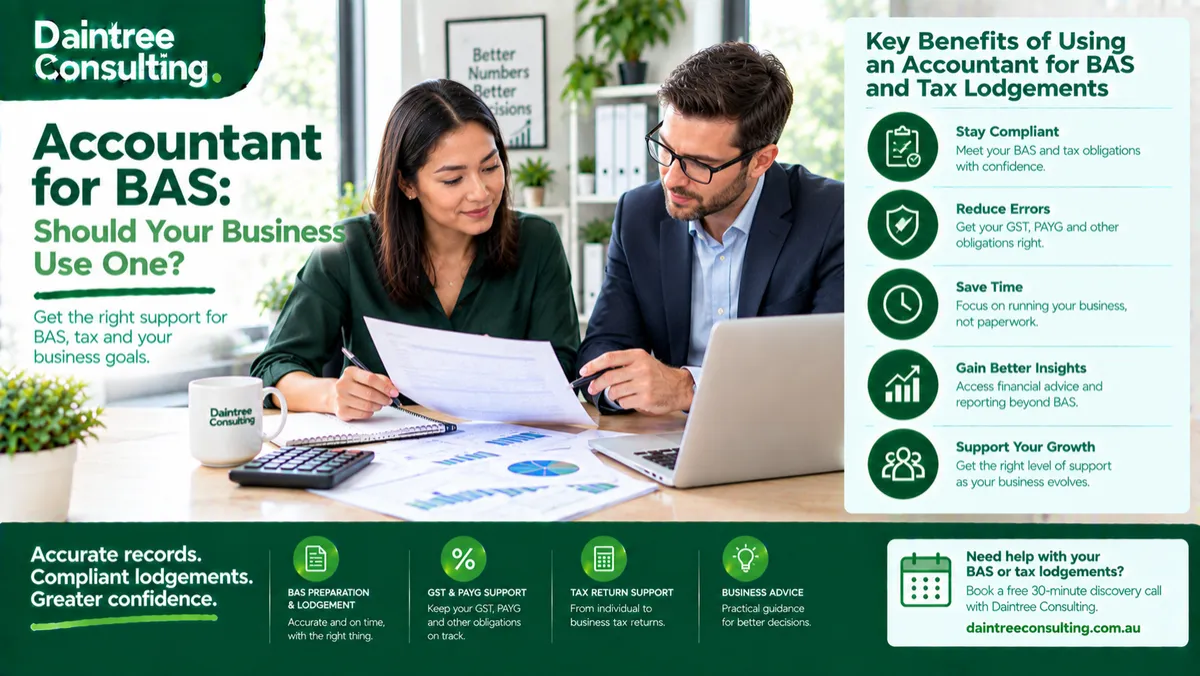
Accountant for BAS: Should Your Business Use One?
Running a business means dealing with financial responsibilities throughout the year, not just at tax time.
Depending on your business, you may need to manage GST, BAS lodgements, PAYG withholding, income tax, business deductions, financial records and other reporting obligations. While some business owners choose to manage these responsibilities themselves, others use an accountant or registered BAS agent to prepare and lodge their forms.
Want expert help? Daintree Consulting's tax and BAS services can take this off your plate. Book a free consultation.
So, should you use an accountant for BAS and tax lodgements?
There is no single answer for every business.
A small business with straightforward transactions and well-organised records may be comfortable handling some obligations internally. A growing or more complex business may benefit from professional support, particularly when bookkeeping, GST, tax deductions, financial reporting and business decisions start becoming more difficult to manage.
The important thing is understanding what professional support actually provides and when it may make sense for your business.
What Does an Accountant Do for BAS and Tax?
An accountant who is appropriately registered may help with more than simply submitting a form to the Australian Taxation Office.
Depending on the engagement and the accountant's qualifications and registrations, services may include:
Reviewing financial records
Checking GST transactions
Preparing BAS information
Preparing and lodging BAS
Preparing business tax returns
Reviewing business deductions
Checking tax-related transactions
Helping address ATO correspondence
Identifying issues in financial records
Providing tax and accounting advice
Preparing financial reports
Helping with tax planning
Australian Government guidance states that businesses can either lodge their own BAS or have a registered tax or BAS agent lodge it for them. Tax returns can also be lodged through a registered tax agent.
This distinction matters because the word "accountant" by itself does not tell you whether someone is registered to provide the particular tax or BAS service you need.
If you are paying someone to provide tax agent or BAS services, check that they are appropriately registered with the Tax Practitioners Board.
Can You Lodge Your Own BAS?
Yes.
Businesses can generally lodge their own BAS using the available ATO channels, provided they meet the requirements for the relevant reporting obligation.
A BAS may include reporting and payment obligations relating to areas such as:
GST
PAYG withholding
PAYG instalments
Fringe benefits tax
Luxury car tax
Wine equalisation tax
Not every business reports all of these.
Your BAS is based on your business's particular registrations and circumstances, and the reporting requirements can differ between businesses.
Business.gov.au states that a business can lodge its BAS itself or use a registered tax or BAS agent.
The question is therefore not whether you can lodge your own BAS.
The more useful question is whether doing it yourself is the most practical approach for your business.
When Does It Make Sense to Use an Accountant for BAS?
There are several situations where professional BAS support may become particularly useful.
1. Your GST Transactions Are Becoming More Complicated
GST can become more difficult to manage as a business grows.
You may have:
Different types of sales
Multiple suppliers
Business assets
Imports
Expenses with different GST treatments
Adjustments
Refunds
Credit notes
Private-use considerations
Multiple business activities
The more complicated the transactions become, the more important it is that your bookkeeping and GST coding are accurate.
An accountant or registered BAS agent can review the records and help ensure the BAS is based on appropriate information.
2. Your Business Has Started Growing Quickly
Growth creates more transactions.
You may move from a handful of invoices and expenses each month to hundreds or thousands of transactions.
At the same time, you may add:
Employees
New suppliers
Additional bank accounts
New payment platforms
Business assets
Multiple locations
New products or services
Larger customer accounts
Your BAS does not necessarily become complicated simply because your revenue increases.
However, growth often makes the underlying bookkeeping and financial processes more complicated.
Professional support can help ensure your BAS process grows with the business rather than becoming a last-minute exercise every reporting period.
3. You Are Not Confident Your Books Are Correct
This is one of the clearest reasons to consider professional help.
You may be unsure about:
Whether transactions have been coded correctly
Whether GST has been recorded properly
Whether all bank accounts have been reconciled
Whether expenses have been classified correctly
Whether adjustments have been recorded
Whether previous BAS figures need reviewing
If you are uncertain about the underlying records, simply submitting the BAS may not solve the problem.
The quality of the BAS depends heavily on the quality of the financial information behind it.
A good process therefore starts before lodgement.
4. Your BAS Keeps Becoming a Last-Minute Job
If every BAS deadline creates a rush to find invoices, reconcile bank accounts and correct transactions, the issue may be your bookkeeping process rather than the BAS itself.
A healthier process is to keep financial records updated throughout the reporting period.
That can make it easier to:
Reconcile accounts regularly
Review GST transactions
Identify missing documents
Investigate unusual transactions
Prepare reports
Check figures before lodgement
Business.gov.au recommends keeping accurate financial records and identifies professional support such as accountants, bookkeepers and BAS agents as options for businesses managing their finances.
Using an accountant for BAS may therefore be most valuable when it forms part of a broader financial process rather than simply being a final submission service.
5. You Are Unsure About Your Tax Obligations
BAS is only one part of business tax compliance.
Depending on your business, you may also need to consider:
Income tax
GST
PAYG withholding
PAYG instalments
Fringe benefits tax
Capital gains tax
Payroll tax
Superannuation obligations
Other industry or state-based requirements
Not every business will have all of these obligations.
An accountant can help you understand which obligations apply to your particular structure and circumstances.
This can be particularly useful when your business is changing.
For example, you may be:
Hiring your first employees
Purchasing a major business asset
Changing business structure
Expanding into a new activity
Acquiring another business
Selling a business asset
Taking on significant finance
Expanding into another state
These situations can create tax considerations that go beyond simply completing the next BAS.
6. You Want Someone to Review Your Financial Records
Using an accountant for BAS can provide an opportunity to identify problems in the underlying bookkeeping.
For example, a review may identify:
Unreconciled bank accounts
Duplicate transactions
Missing invoices
Incorrect GST treatment
Unusual expense classifications
Incorrect opening balances
Unrecorded transactions
Errors carried forward from previous periods
This is particularly important if your business has changed bookkeepers, accounting software or internal processes.
A BAS should not be treated as a standalone document.
It is produced from the financial information your business has accumulated during the reporting period.
Accountant for BAS vs BAS Agent: What's the Difference?
Business owners sometimes assume they need an accountant specifically to lodge their BAS.
That is not necessarily the case.
A registered BAS agent can provide BAS-related services within the scope of their registration.
A tax agent can provide a broader range of tax-related services, including tax return preparation and lodgement.
Business.gov.au describes a BAS agent as a specialist who can help prepare and lodge BAS, while tax agents can prepare and lodge tax returns and BAS and provide advice on tax laws relevant to the business.
The right professional depends on what you actually need.
If you only need help with BAS preparation and lodgement, a registered BAS agent may be appropriate.
If you need BAS support alongside business tax returns, tax advice and broader accounting services, an appropriately registered accountant or tax agent may provide a more integrated solution.
The important point is to check the professional's registration and confirm what services are included in the engagement.
Should Your Bookkeeper Lodge Your BAS?
This depends on the services your bookkeeper is authorised and engaged to provide.
Bookkeeping and BAS services are not necessarily the same thing.
A bookkeeper may maintain:
Sales records
Purchase records
Bank reconciliations
Accounts payable
Accounts receivable
Payroll records
General ledger transactions
Supporting documents
Those records may then be used to prepare a BAS.
If someone is providing BAS services for a fee, make sure they have the appropriate registration with the Tax Practitioners Board.
Business.gov.au specifically advises businesses to check that a person providing BAS services is a registered agent.
This is particularly important when outsourcing your bookkeeping and tax administration to different providers.
Everyone involved should understand who is responsible for:
Maintaining the books
Reviewing GST coding
Preparing the BAS
Reviewing the BAS
Lodging the BAS
Communicating with the ATO
Paying the amount owing
Clear responsibilities can help prevent gaps between bookkeeping and lodgement.
What Does an Accountant Need Before Lodging Your BAS?
Your accountant or BAS agent needs reliable financial information to prepare the BAS.
Depending on the business, this may include:
Updated accounting records
Bank statements
Bank reconciliations
Sales invoices
Purchase invoices
Expense receipts
Payroll records
GST information
Asset purchase records
Loan information
Previous BAS information
Other supporting documents
The exact information required depends on your business.
The cleaner your records are before the BAS preparation begins, the easier it may be to review the figures and investigate anything unusual.
This is why good bookkeeping and BAS preparation should work together.
If the accounting records are incomplete, an accountant may spend additional time resolving bookkeeping issues before the BAS can be finalised.
How Much Does an Accountant for BAS Cost?
There is no standard price for BAS accounting services.
The cost can vary depending on:
Transaction volume
Business size
Number of employees
Number of accounts
Complexity of GST transactions
Quality of bookkeeping
Frequency of BAS lodgement
Level of review required
Whether bookkeeping is included
Whether tax services are included
Whether broader accounting support is provided
A business with straightforward transactions and clean monthly bookkeeping may require a very different level of BAS support from a growing business with multiple accounts, employees and complex transactions.
Rather than comparing fees alone, it can be useful to understand exactly what the service includes.
For example, ask whether the quoted service covers:
BAS preparation
BAS review
BAS lodgement
GST reconciliation
Bookkeeping corrections
ATO communication
Tax return preparation
Accounting advice
The cheapest BAS service is not necessarily the same as the simplest overall solution for your business.
Can Using an Accountant Give You More Time?
One of the practical benefits of outsourcing BAS and tax administration is reducing the amount of time the business owner spends on financial administration.
Instead of spending hours:
Reconciling transactions
Checking GST coding
Searching for missing invoices
Preparing BAS figures
Investigating discrepancies
Monitoring lodgement deadlines
you can focus more of your time on running the business.
This does not mean the business owner can ignore their financial responsibilities.
You still need to provide accurate information and understand your obligations.
But professional support can reduce the amount of technical and administrative work you need to manage personally.
Can an Accountant Help With More Than BAS?
Yes.
For many growing businesses, the value of professional accounting support extends beyond tax lodgements.
Depending on the engagement, an accountant may also help with:
Financial reporting
Regular financial reports can help you understand revenue, expenses, profit, assets, liabilities and cash-flow trends.
Tax planning
Rather than only looking at tax after the financial year has ended, tax planning can help you consider relevant obligations and decisions throughout the year.
Cash-flow management
Financial information can be used to identify upcoming cash requirements and potential pressure points.
Budgeting and forecasting
Businesses can use budgets and forecasts to compare expected performance with actual results.
Business decisions
Reliable financial information can support decisions about hiring, investment, expansion, pricing and business structure.
This is where the relationship between bookkeeping, accounting and business advisory becomes important.
BAS compliance may be the immediate reason you contact an accountant, but your broader financial needs may eventually become more important.
Signs You May Have Outgrown DIY BAS Lodgement
You may want to consider professional support if:
Your transaction volume has increased significantly
You are regularly unsure about GST treatment
BAS preparation takes several hours every quarter
You are frequently correcting bookkeeping errors
Your records are not reconciled before BAS preparation
You have employees and PAYG withholding obligations
Your business has multiple income streams
You are buying or selling significant assets
Your business structure is changing
You receive frequent ATO correspondence
You are unsure whether you are meeting your tax obligations
You want more than basic compliance support
None of these automatically means you need an accountant.
But they can indicate that your financial administration has become more complicated than it was when you started the business.
DIY BAS vs Using an Accountant
Managing BAS yourself can make sense when your business has straightforward transactions, you understand your reporting obligations and your records are well organised.
Professional support may become more useful when the business becomes more complex or when the time required to manage BAS starts taking attention away from running the business.
The decision can therefore be less about whether you can lodge your BAS yourself and more about whether you want to manage the entire process internally.
You should consider:
How confident are you with GST?
Are your records reconciled?
Do you understand what the BAS figures represent?
Can you identify unusual transactions?
Are your supporting documents organised?
Are you comfortable managing ATO deadlines?
Do you need broader tax advice?
Is your time better spent on other areas of the business?
Your answers will help determine the level of support that makes sense.
What About Business Tax Returns?
BAS and business tax returns are related, but they are not the same thing.
A BAS generally reports particular business tax obligations for the relevant reporting period.
A business tax return deals with income tax obligations for the relevant entity and financial year.
Depending on the business structure, the tax return may relate to a:
Sole trader
Partnership
Company
Trust
The reporting requirements can differ between structures.
Business.gov.au states that businesses can use a registered tax agent to lodge their tax returns, while some businesses and structures can lodge through other available channels.
This is one reason it can be useful to have your BAS and broader accounting processes coordinated.
The financial information used throughout the year can feed into the year-end tax process.
Why Accurate Bookkeeping Matters Before Tax Time
An accountant cannot produce reliable results from incomplete information.
If your books contain missing transactions, unreconciled accounts or incorrectly classified expenses, additional work may be required before tax returns or BAS can be completed.
That is why the quality of your bookkeeping process matters.
Good bookkeeping should help maintain:
Accurate sales records
Expense records
Bank reconciliations
Accounts receivable
Accounts payable
Payroll records
GST information
Asset records
Supporting documentation
The better organised these records are throughout the year, the easier it can be for your accountant to review the business's financial position and prepare the relevant reporting.
Choosing an Accountant for BAS and Tax Lodgements
If you decide to use professional support, do not only ask, "How much do you charge?"
Ask what the service actually includes.
Useful questions include:
Are you registered with the Tax Practitioners Board?
If you are engaging someone for tax agent or BAS services, confirm the appropriate registration.
Do you handle both BAS and tax returns?
If you want one provider to manage both, confirm this before engaging them.
Will you review my bookkeeping before lodging?
Some services may include reconciliation and review; others may assume your books are already complete.
Who communicates with the ATO?
Understand whether ATO correspondence is included and who is responsible for responding.
How will you identify issues?
Ask whether the provider reviews unusual transactions or simply prepares the BAS based on supplied figures.
Can you support my business as it grows?
Your needs may change as transaction volumes, employees, revenue and financial complexity increase.
The right arrangement should match your actual requirements.
How Daintree Consulting Can Help With BAS and Tax Compliance
Daintree Consulting supports Australian businesses with accounting, bookkeeping, payroll, BAS and tax-related financial processes.
Support can include:
BAS preparation and lodgement support
GST and transaction review
Financial record reconciliation
Bookkeeping coordination
PAYG-related reporting support
Business tax return support
Tax planning
ATO correspondence support
Management reporting
Financial oversight
The aim is to connect compliance work with the broader financial information your business needs.
Rather than treating BAS as a standalone quarterly task, a well-managed process can keep your financial records organised throughout the year and make it easier to understand what is happening in the business.
If your business has reached the point where BAS, tax and bookkeeping are taking too much of your time, it may be worth reviewing how those responsibilities are currently managed.
Book a free 30-minute discovery call with Daintree Consulting to discuss your BAS, tax and accounting requirements.
Frequently Asked Questions
Do I need an accountant to lodge my BAS?
No. Businesses can generally lodge their own BAS. You can also use a registered tax or BAS agent to prepare and lodge it.
Can a bookkeeper lodge my BAS?
A bookkeeper may maintain the financial records used to prepare a BAS, but if they are providing BAS services for a fee, they generally need the appropriate registration. Check the Tax Practitioners Board register before engaging someone for BAS services.
Is an accountant better than a BAS agent for BAS?
It depends on what your business needs. A registered BAS agent can provide BAS-related services within their scope. An appropriately registered accountant or tax agent may be able to combine BAS support with tax returns, tax advice and broader accounting services.
How often do businesses need to lodge BAS?
BAS reporting frequency depends on the business's circumstances and GST/PAYG obligations. BAS can be quarterly, monthly or annually in some circumstances. The due date shown on your activity statement should be followed.
Can an accountant help with late BAS lodgements?
A registered tax or BAS agent may be able to assist with outstanding lodgements and communicate with the ATO where authorised. If a BAS is overdue, it is generally sensible to address it promptly rather than allowing outstanding obligations to accumulate.
Does using an accountant mean I don't need to keep financial records?
No. Your business still needs appropriate financial records. An accountant relies on the information and documentation you provide to prepare and advise on your tax and financial affairs.
Can an accountant help with tax planning as well as BAS?
Yes, if tax planning is within the accountant's service scope and they are appropriately registered for the relevant tax services. Tax planning can involve considering the business's financial position, transactions and future decisions rather than simply preparing a completed tax return.
Is the cost of using an accountant tax deductible?
Professional fees may be deductible in some circumstances, but the tax treatment depends on what the expense relates to and the applicable tax rules. Your accountant can advise you based on your circumstances.
The Bottom Line
You do not necessarily need an accountant to lodge your BAS or business tax return.
However, as your business becomes more complex, professional support can provide more than simply submitting forms.
A registered tax or BAS agent can help with the preparation and lodgement process, while broader accounting support may help you maintain accurate records, understand your tax obligations, review financial information and make better business decisions.
For a straightforward business with organised records, DIY BAS may be manageable.
For a growing business dealing with increasing transaction volumes, employees, complex GST transactions, tax questions or broader financial decisions, professional support may become increasingly useful.
The key is making sure the person you engage has the appropriate registration and that you understand exactly what their service includes.
Good BAS and tax management starts with accurate financial records throughout the year—not just at lodgement time.
Talk to Daintree about your tax and BAS
Our ex-Big 4 team gives clear, senior-reviewed advice so you can act with confidence.
Book a free consultation →
Or explore our tax and BAS services.
